I HAVE CLOSED DOWN THIS BLOG. Please click the photo above to be REDIRECTED TO MY NEW (continuation) BLOG.
Showing posts with label Castell Henllys. Show all posts

Wednesday, 12 June 2019

Age old tasks


Wales: Archaeological excavations have uncovered numerous tools and artefacts that give an insight into how the Iron Age people at Castell Henllys actually lived from day to day. Our (personal!) tour guide showed us different methods of grinding grain to make flour. She had a concave rock that enabled her to rub hard at the grain with a stone, work clearly needing strong arms and a lot of stamina. She also had a simple corn mill: two flat stones with the upper one rotating around a wooden post. Grain was poured down the centre and distributes out through grooves. The action of the stones rubbing together grinds it down into flour.


They have not found any cloth still surviving but they have found stone weights that were used to hold the warp threads on a rudimentary wooden loom. Spun threads of wool and flax were used to weave cloth, dyed with herbal decoctions.


In the grounds of the fort, there was a simple wood-turning lathe, powered by a foot paddle.


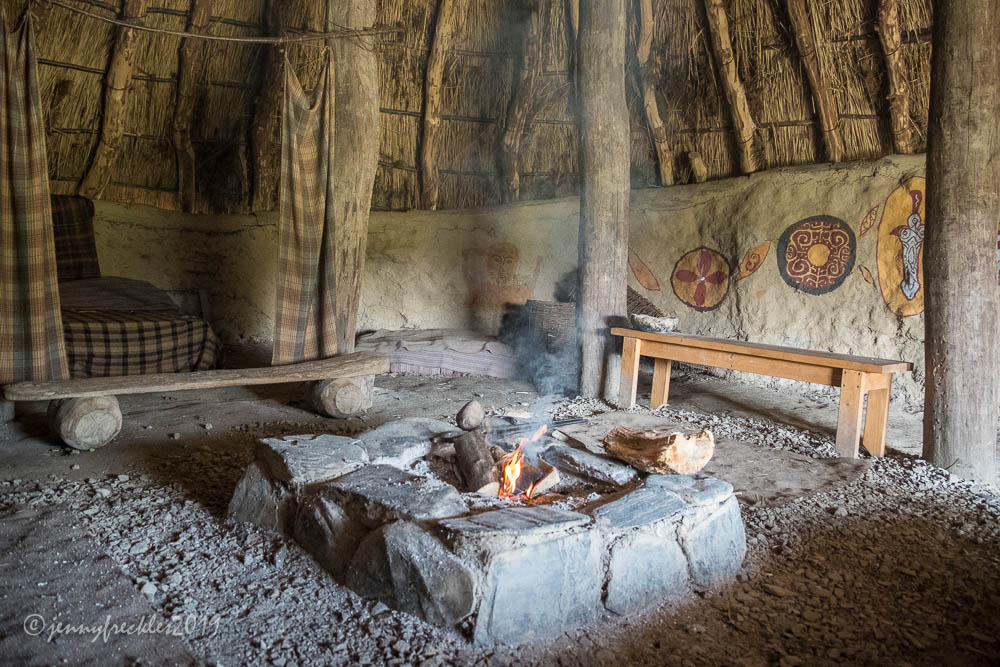
Some of the roundhouses were decorated with painted designs: shields, knots and wild animals like this powerful wild boar. The warriors would have killed deer and boar for their meat and skins.


We had such a good time on our visit to Castell Henllys. It is a kind of living history and seeing, touching and smelling makes it all come alive. It must be a super place for children to learn. It's all in a lovely setting too, with a path by a stream tumbling through a wooded valley and leading up to the hill fort. There's a very good visitor centre with a shop, an excellent café and some interactive information boards and videos. Highly recommended if you're in the Cardigan/Pembrokeshire border area.

Tuesday, 11 June 2019

Building Castell Henllys


Wales: The first roundhouse was reconstructed on the Castell Henllys site in the 1990s. The original buildings are beginning to deteriorate and are now being renewed, which gave us a good insight into the building methods.

A company that builds using timber frames has started to put in place the wooden structure of a new hut. Then the walls will be constructed using hazel rods woven through timber posts (the wattle) - see example above left. Once the reed-thatched roof has been added, the walls will be finished with dried mud (the daub). The guide told us that the circular structure is built around a central post. Once the structure is balanced  and self-supporting, roped and jointed together, the central post is sawn off up in the roof, to provide an open living area.


There's a great beauty in the roof structure, being at once organic and ingeniously engineered. The photo below is looking more or less directly up to the apex in the middle.


This is a more detailed view of the thatch overhang at the entrance, showing the timber and ropes.


Monday, 10 June 2019

Iron Age village


Wales: Whilst in Wales, we had a most interesting tour of an Iron Age village, at Castell Henllys, which has been excavated and studied for the past twenty years by archaeologists from York University. They have reconstructed several roundhouses on the actual foundations of a hill fort, belonging to the Demetae tribe, dated to between 500 and 100 BC. Their work has enabled a greater understanding of the Iron Age period, as well as providing training for archaeology students and a wonderful visitor attraction. Luckily, we visited when it was very quiet and had a personally guided tour, which was really fascinating.

The roundhouses are built of wattle and daub on a wooden framework, with reed thatched roofs. The granary (the smaller hut in the photo above), where food was stored, is built on stilts off the ground to mitigate against damp and vermin. The settlement was protected by a complex of earthworks and ditches, including a 'cheveaux de frise' - a stony ditch (right) designed to protect against horses and chariots.

Heat, light and cooking were provided from a central fire within the roundhouse, whose smoke was drawn out through the thatch.


The roundhouses were home to extended families and some have private sleeping quarters separated by woollen curtains. It's estimated that the village could have housed over 100 people, led by a wealthy and influential chieftain. The people were very resourceful and skilled: coppicing woodland, growing crops and keeping livestock;  spinning, dyeing and weaving cloth; turning wood; weaving baskets; grinding grain to make bread and generally living a healthy and sustainable lifestyle. Some would have been warriors and hunters, protecting the settlement from wild animals and human enemies.

The hill fort seems to have been abandoned during the 1st century BC, possibly due to the Roman invasion.