I HAVE CLOSED DOWN THIS BLOG. Please click the photo above to be REDIRECTED TO MY NEW (continuation) BLOG.

Thursday, 3 November 2016

Trains, cars and hot dinners


I've shown variations of this picture before, but the scene still pleases me. It is a high viewpoint you can only get on the rare occasions that the top floor of Salts Mill is opened to the public. The grimy windows only add to its appeal, I think. The window overlooks Saltaire station; a train to Leeds is just drawing up to the platform. The building across the road is now part of Shipley College and was the Dining Hall in Victorian Saltaire, built to supply the mill workers with nutritious hot meals. There is a tunnel under the road, connecting the Mill to the Dining Hall.

I notice that part of Victoria Road has recently been marked out as bays for 'Car Club only'. I was not aware that there was a Car Club in the area, though they have been talking about it for years. For many years I didn't have a car and longed for the facility to be available locally, just for those occasions when I really needed a vehicle for a short time. Now I have a car... so I don't need the Car Club. Typical!

(Photo taken a few weeks ago before the trees started to look very autumnal.)

Wednesday, 2 November 2016

We are fearless...


I am tickled by the new livery on our local Northern Railway trains: 'We are fearless; we are Northern'. There is always something defiant and proud about us northerners; so much in the UK is London and south-centric. The Conservative government have been talking about a 'Northern Powerhouse' for several years, the idea being to boost the key northern cities, improve transport links and bring in investment. We will believe it when we see it! I recently saw a spoof article (here) that seemed to sum it up. It said that the government have now decided that the Northern Powerhouse will be relocated to London! Many a true word is spoken in jest... Already the Tories have announced a plan to move 228 jobs in the 'Northern Powerhouse' department from Sheffield to London!
Anyway, I am adopting the railway strapline for my blog. We are fearless!


Tuesday, 1 November 2016

Pink pop


More pink geraniums... Geraniums (or pelargoniums, if you're a purist) must win the award for the plant that most easily and instantly brightens a dull corner. This is one of Saltaire's small front gardens.

Monday, 31 October 2016

Ooh, just realised the last post was my 2500th! Seems like a good milestone.  I hope I can do another 2500 - and more!

Pink blush


Nancy's blushes, pale carmine, party surprise, rose trellis - just a few names for this shade of pink, according to the paint manufacturers' charts. Personally, I never would choose pink to decorate a room. Being a naturally fair-skinned blonde (English rose, I guess) I do, however, like to wear pink, and have a sweater in a similar colour to this geranium. The plant was in the greenhouse that runs along one side of the walled garden at Scargill House. Despite the lateness of the season it was full of flowers, including some late flowering sweet peas that filled the air with their delightful fragrance.

Sunday, 30 October 2016

Within the walls


Whilst in the Yorkshire Dales I was staying at a Christian holiday and conference centre, Scargill House. It's a wonderfully peaceful place in a lovely setting, and nowhere is more beautiful to rest awhile than the walled garden. It is well-established, though it had been neglected for a time and has been revived by the careful tending of volunteers over the past two or three years. Even at this season there were many flowers still blooming and plenty of rich colour in the foliage too. 


Saturday, 29 October 2016

It's all about the sky


There were fantastic views driving back down towards Grassington from the lead mining area. Although I wished the incessant rain would stop for longer than just a few minutes at a time, that kind of weather makes for some fabulous and dramatic skies.

I learned several things during the week:
- a plastic bag is better than nothing for keeping one's camera reasonably dry, though excessive use of the telephoto lens in the rain can cause moisture to seep inside the lens casing;
- a microfibre towel is a must-carry accessory for a photographer when it's raining;
- my boots and coat appear to be waterproof;
- waterproof over-trousers keep you warmer as well as drier;
- you should don the said over-trousers before you put your boots on;
- 'tis also better to put the rain-cover over one's backpack before it starts raining;
- similarly, it's better to put one's gloves on before one's hands get cold!
- adjourning to a nice café serving decent coffee and cake makes everything seem much better.

Friday, 28 October 2016

Yarnbury lead mines


The scene on the hills above the village of Grassington, in Wharfedale, is very different today from two hundred years ago. In the late 18th and 19th centuries, the Yarnbury lead mines employed about 170 people and, for a time, were very prosperous. Today little remains but the traces of some of the workings and buildings, bell pits, spoil heaps and a solitary chimney. It's a bit bleak on a rainy day! But well worth a visit and I might go back in kinder weather to explore further.  


Nowadays there are just sheep and a few tourists.


The former mine offices and agent's house are now residential properties; very attractive buildings, though the setting, a few miles outside Grassington up a steep and narrow track, is remote and a bit bleak.


Thursday, 27 October 2016

Autumn woodland


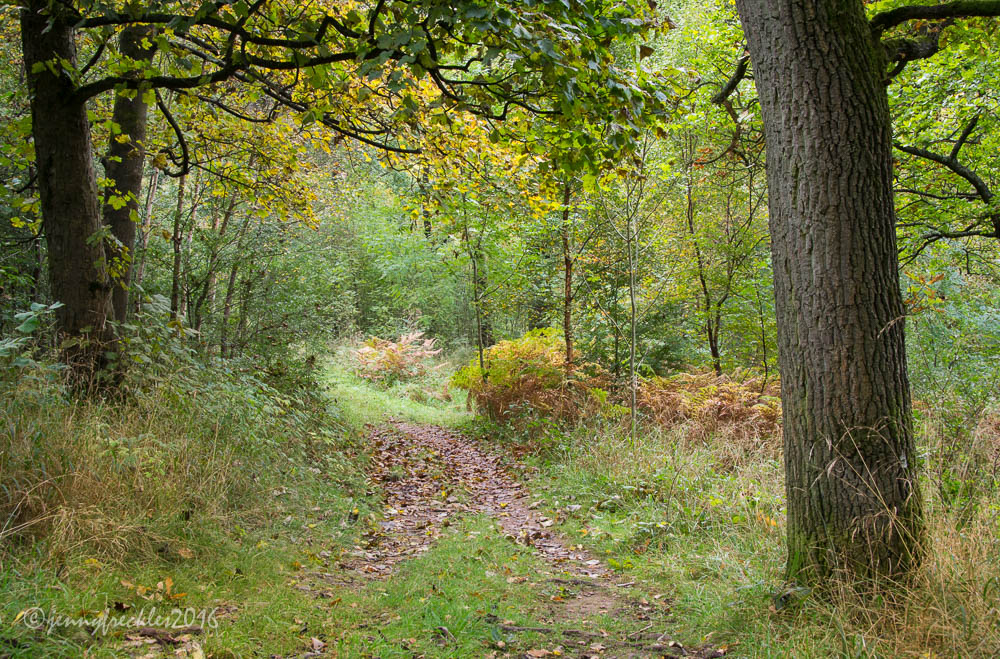
By and large, English woods are nowhere near as spectacular in their autumn colour as the renowned woodlands of North America. It's the pops of red from the sugar maples that punctuate and give vibrance to those vistas. You rarely find maples in this country in ancient woodland, since they were mainly introduced to country estates and gardens. Nevertheless, the gentle autumn tones of green and gold are pleasing to the eye.

Grass Woods, near Grassington in Wharfedale, are best appreciated in spring when the bluebells and wild garlic flower abundantly. In autumn, they have a softer story to tell.

Wednesday, 26 October 2016

Chestnut beauty


Sometimes, taking the wrong path can prove rewarding. I had been exploring the little church in the hamlet of Conistone in Upper Wharfedale. A small gate in the wall at the end of its graveyard seemed to offer a quicker route back to my car but I quickly realised I had strayed into the tack yard of a stables. I apologised to the lady tending the horses - and asked if I might capitalise on my error by taking a few photographs! This chestnut beauty posed nicely, with quite a wistful look in his (or her) eye.

Tuesday, 25 October 2016

St Mary's Church


St Mary's Church, Conistone - a pretty little church, grade II listed, dating back to the 11th or 12th century but rebuilt in 1846. It is actively used for worship and seems very well looked after.


Monday, 24 October 2016

Conistone


Not far from Kilnsey Crag and across the River Wharfe, the attractive little village of Conistone nestles in the valley bottom. There has obviously been a settlement here for hundreds of years. The tiny church dates back to the 11th or 12th century and I found an old bricked-up doorway in the wall of one house, with a date stone that I think reads 1697.


Sunday, 23 October 2016

Kilnsey Crag


The overhanging limestone cliff of Kilnsey Crag is one of the dominant features in the valley of the Upper Wharfe. It was shaped by the glaciers that once gouged out the valley and now stands about 170 feet high, with an overhang of 40 feet that makes it a magnet for climbers.

Saturday, 22 October 2016

Red squirrels


We visited a red squirrel sanctuary near Hawes in Wensleydale. There are very few areas in Britain where our native red squirrels manage to survive. Most have been crowded out by introduced American grey squirrels. The reds are smaller and need larger areas in which to thrive. For many years, there have been attempts at conservation and land management to protect them but you have to go to specific areas to have any chance of seeing them.

I've never seen them in the wild before. I was delighted to get the chance to see and photograph them, though getting good shots proved even harder than I anticipated. The squirrels dart around incredibly quickly, so you need a high shutter speed and a fast telephoto lens. My camera and lens were barely up to the task; the rain and consequent low light didn't help. Choosing the highest ISO possible, shutter speed of around 1/500 and much experimentation with focus provided me with a very few passable images, which I've had to process quite carefully to reduce the grainy 'noise' caused by the high ISO.

Having said all that, aren't they adorable? There were half a dozen of them scampering around, not tame but certainly unfazed, after a while, by the fifteen or so photographers. We moved slowly and kept quiet and were richly rewarded. One of them ran right over my feet and another came down to a tree branch right beside me and spent quite a while 'eyeballing' me. I didn't dare move so I didn't get a photo, even though it was so close I could have touched it. What a thrill though!


Friday, 21 October 2016

Autumn comes to the Dales


I'm starting my retirement as I mean to go on, with holidays and my camera...  I spent a week at Scargill House in the Yorkshire Dales, Upper Wharfedale to be precise. It was a photography workshop; always good to spend time with like-minded folk and swap tips and ideas. Unfortunately the weather was rather wet (after a lovely week the previous week. Typical!) though that did make for some spectacular skies. On the journey there, just near Grassington, there are lovely views - enhanced on this occasion by a fragment of rainbow.


Thursday, 20 October 2016

The Kennet in Saltaire


Here are a couple more photos of the Kennet in Saltaire, as it celebrated the two-hundredth anniversary of the opening of the Leeds-Liverpool Canal by recreating the first full navigation in 1816. The vessel is a restored working barge that is the floating museum and educational centre of the Leeds & Liverpool Canal Society.


Wednesday, 19 October 2016

Two hundred years


The Leeds-Liverpool Canal, which passes through Saltaire, was a decisive factor in Sir Titus Salt's plan to site his huge woollen mill at this spot.  Completed in 1816, the canal pre-dates the mill by almost forty years. This year, the bi-centenary of the Canal is being marked by various events, the most significant being the recreation of the first full navigation in 1816, when local people turned out in their thousands to greet the boats, church bells were rung, cannons fired and brass bands played. During October, the restored working barge, Kennet, is making its way along the canal, stopping off at various points for celebrations.

Despite very heavy rain, I went down to the canal in Saltaire to see the Kennet pass through. (The things I do for this blog!) There was a brass band, playing under the bridge for shelter! The church bells rang and a couple of hundred hardy souls, including the Lord Mayor of Bradford and a BBC Yorkshire camera crew were there to witness the event. Tempting to think we were indeed 'recreating' something... except that in 1816 Saltaire didn't exist and the boats would have been making their way through green fields and heading for the Five-Rise Locks at Bingley for whatever razzmatazz the townsfolk there had dreamed up.

Never mind, it makes a good 'old' picture, doesn't it?


Tuesday, 18 October 2016

Wreathed in smoke...


... and smiles. It's clear just how much the people who own and care for the exhibits at these steam fairs love and are passionate about steam and machines.  They spend hours polishing them, oiling them, sprucing them up - and equal numbers of hours chatting and comparing notes, beer in hand. There are a few women (wives and girlfriends, perhaps, working on the principle "If you can't beat 'em, join 'em!") but it is mostly blokes, for whom clearly this is an all-consuming hobby.

Monday, 17 October 2016

From consternation to celebration


More from Chipping Steam Fair.... This huge traction engine, an 1889 Marshall engine named Mary Margaret, was a star exhibit. Owned by M Davison, it usually 'lives' in Co. Durham at the Beamish Museum. It had been planned to demonstrate how it could power a saw mill. These big steam-driven machines were mostly used to pull heavy loads or to run agricultural machinery, by means of a continuous leather belt attached to a flywheel. They were first produced in the 1850s and their use had died out in the UK by the 1950s, though many have been preserved and maintained by enthusiasts. 

The day was dry and bright but the previous few days had been wet and the ground was soft. This massive machine (which weighs 10 tonnes) therefore had a great deal of difficulty manoeuvring and its huge wheels were sinking into the mud. There was much consternation, and then a great deal of effort and concentration, using wooden sleepers to try and gain some purchase on the turf. Eventually - celebration! They got it into place and attached the huge belt from the flywheel to the circular saw, which was powered up. It then sliced through enormous tree trunks like they were butter. Aside from a pair of goggles, there was not much 'elf and safety' in evidence for the operators!


Sunday, 16 October 2016

Traffic light colours


Possibly my favourite photo of the steam fair batch (which goes to show how bad the rest are!) I liked the shapes and the red, yellow and green primary colours, like traffic lights... and it all reminds me nostalgically of my dad's garage, somehow.