I HAVE CLOSED DOWN THIS BLOG. Please click the photo above to be REDIRECTED TO MY NEW (continuation) BLOG.
Showing posts with label Knaresborough. Show all posts

Tuesday, 21 February 2017

Snowdrop gardens


The gardens at Goldsborough Hall are known locally for their display of snowdrops in February and are open on just two Sundays for public viewing. On the first Sunday this year there was more snow around than snowdrops, so I chose to visit the second Sunday. It was a day that promised sunshine but, in the end, disappointed, even though it was quite mild. The massed snowdrops are very pretty though I think I prefer them when they are interplanted with more colourful species like the hellebores below. 


Monday, 20 February 2017

Goldsborough Hall


Goldsborough Hall, near Knaresborough, is a Grade II* listed building that dates back to Jacobean times, the early 1600s. Built by Sir Richard Hutton, a prominent lawyer who became High Sheriff of Yorkshire in 1623, it was for many years a family home, eventually becoming part of the Harewood estate in the 1750s. It was the home of Mary, Princess Royal, after she married the 6th Earl of Harewood in 1922. She was the daughter of King George V and Queen Mary and the King and Queen are known to have stayed here many times in the 1920s.  It was a school during WWII, then reverted to a family home and later became a nursing home. In 2005 it was sold again and once more reverted to a family house, though now the owners host weddings and corporate events, accommodating guests in luxurious rooms. 


They have also replanted the neglected gardens, which are open to the public on a few days each year as part of the National Gardens Scheme. It raises money for charity (and provides retirees like me with an endless source of pleasant outings!)

The surrounding estate and village bear all the hallmarks of an English country house estate, although the village was auctioned off in 1952, ending 1000 years of estate ownership. 


Tuesday, 6 September 2011

Flower power and a smile


Knaresborough's residents seem to take pride in making their homes look pretty. There are beautiful floral displays evident throughout the town, which all adds to the town's charm and character.  Here we have an adundance of pink petunias, flowing over the railings outside a town house beside the main railway station.  If you look back at Sunday's photo you can see the back of this house, one of the tall cream-coloured houses between the railway bridge and the church.

This house also hosted two colourful 'trompe l'oeil' paintings in its 'blind windows'.  You can see the house has been taken over by warring Cavaliers and Roundheads, left behind after the English Civil War.  These two were certainly raising smiles from the many passers-by.

The reason for 'blind windows', as I said yesterday, possibly stems from an unpopular tax on windows which was imposed in 1696 - by the wonderfully named 'Act of Making Good the Deficiency of the Clipped Money'.  It was prior to the introduction of income tax, and was an attempt to tax people according to their wealth (if you had a big house with more windows you paid more) without invading the privacy of people's actual income.  Some say that this is where we get the phrase 'daylight robbery' from.

I don't know what 'the clipped money' was, but on Sunday I heard about some local stories of a gang of 'coiners' who shaved gold off the edges of coins (in those days coins were made of real gold) to melt down and make counterfeit coins. Over time the practice effectively devalued the currency.  So maybe it has to do with that - 'clipping' the edges of coins.

Monday, 5 September 2011

Trompe l'oeil

Knaresborough, when I visited, had just had an Arts Festival.  Dotted all around the town were these rather marvellous trompe l'oeil features, a project that originated as part of the Festival a few years ago but which has been futher developed by Renaissance Knaresborough. (Click on each to really appreciate them).


 A secret tunnel at the railway station..
 Doors and windows..                     


                                            Even Mother Shipton herself!                                               
 

Apparently the town is well suited to this, as many of the Georgian buildings have 'blind windows' - bricked up windows.  There are various theories about these - maybe they were a way of avoiding window tax, or simply used to keep the symmetry of the buildings without the expense of glass.

Sunday, 4 September 2011

Picture postcard


To really appreciate Knaresborough's picturesque charm, you need to get up high on to the castle rock, from where you can enjoy wonderful views along the river.  This is the 'classic' photo, seen on a million postcards, calendars and jigsaws.  Much of the town centre - its winding shopping streets and the market place - is up at castle level, so you don't really notice the climb. The ruined castle area is interesting too, with a small museum and lovely gardens to explore.  One of the gardens has a children's paddling pool, which was full of happily squealing children on the day I visited. (Gran-in-waiting is making a mental note of these facilities now!)

Saturday, 3 September 2011

Messing about on the river


You used to be able to hire rowing boats on rivers and lakes all over the place (even in Saltaire in the good old days) but it seems to be a pastime that is rapidly dying out.  It's alive and well in Knaresborough though, as you'll have seen from my previous photos.  On the beautiful summer's day when I visited, there were lots of families out on the river, enjoying spectacular views of the Victorian viaduct towering above them.  There are at least three different operators offering boats for hire and for a modest sum you can spend a pleasant hour gently cruising up and down.  Everyone gets to be happy... mum gets a well-earned rest, the kids like the novelty and enjoy trailing their hands in the water - and dad gets to show off his muscles!  And for couples, it can be a really romantic interlude (once you've stopped laughing at your partner's inexpertise with the oars, that is!)

Friday, 2 September 2011

Medieval treasures


I love this view, which shows Knaresborough's ancient charm to perfection.  The wonderful chequerboard house in the middle is known as the Old Manor House.  It dates back to 1208 when it was built as a hunting lodge for King John, around an oak tree which still stands in the centre of the house.  It was recently restored and if you're interested in old houses, there is a really fascinating article here.  It's believed that after Cromwell's troops defeated the Royalists at Marston Moor, in the First English Civil War, the treaty of capitulation was signed by King Charles here in this house, in Cromwell's presence.  It has a 400 year old mulberry tree in the garden which still bears fruit.  It remains a private residence.

Behind the black and white house you can see a thatched house dating back to the 1500s, Thatched Manor Cottage.  Its thatch was destroyed by fire a few years ago and has had to be renewed. I found an interesting picture of it being rethatched here.  It sits at the bottom of the wonderfully named Water Bag Bank - so called because ponies used to haul bags of water up the steep hill from the river into the town.

The church at the top is St John's Parish Church.

Thursday, 1 September 2011

Victorian progress


The railway finally did reach Knaresborough in 1851, when this impressive railway viaduct was completed across the steep valley of the river.  An earlier bridge had collapsed three years before, just as it was almost finished.  (That must have been annoying!)  Victorian times, in Knaresborough as elsewhere, saw rapid progress in improving the town and living conditions for its inhabitants. Chapels and schools were built, gas street lighting established and a sewerage system installed.  But much of its earlier history is still very evident in its buildings, lanes, street names and the now ruined castle that towers over the town.

Wednesday, 31 August 2011

Living by the river, Knaresborough style


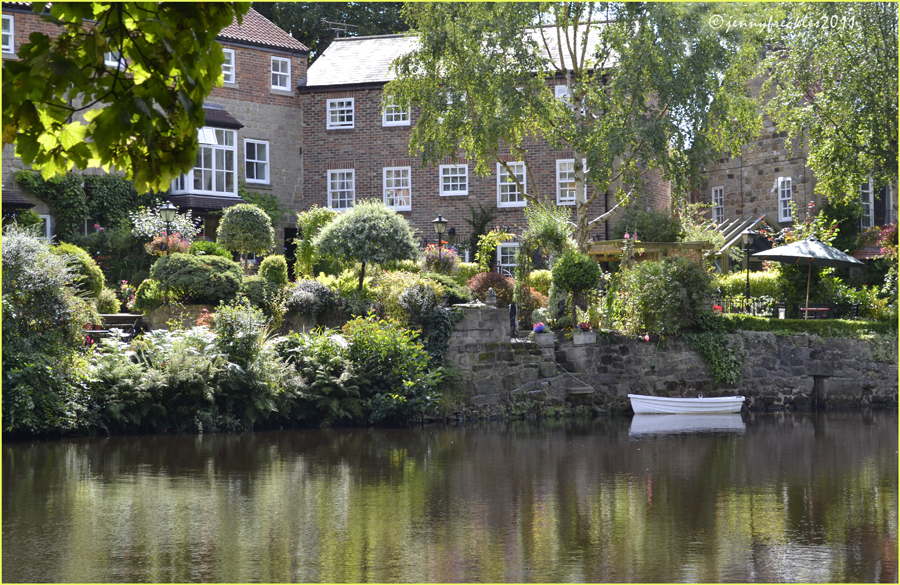
Walking into Knaresborough through the Mother Shipton Estate you glimpse some lovely houses along the riverside.  These apartments have been converted from an old mill building, Castle Mill, that nestles at the foot of the castle rock. Originally a papermill, it was replaced in 1791 by a cotton mill that was converted in 1811 to spinning flax to make fine linen.  It had the honour of supplying linen 'by royal appointment' to Queen Victoria's household and in 1851 was awarded the Prince Albert Medal for producing a handwoven seamless shirt. (See the things you learn by reading this blog!)

But industrial development was rather hampered by Knaresborough's relative isolation, being a difficult place to connect by canal or rail to the major centres of population like Leeds.  In many ways that has been our gain, as it is nowadays a truly delightful and picturesque town, retaining much of its ancient charm.  In fact, I don't know why I haven't visited much more often. It's only about 20 miles from Saltaire.  I had a lovely day-out there.

Tuesday, 30 August 2011

Petrified


Beside Mother Shipton's Cave is Knaresborough's famous Dropping Well, 'England's oldest visitor attraction', which has been drawing curious crowds since 1630.  A fine example of what is known as a petrifying well, its ability to turn objects into stone was at one time thought to be the result of magic or witchcraft.  Now we know that it is a geological phenomenon.  Water seeps from an underground lake through limestone rock along aquifers, picking up mineral deposits along the way.  It rises to the surface in a spring which cascades down the rock face, leaving behind the mineral deposits, which form new layers of stone.  (It's the same process that produces stalagmites and stalactites in underground caves, but it is rarer that this happens above ground). Anything left in the water's path becomes coated with stone, and so for hundreds of years people have hung objects under the flow.  Teddy bears, hats and shoes can be seen and many celebrities have donated items to be 'petrified' - some can be viewed in the museum nearby.  Apparently it takes 3-5 months for a small teddy bear to turn to stone.  Nowadays the rock face is scrubbed regularly to try and prevent the mineral deposits becoming too heavy and breaking the rock.


Monday, 29 August 2011

Mother Shipton


Mother Shipton (born Ursula Southeil) was England's most famous soothsayer and prophetess. She lived some 500 years ago during the reigns of King Henry VIII and Queen Elizabeth I.  She was said to have been born in a cave by the River Nidd in Knaresborough, North Yorkshire, during a violent thunderstorm.  Reputed to be very ugly (the archetypal hag or crone) she nevertheless married Toby Shipton, a carpenter.  The first book of her prophecies did not appear until 80 years after her death, and most of what is written is believed to have been invented after she died. Neverthless, the legends about her probably have some basis in truth.  She is said to have prophesised the defeat of the Spanish Armada in 1588 and Samuel Pepys's Diary records that she forewarned of the Great Fire of London (1666).


The cave and well associated with her are now preserved within an area of parkland, which was landscaped in the 18th century.  There is an attractive walk by the riverside, through an avenue of ancient beech trees.