I HAVE CLOSED DOWN THIS BLOG. Please click the photo above to be REDIRECTED TO MY NEW (continuation) BLOG.
Showing posts with label Lancashire. Show all posts

Sunday, 7 October 2018

Gawthorpe's Great Barn


In the grounds of Gawthorpe Hall, there is the Great Barn which was built around 1603. The adjoining coach house, a Victorian addition, is now used as a tea room.


You can't enter the barn, which appears to be used for storage and events, so I took a photo through a window. It is rather magnificent, said to be one of the largest aisled threshing barns in Europe. The aisled design allowed greater space for threshing grain and for storage. Interestingly, in the 1950s the barn was used by Burnley Football Club as a training ground. The club now have modern facilities on the estate.


Saturday, 6 October 2018

Gawthorpe's Brontë connection


I loved this rather beautiful tryptych showing different views of Gawthorpe Hall. There was no explanatory label but it obviously depicts the Hall after its renovation by Sir Charles Barry in the 1850s.

What is now the drawing room (below) was at one time a dining room, and has original 1603 Jacobean panelling, though the fire surround and some of the furniture date to the Victorian restoration. The inlaid table on the right, a teapoy that held a tea chest (when tea was such a valuable commodity that it was kept under lock and key), is by A W N Pugin, who collaborated with Barry on this private house, as well as more famously on the Houses of Parliament.

The Hall has connections with Charlotte Brontë, whose home in Haworth was about eighteen miles away. She visited Gawthorpe in 1850 and again in January 1855, where it is said she caught a chill from walking around the grounds, from which she never recovered. She died in March 1855. Apparently the green sofa in the drawing room dates back to that time and the Brontë bottom may have settled upon it! (Wow!)


There are many wonderful portraits displayed in the Hall, many loaned by the National Portrait Gallery. There are also some touching family photos. The grouping below shows members of the Kay-Shuttleworth family, whose two sons (in the heart shaped frame) were both killed in the Great War.


The magnificent four-poster bed (below) was a 21st birthday gift to Miss Rachel Kay-Shuttleworth, the last of the family to live in Gawthorpe Hall. She was an accomplished needlewoman, and from 1905 to 1918 she made the bedspread and hangings, embroidered in crewel work. They were finished on Armistice Day 1918, commemorated with a little palm tree and the date. During her life, she amassed a huge collection of textiles from all over the world, as a means of preserving them and disseminating information about the traditions and skills involved in their production. Some of these are on display in Gawthorpe Hall. See here for an interesting blog post about the Gawthorpe Textile Collection.


Friday, 5 October 2018

Gawthorpe Hall


Continuing to make the most of my National Trust membership, I ventured 'over the border' into Lancashire to visit Gawthorpe Hall, near Burnley.

It started out as a 14th century pele tower (a defence against invading Scots) and was extended into an Elizabethan house in the early 1600s by the Shuttleworth family, who owned it right up until it was given to the NT in 1970.The Hall as you see it now was redesigned in the 1850s by Sir Charles Barry, who designed the Houses of Parliament and Highclere House, known to many as 'Downton Abbey', so it has become known as the 'Downton of the North'.

It's in a relatively urban area, set in a small area of parkland and estate. It is run in partnership with Lancashire County Council, who have some offices in the hall.


As these kinds of places go, it's a modest house in modest grounds, but interesting nevertheless. The small ornamental terrace, overlooking the River Calder, was laid out as part of Barry's design.


I was surprised by a flock of sheep, evidently used as lawn mowers! Even more surprised to find the wifi code engraved in stone on a seat on the terrace... Actually it says: Kynd Kynn Knawne Kepe - 'kind friends know and keep', the motto of Sir James Kay, who married into the Shuttleworth family in 1842 and took the surname Kay-Shuttleworth. It was he who commissioned Sir Charles Barry to restore and improve the house.


Thursday, 15 June 2017

Sunset at Formby


'The biggest cliché in photography is sunrise or sunset.' Catherine Opie

Never mind, I think I'm allowed a cliché now and again. We took an evening walk on the beach near Formby when I was on my Liverpool trip a while back. The sunset was not spectacular but the sky was pleasing, nonetheless, and my iPhone did a creditable job of capturing it.

I was going to post something else today but in the wake of a lot of bad news both nationally and further afield, and from a couple of my friends too, I decided a brief pause to reflect on a peaceful scene might be the more appropriate thing for today. My thoughts and prayers are with the friends I know personally and also all those I don't know, who have lost or are anxious about loved ones or who are suffering in body, mind or spirit.


Friday, 26 May 2017

All the fun of the fair


Liverpool trip
Have you ever been in a Hall of Mirrors, those distorting mirrors that they have in fun fairs and amusement parks? For some reason ever since I was a child I have found them absolutely hilarious and have been known to collapse, helpless with hysterical laughter, once inside. I was delighted to find that the seaside resort of Southport did not disappoint. There was a hall of mirrors in the pier amusements. I'm taking the risk of posting some images! I might pin the second one on the fridge as a deterrent!


Tuesday, 23 May 2017

Southport


Back to my Liverpool trip last month... So many outings, I'm finding it hard to fit all the photos in!

Whilst in Liverpool, I took the train a few miles up the coast to Southport. As with most of our northern coastal towns, the resort's heyday was in late Victorian and Edwardian times, when those with money came to stay in elegant hotels, believing sea-bathing to be a cure for many ills, and the working class had day-trips to the seaside. The legacy of those times is found in Southport's extensive Marine Gardens, recently restored by the town council in a £5.5 million project.

The huge lake, with its elegant bridges, was at one time the scene of elaborate, masked Venetian galas and firework displays. (One of the stone, arched bridges is in the background of my photo below. The tall suspension tower belongs to a newer road bridge behind the gardens.) Things are rather more sedate these days but it's very pleasant to stroll around. There are children's playgrounds, bowling greens and a miniature railway that has run through the gardens since 1911.


Southport is nowhere near as run down as many of our seaside towns. It is close to several prestigious championship golf courses, strung out along the sandy coast, including Royal Birkdale which sometimes hosts the Open Championship. The town also holds several major shows each year, like the Southport Flower Show, the UK's largest independent flower show, and it is a conference venue.

One of its 'jewels' is Lord Street, a long and wide boulevard with gardens in the middle. It holds many of the town's public buildings and many shops and cafés, under elegant glass arcades. There's also a market and a pedestrianised shopping area, so the town is a magnet for those who love shopping. I enjoyed my day there very much! (Treated myself to lunch in the Westminster Tearooms too: smoked salmon sandwiches, tea in a silver teapot, fine bone china teacup - wonderful!)


Saturday, 29 April 2017

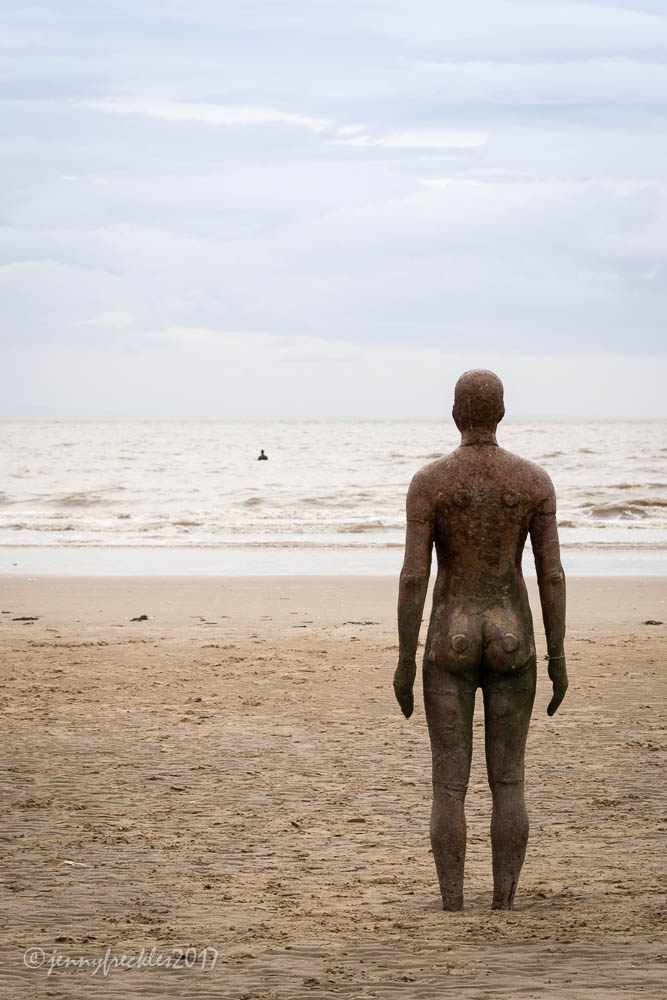
The Iron Men


I had a wonderful holiday with some friends recently, on the west coast just outside Liverpool, a surprisingly interesting and attractive area. They were puppy-sitting for some relatives, necessitating many windswept walks. I took loads of photos!

It so happens that the house we were staying in overlooks Crosby beach, which holds a huge art installation, Another Place, by Sir Anthony Gormley (who also designed The Angel of the North). It consists of 100 cast-iron figures, each weighing 650 kilos, cast from Gormley's own body. They are spread out over 2 miles along the coast and reach more than half a mile out to sea. At this location, across a shallow, sandy foreshore, the tide ebbs and flows with a huge reach, so that sometimes the figures are submerged and sometimes revealed. Some are half buried in the sand as it gets blown around, and each is different due to the gradual weathering of tides and wind. (One or two have even had clothes added, by jokers, but the ripped and trailing fabric adds its own pathos.)

Early morning puppy walks meant I could catch the beach with no-one else on it and the lonely figures staring out to sea have a melancholy, even sinister, air.  It's a little unnerving to see a still and silent figure apparently watching another figure walk under the waves. 


This was another item on my 'bucket list' to see and it is satisfying to be able to tick it off, though I'd love to go back again to see the figures in different lights and weather. It is a powerful and moving sight.


Tuesday, 18 October 2016

Wreathed in smoke...


... and smiles. It's clear just how much the people who own and care for the exhibits at these steam fairs love and are passionate about steam and machines.  They spend hours polishing them, oiling them, sprucing them up - and equal numbers of hours chatting and comparing notes, beer in hand. There are a few women (wives and girlfriends, perhaps, working on the principle "If you can't beat 'em, join 'em!") but it is mostly blokes, for whom clearly this is an all-consuming hobby.

Monday, 17 October 2016

From consternation to celebration


More from Chipping Steam Fair.... This huge traction engine, an 1889 Marshall engine named Mary Margaret, was a star exhibit. Owned by M Davison, it usually 'lives' in Co. Durham at the Beamish Museum. It had been planned to demonstrate how it could power a saw mill. These big steam-driven machines were mostly used to pull heavy loads or to run agricultural machinery, by means of a continuous leather belt attached to a flywheel. They were first produced in the 1850s and their use had died out in the UK by the 1950s, though many have been preserved and maintained by enthusiasts. 

The day was dry and bright but the previous few days had been wet and the ground was soft. This massive machine (which weighs 10 tonnes) therefore had a great deal of difficulty manoeuvring and its huge wheels were sinking into the mud. There was much consternation, and then a great deal of effort and concentration, using wooden sleepers to try and gain some purchase on the turf. Eventually - celebration! They got it into place and attached the huge belt from the flywheel to the circular saw, which was powered up. It then sliced through enormous tree trunks like they were butter. Aside from a pair of goggles, there was not much 'elf and safety' in evidence for the operators!


Sunday, 16 October 2016

Traffic light colours


Possibly my favourite photo of the steam fair batch (which goes to show how bad the rest are!) I liked the shapes and the red, yellow and green primary colours, like traffic lights... and it all reminds me nostalgically of my dad's garage, somehow.

Saturday, 15 October 2016

Bored?


All dressed up in their overalls; not sure if the blackened faces were earned or just for show! The kids looked a bit bored though... Perhaps, if dad is a fanatic, they have to spend a lot of weekends at steam fairs...

Friday, 14 October 2016

Green Panther


Chipping Steam Fair - This metallic green was a thrilling colour. I like the abstract image but the whole car - a 1974 Panther J72 - was rather thrilling and beautiful too. It was for sale; it could have been yours for a mere £27000!  Though how you drive one on the road, heaven knows... Imagine trying to turn out of a side road with that amount of bonnet (hood!) sticking out, before you could see what was coming! (Yup, I'm so practical...)


Thursday, 13 October 2016

Steam fair


Earlier in the summer, I visited a steam fair in Chipping in Lancashire. It was a relatively small gathering but still quite interesting. There were more classic cars and old tractors than steam engines, but plenty of sideshows and lots going on.

I was very disappointed in all the photos I took. Sometimes you just get days like that, don't you? The sun was bright and it was quite a hot day, so there were a lot of harsh shadows to deal with and there wasn't much steam about; that's always much better when it's cold and the steam hangs in the air. At busy events I often find it hard to isolate the point of interest from the background. I'm rather shy of asking people for portraits and the candid shots I took were all pretty useless, seeming to catch people just when they were looking unattractive! Never mind, I'll try again another time. Learning all the time...

I'll show a few pictures over the next few days, just for interest, though they are not up to standard!

Friday, 15 July 2016

Morris dances


Royal Preston Morris Dancers in action...
The costumes are traditional and each dance side has its own livery. They don't usually wear peaked caps (as far as I recall) and I wasn't sure about those!  Made them look rather incongruously like school boys. The dancing was good though. You should hear the sound of eight sets of clogs pounding on a wooden floor...

Thursday, 14 July 2016

Morris men


The Barrowford festival celebrating the 200th anniversary of the opening of the Leeds-Liverpool Canal was only a small event - a few stalls and refreshments, some (very interesting) displays about the canal, a tombola. (Surprise, surprise - I won a box of posh teabags from the famous 'Bettys of Harrogate'). There were also a couple of Morris dance sides - the men's Royal Preston Morris Dancers and a team of female clog dancers (whose name I have sadly forgotten).

As always at such events, there was plenty of dancing but also lots of sitting around chatting - and the occasional glass of beer was consumed (not by me!)

I really enjoy watching the dancing, though it's a complex subject and I don't know a huge amount about it. It's interesting to note the variations between the sides and the types of dances. Northern Morris is quite different from what you see further south (Cotswold). The dancers often wear clogs and many of the dances use sticks rather than hankies. I love that these old traditions are kept alive but the average age of the dancers tends to be 'mature' and one wonders if it will die out eventually.

It's all too easy to poke fun at - but then, some of the jokes are quite amusing:

'Our local Morris group has a team of men, a team of women and a team of children too. They call them Morris Minors.'

'Did you hear about the bus load of Morris dancers that was hijacked? The hijackers threatened to release one every hour until their demands were met.'

And the old adage: 'You should make a point of trying everything once -  except incest and Morris dancing.'

Monday, 11 July 2016

Pendle Heritage Centre


I bravely ventured across the border into Lancashire recently (!) to Barrowford, a town I have never visited before. The town itself was a bit of a disappointment really. Although it has an interesting history and has some very old buildings scattered around, I thought it fell just short of being picturesque.  It does, however, have this lovely old house on the outskirts. 

Once a farmhouse, Park Hill is now the Pendle Heritage Centre, a museum and visitor centre. It sits beside an ancient crossing point over the river named Pendle Water. Originally the site held a timber house and then a stone building that was enlarged and altered through the years from the 16th century. There are three different building periods visible in the frontage in my photo.  The house was for centuries the home of the Bannister family, whose most famous descendant is Sir Roger Bannister, the distinguished neurologist and athlete, the first person to run a mile in under four minutes.

Behind the Heritage Centre is a pretty 18th century walled garden and the lovely 15th century cruck- framed barn, below, that was rebuilt here in the 1980s after being moved from another site.

Inside the Heritage Centre, much of it has been left in a raw state so that you can see how the building was constructed and altered. There are interesting displays about the history of the area, including the story of the Pendle Witches, who were tried and hanged in 1612.

Friday, 4 April 2014

RSPB = Rare Sights Produce Bliss


I visited one of my favourite wild places at the weekend - Leighton Moss RSPB Reserve. Hidden away down country lanes, it's a wonderful haven of reedbeds and lagoons, not far from Morecambe Bay and the southern end of the Lake District.  There are peaceful paths through reeds and woodland and a few well-placed hides with panoramic views over the lagoons.  Despite only having an ancient pair of binoculars, I still saw a good number of bird species as well as some red deer. I was thrilled to watch three harriers swooping about. They are beautiful birds. I am pretty sure I identified them as marsh harriers - the two males had very distinctive patterns of black wingtips, then grey bands and then brown patches close to their bodies. A male bullfinch thrilled me with its brilliant colours. I also saw my favourite little bird - that pink and grey bundle of fluffiness, the long-tailed tit. Leighton Moss is famous for being a breeding area for the elusive and rare bittern. I have never seen one but I did hear their curious booming sound, like someone blowing over the neck of a bottle. No bird photos, as I don't have the huge lens necessary for good wildlife photography - and anyway I just like quietly watching and enjoying the stillness in a place like that. Despite the very overcast weather, I had a blissful day out.


Tuesday, 14 May 2013

Put the kettle on, mother


The hamlet of Wycoller would be less attractive if it didn't have a tearoom and a little craft centre. Happily it does, housed in an old stone building, a converted shippon (a cowshed and dairy). Its centrepiece is this magnificent Victorian open range, of the type that would have been found in most homes at one time. The houses in Saltaire all had similar things, providing heat (and boy, was this one pumping out some heat!), cooking facilities and scope for heating water. You don't often see them now, and I have rarely seen one in full working condition. Isn't it wonderful? They were not using it to cook on though, I hasten to add.
Having taken the photo, I elected to take my drink outside into the garden to enjoy a relaxing time in the sunshine, topping up my Vitamin D.
(By the way, don't visit Wycoller on a Monday as the tearoom and shop is closed.)

Monday, 13 May 2013

Sunshine plant


Marsh marigolds, one of the first bog plants to bloom in the spring, made a vivid splash of colour in one of the ponds in Wycoller. Alongside the little beck, a string of pools and marsh areas has been constructed. It makes a lovely area in which to walk or relax (plenty of benches for weary hikers) but I imagine it is also used as a resource by school groups. There was plenty of scope for pond-dipping and marvelling at all the wildlife that ponds and bogs contain. It always makes me happy to see efforts being made towards nature conservation and education.

Sunday, 12 May 2013

Living sculpture


I really liked these 'living sculptures', constructed by local community artists as part of a project to enhance and regenerate the landscape round Wycoller.  They are woven from willow that is still growing, so in summer the sculptures (including a tunnel, a bower, and a horse - who appears now to be riderless) become leafy and green. In winter the leaves drop, revealing the bare framework again.  In this late spring, there were one or two green shoots, but I enjoyed seeing the graceful lines of the woven branches.