I HAVE CLOSED DOWN THIS BLOG. Please click the photo above to be REDIRECTED TO MY NEW (continuation) BLOG.
Showing posts with label ruins. Show all posts

Wednesday, 11 December 2019

St James and the Bell Chapel, Thornton


St James Church Thornton, where the Christmas Tree Festival was (see yesterday), is an imposing church with a huge spire, on the road leading to the village of Thornton, a suburb of Bradford. The existing church dates from 1870. With all the Christmas trees inside, I couldn't really see the interior properly but it has some fine William Morris & Co stained glass.

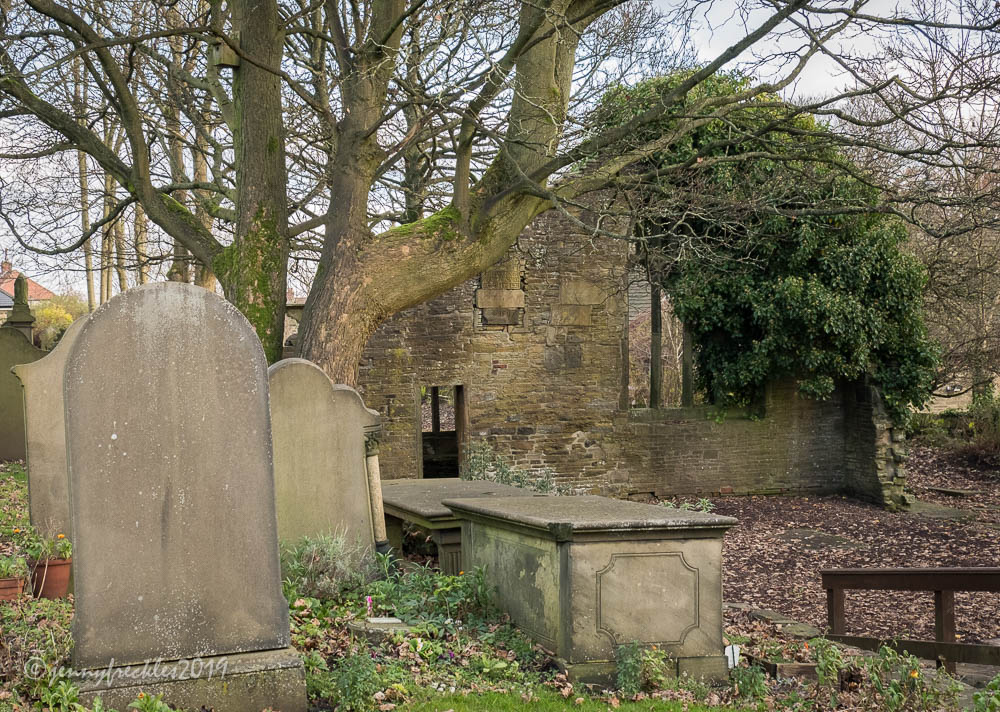
Across the road is the Bell Chapel, which has Brontë connections. Charlotte Brontë and her sisters were born in Thornton and baptised in the Bell Chapel, where their father Patrick was minister for five years from 1815-1820, before they moved to Haworth. The chapel is now ruined. I thought you could explore it, but it was roped off so I assume it is considered dangerous. The octagonal bell tower, covered in ivy, looks like a romantic folly and the surviving east wall, with the tracery of a window and a date stone showing 1612 is also being overgrown by ivy. The late medieval chapel was rebuilt in 1612 and again in 1818 when Patrick Brontë was in charge. It's a pity it is now in a poor state again, as I know that a few years ago a group of volunteers did a lot of work to restore it and make it safe for visitors.


Sunday, 25 August 2019

Top Withins


From the Brontë Falls, if you follow the rough track that climbs the valley side, you can walk on to Top Withins, the ruined farmhouse that is reputed to have been the inspiration for the Earnshaw home in Emily Brontë's novel 'Wuthering Heights'. It is spelled 'Withins' on OS maps and most signs but seems to have become 'Withens' in popular culture. Most of the online links I found spell it that way. It is a popular literary shrine. The signposts to it are in English and Japanese!


There are plaques explaining a little of its history. The land here was farmed for at least 400 years, until the 1890s. In 1591, William Bentley divided his estate between his three sons, and that probably led to the origins of the three farms: Top, Middle and Lower Withins, all now ruined. This kind of divided inheritance was common in the area and meant that families were forced to support themselves with ever dwindling parcels of land, resulting in much poverty and distress. The land was hard to work anyway and only supported a few dairy cattle, sheep and small fields of oats. Families supplemented their income by hand loom weaving and the men worked in the many stone quarries on the moors.

The views from up here are bleakly beautiful. It's rarely warm, with keen winds sweeping across the moors. It must have been a difficult place to live, even though in those days there was a lot more activity, with people living and working on the moorland.


There are a few hamlets and villages nearby but Haworth, the nearest place of any size, is about four miles across the moor. In my photo below, it lies in the dip beyond the trees on the hill. Although the area looks rather flat in the photo, that is deceptive. This is a high moorland plateau, dissected by deep V-shaped valleys cut by small streams and sloping gradually down in the distance to the broad valley of the River Aire, which was originally gouged out by a glacier 12,000 years ago. The steep and narrow gorge where the Brontë Falls is situated is the zig-zag, bracken-filled line on the right. 


Monday, 27 May 2019

St Dogmael's (Llanduddoch)


Wales:  Our holiday flat was at the northern end of the sizeable and sprawling village of St Dogmael's (Llanduddoch in Welsh). The village is a mixed development, with old cottages, Victorian terraces (built when the area was a thriving shipbuilding centre) and some newer houses spreading up the hillside. Many of the older houses are brightly painted, and some are built in a local style, where slate bands run through the stonework, as in the house on the right edge, above.  


The oldest part of the village is centred on the ruined abbey, built in 1115 for an abbott and twelve monks of the Order of Tiron, which began in France. St Dogmael, after whom the village is named, was a 6th century Welsh saint; his statue stands near the abbey.  


You don't need me to tell you that, like all our abbeys, it was dissolved in 1536 on the orders of Henry VIII. The land and buildings were leased to a John Bradshaw, who plundered much of the stone to build a mansion. The ruins that remain have a certain charm and provide a tranquil little oasis in the centre of the village.

Further out to the north is another interesting building, now in private ownership. It's called Albro Castle and was, from 1840 to 1935, the workhouse for the area, taking in the destitute. You can see the different wings and yards, where men and women, children and the infirm were separated. (See HERE) In 1944 it was, briefly, a billet for American soldiers prior to the Normandy invasion, also an old people's home and is now being converted by its owners into holiday accommodation. (See HERE)


Sunday, 31 March 2019

The monk's cell


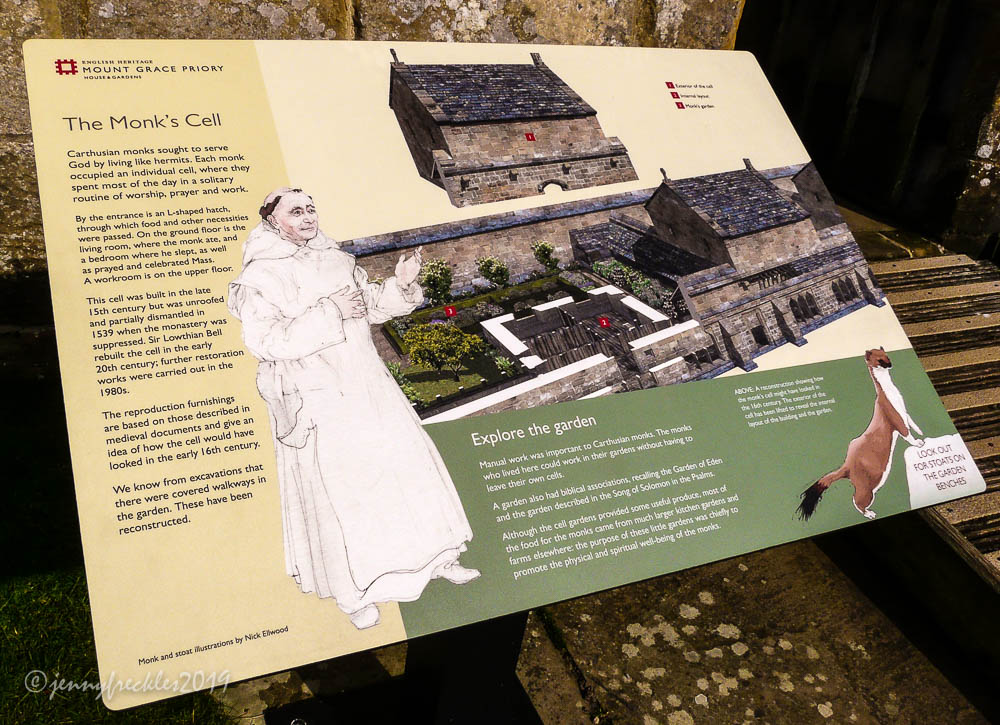
One of the monk's cells at Mount Grace priory has been rebuilt and furnished as it would have been when the monastery was in use in the 1400s. Carthusian monks lived as hermits, spending most of each day alone in their cells, in prayer, worship and work. Though their cells were simple they were not, apparently, spartan. They were actually quite spacious houses, with a sitting room, bedroom, latrine and a sanctuary used for prayer and writing. They had a piped water supply. Upstairs was a workroom. Some of the monks were weavers, others copied and illuminated manuscripts and some were bookbinders. Each cell had its own walled garden with a covered walkway, where the monk could walk and pray. Here, they grew herbs and plants but its main purpose was the spiritual and physical wellbeing of the monks, since meals and other necessities were delivered to them through a hatch in the wall. I have to say I found it fascinating to learn about. The way historical places are set out and explained these days is often really good.


Saturday, 30 March 2019

Mount Grace Priory


It was the first day of Spring! After a week or two of rain and wind, it did actually feel quite spring-like and I felt I needed a day out to celebrate. I went to Mount Grace Priory, which lies on the edge of the North York Moors National Park near Northallerton, about 50 miles north-east of Saltaire. It is a ruined medieval Carthusian monastery, founded in 1398 and dissolved (as they all were) by Henry VIII in the 1500s.

Carthusian charterhouses were different from many of the other monasteries, which were strong and active communities. Here, the monks lived as hermits, in their own cells (small houses really), only coming together in the chapel for the nocturnal liturgies, and on Sundays and feast days. They were a silent order and strictly vegetarian.

The plan of the monastery, therefore (see model on left) was a church and individual cells arranged around a central cloistered courtyard. There were at least 17 monks and a small community of lay brothers who looked after them.


The site now belongs to the National Trust, and is administered by English Heritage. The church is ruined but some of the graceful archways and the tower still stand. 


Within the ruined sanctuary is a powerful, modern sculpture by Malcolm Brocklesby: The Madonna of the Cross. Here, 'the Madonna is portrayed not as a meek figure but as a determined young woman, who understands the wonder and importance of her calling and dedicates her child to the purpose of the Creator. The sculpture incorporates both nativity, crucifixion and resurrection - the three facets of Christianity that establish the atonement of mankind'.  


Tuesday, 12 March 2019

Barden Tower and the Priest's House


On the valley side just above Barden Bridge sits Barden Tower. It was a hunting lodge and administrative centre, when hunting deer and wild boar was a sport popular with noblemen and vast tracts of hunting forest were owned by local lords. It was rebuilt as a residence in the 15th century, by Henry Clifford, who preferred it to his family seat at Skipton Castle. The adjacent Priest House was built in 1515.

The tower was restored by Lady Anne Clifford in the late 1600s, but after her death it was no longer used. Decay accelerated in the 18th century when lead and timber from the roof disappeared. For a full account of its interesting history, see HERE. Nowadays, the crumbling walls are all that remain, and you cannot go inside as it's unsafe. You can, however, see the remains of fireplaces and the various floor levels inside. It is now in the care of the Dukes of Devonshire, who own the Bolton Abbey Estate.

The Priest's House (bottom photo) has recently been fully restored as a romantic venue for weddings and events. See HERE.


Friday, 8 September 2017

Kirkham Priory


On the way back from Scampston (see Wednesday) we called in at Kirkham Priory, an Augustinian priory founded in 1120, by Walter l'Espec, Lord of nearby Helmsley, who also founded the larger and better known Rievaulx Abbey. Kirkham was surrendered in 1539 during the Dissolution of the Monasteries. It is prettily situated on the banks of the River Derwent and is now in the care of English Heritage. During WWII, it was used as a base for troops to test D-Day landing vehicles in the river and to practise climbing up scrambling nets hung on the ruined priory's walls; Churchill visited it.


It has a special place in my heart; I have many happy childhood memories there. My parents always used to stop there to break the long car journey from our home in the East Midlands to holidays in Scarborough on the East Yorkshire coast. My sister and I used to race around the ruins, glad to get out of the car and stretch our legs. We used to picnic overlooking the river. I recall my mother used to make (curiously) sandwiches of cream crackers and cheese, which had always gone a bit soft by the time we stopped to eat. I still recall the way, if you pressed them, little curls of butter would ooze through the tiny holes in the crackers! Happy days...  All those years ago, a twist in the road leading down into the valley provided a sudden and surprising vista of the ruins and the river. Nowadays the lovely view is entirely blocked by mature trees.


Wednesday, 8 May 2013

Wycoller Hall


The hamlet of Wycoller centres around the ruin of Wycoller Hall. The first hall on the site was built by the Hartley family in the 15th century, and it later passed by marriage into the Cunliffe family. The area was a sheep farming and weaving community. As handloom weaving declined, with industrialisation in the nearby towns, so the fortunes of Wycoller fell and many of the estate's tenants had to move out to the towns for work. In 1818, the Hall's last owner, Henry Owen Cunliffe, died with outstanding debts and creditors started to dismantle the Hall and sell off its stone to build mills. By the early 1900s the Hall was in ruins.

It is believed that the hall was the inspiration for 'Ferndean Manor' in Charlotte Brontë's novel 'Jane Eyre'. The village of Haworth, where the Brontës lived, is only a few miles away and Charlotte would have known this area well.


This old fireplace has been rebuilt by the 'Friends of Wycoller' group which works to preserve the area.

Tuesday, 19 April 2011

Surprise View


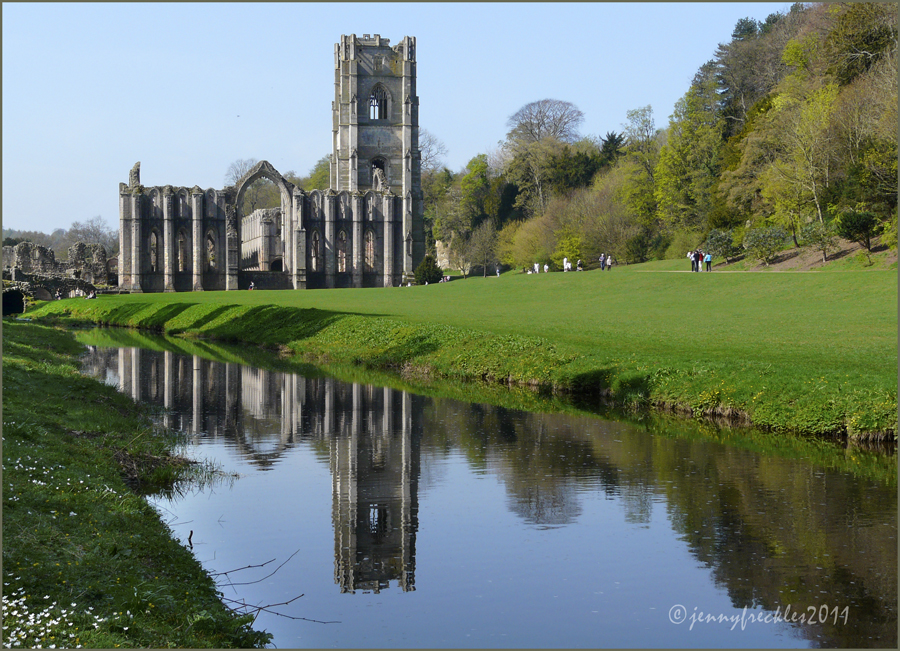
The aptly named 'Surprise View' - a lovely vista of the ruined Fountains Abbey, with the River Skell in the foreground that forms part of the Studley Royal water garden.  There is a high-level path through the woods around the estate, which leads to a Gothic pavilion called Anne Boleyn's Seat (though she never sat there, for sure!).  Coming out of the trees, the sudden view along the valley takes you completely by surprise and is as impressive and beautiful as it must have been when it was first conceived more than 200 years ago.

I will be posting some more photos of Fountains Abbey and the Studley Royal estate on my other blog, Seeking the Quiet Eye, starting here (three posts in all).

Sunday, 17 April 2011

The Cellarium, Fountains Abbey


This is probably one the most famous images of Fountains Abbey and one of the most stunning parts of the ruins.  This long span of vaulting, incredibly, survived intact when the Abbey was dissolved and began to be plundered for its stone. It formed the roof of the Cellarium, the area where the monks ate, slept and socialised - though, when the monastery was in use, the area would have been partitioned and not the long, open space we see today.

The monastery was founded in 1132 and, soon after, was admitted to the Cistercian order, an austere and devout order that originated in France.  A large lay brotherhood, working alongside the monks, cared for the buildings and farmed sheep and soon the Abbey was wealthy and influential.  It seems, however, that the enterprise grew too large for its monastic roots and economic collapse in the 14th century saw the monastery decline and some of its lands sold off.  A brief period of revival was cut short in 1539 by King Henry VIII's Dissolution of the Monasteries (when he made himself the head of the Church of England and severed ties with the Roman Catholic Church).  In 1540 the estate was sold to Sir Richard Gresham and became the property of a succession of wealthy families, who built Fountains Hall and landscaped the gardens.

Saturday, 16 April 2011

Fountains Abbey


When I pulled back the curtains last Saturday morning, I decided that to spend the day doing chores as I'd planned was criminally insane.  It was clearly going to be a splendid day - and it was... more like summer than spring. So I grabbed my camera and set off for Fountains Abbey, which is a very famous beauty spot north of Harrogate, about an hour's drive from here.  It also happens to be another World Heritage Site like Saltaire.  And since we are celebrating World Heritage Day on Monday 18th, it seems a good time to show you some of its beauty.

In actual fact the site is 'Fountains Abbey and Studley Royal' - a huge medieval monastery (reduced to ruins by Henry VIII's brutal dissolution of the abbeys in the 16th century) set within the beautiful valley of the River Skell, which was transformed in the 18th century into a stunning water garden and deer park by the Aislabie family who lived at Studley Royal, adjacent to the Abbey.

You could easily write a book about its history and the estate as it is today (and people have done!) so I won't try and cover everything here.  Please have a look at the website for more information and pictures - and enjoy my photos of this lovely spot.

This is my entry for 'Weekend Reflections' hosted by James at Newtown Area Photo - the gathering place for beautiful and creative interpretations of that theme from bloggers far and wide.  Do have a look at this week's other entries - click here.