I HAVE CLOSED DOWN THIS BLOG. Please click the photo above to be REDIRECTED TO MY NEW (continuation) BLOG.
Showing posts with label exhibition. Show all posts

Wednesday, 11 March 2020

Embroidery


The brightly coloured dogwood stems in the winter borders at RHS Harlow Carr Gardens always uplift my spirits. I feel starved of colour in the winter. I think the shrubs make lovely abstracts - as, indeed, I suppose is the intended effect.


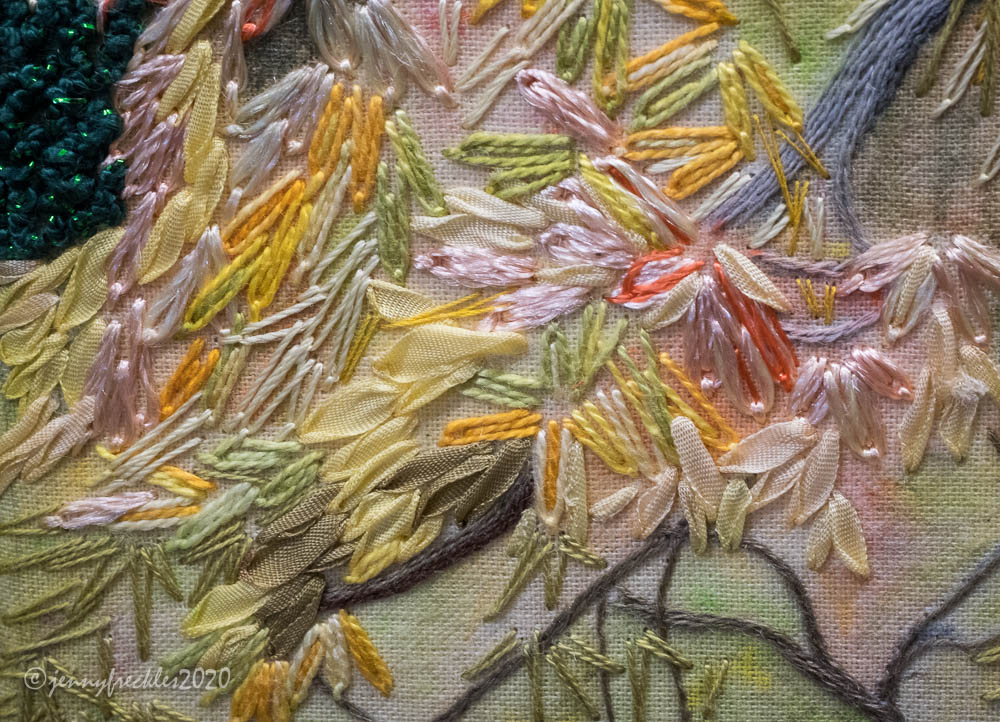
The colours were echoed in an exhibition in the library there. These were panels made by the Richmond and Leyburn Embroiderers' Guild. They had taken four seasonal photographs of the gardens and chopped them each into 48 squares. Members of the Guild had then interpreted each small square using embroidery and fabric collage. The resulting squares were then collected into wall hangings. The one pictured depicts 'Autumn'. In close-up, the work was exquisite, with a huge range of stitches and fabrics. Viewed from further back, the resemblance to the photographs was amazing.

I can't embroider for toffee... school needlework lessons sadly killed all my enthusiasm for such crafts. I can recognise good work when I see it though.


Saturday, 12 October 2019

Weaving abstracts


I found the 'Weaving the Future' exhibition (see yesterday) absolutely fascinating in its content and very inspiring too. With the sun streaming through the roof lights onto the varied exhibits, there was lots of scope for abstract-type photos and I could have stayed forever, looking and experimenting. Here are a few of the shots I took that I liked.

The pink sheets are punched cards that drive textile looms and tell the machinery how to create the pattern. These are from a local carpet factory.


The storage boxes set into the walls are relics of the past, when the roof space was a weaving shed. The faded, peeling paint and the shadow patterns attracted me.


These are some of the innovative fabrics that were displayed: light but strong fibres that could be used for insulation or load bearing. The honeycomb construction in the bottom picture makes for a very strong fabric that could be used for strengthening in buildings or bridges. I liked the effect of them set against the faded paint on the mill's walls.


Friday, 11 October 2019

Weaving innovations


These may look like artistic pieces and in many ways they are, but they are displayed in the 'Weaving the Future' exhibition as serious demonstrations of advanced new techniques. 'Knit: Design: Research' is an experimental design studio based in the School of Design at Leeds University. These pieces, by Dr Elizabeth Gaston and Dr Jane Scott, explore how knitted materials can change colour and adapt in shape and form according to environmental conditions.  Read more about their work HERE.


This piece above is called 'Canopy' and explores 3D knitting: 2D freehand loop construction can be formed into 3D structures by the use of tension. This isn't 'new' in itself. It is inspired by nature and the inherent properties of knitting, but they are exploring how this can be used sustainably in interiors, architecture and fashion.

The chair, below, is made by 'Solidwool', from coarse wool that was once considered worthless. Combined with a bio-resin, it can be shaped into chairs, tables and other items, creating attractive and functional products with a relatively low impact on our planet.


This is the surface of the seat, close up - it was really stylish.


Thursday, 10 October 2019

Weaving the Future


There is currently a truly remarkable exhibition, 'Weaving the Future', in the roof space of Salts Mill, commissioned for Saltaire Festival. With absolutely stunning photos by Tim Smith (printed on woven textiles), it shows how our local textile industry - the driver for the first Industrial Revolution but having declined in the late 20th century - has now adapted. Local mills produce very high quality and distinctive fabrics, from wool, cotton and other fibres, for specialist markets around the world. Together with researchers at some of our leading universities, they are spearheading a new revolution, adapting traditional technologies to create innovative materials: weaving silk to make heart valves and knee cartilage; new fabrics for use in aerospace and construction; electro-spinning to produce dense membranes of extremely thin fibres which can be used, for example in wound dressing or to filter toxins from drinking water. It was fascinating to see some of these innovations.

The exhibition also makes the link between the binary systems that drove the old textile looms (illustrated by the pattern cards of punched holes that you can see on the left of my photo below) and the digital computer technology that now underlies almost every facet of modern life and industry. Many of the businesses that now occupy much of the floor space in Salts Mill are involved in innovative digital technology, like Radio Design who design, manufacture and export wireless communications systems used, for example, in mobile phone masts. Serendipitous...


Images in my two photos above were taken in local mills and show the processes of spinning and dying yarn. In the background of the top photo is a picture taken in a factory that makes cycle frames from woven carbon.

Below are some of the specialist fabrics produced locally: felt damper pads for pianos, green baize for snooker tables and biodegradeable wool coffins.


The photography on display is superb, as is the video installation that shows dancers performing movements inspired by textile workers, overlaid with footage of textile processes. It has a sound track of music made in response to the sounds and rhythms of mill machinery. It is so beautiful, graceful and evocative that it brought tears to my eyes.

All this feast for the senses is in one of my favourite spaces: the roof space at Salts Mill, originally the longest weaving shed in the world. The exhibition is on until 20 Oct, weekends only.


Wednesday, 12 June 2019

Age old tasks


Wales: Archaeological excavations have uncovered numerous tools and artefacts that give an insight into how the Iron Age people at Castell Henllys actually lived from day to day. Our (personal!) tour guide showed us different methods of grinding grain to make flour. She had a concave rock that enabled her to rub hard at the grain with a stone, work clearly needing strong arms and a lot of stamina. She also had a simple corn mill: two flat stones with the upper one rotating around a wooden post. Grain was poured down the centre and distributes out through grooves. The action of the stones rubbing together grinds it down into flour.


They have not found any cloth still surviving but they have found stone weights that were used to hold the warp threads on a rudimentary wooden loom. Spun threads of wool and flax were used to weave cloth, dyed with herbal decoctions.


In the grounds of the fort, there was a simple wood-turning lathe, powered by a foot paddle.


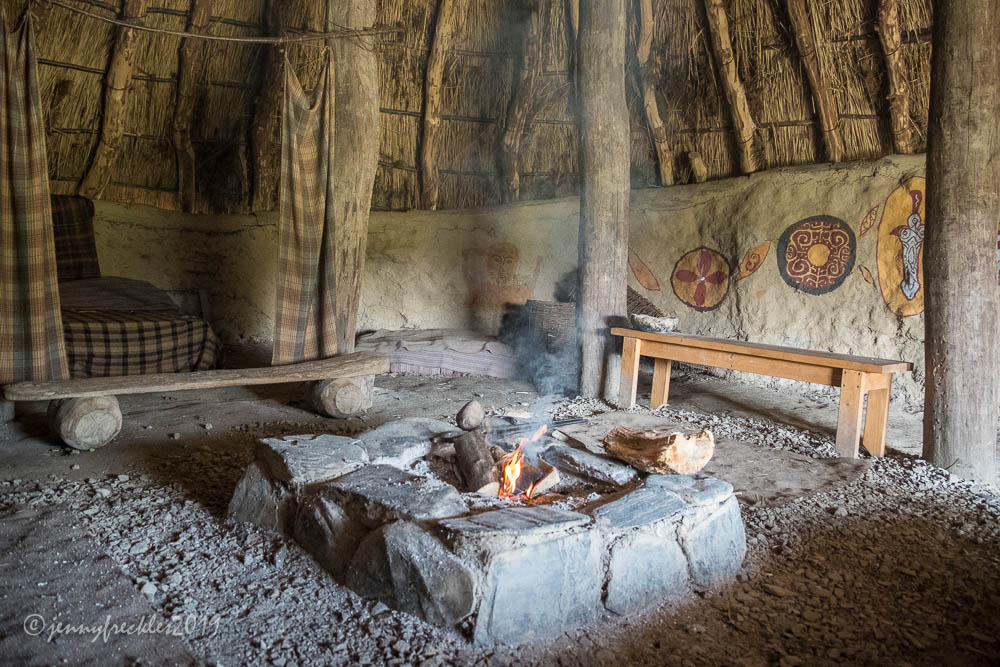
Some of the roundhouses were decorated with painted designs: shields, knots and wild animals like this powerful wild boar. The warriors would have killed deer and boar for their meat and skins.


We had such a good time on our visit to Castell Henllys. It is a kind of living history and seeing, touching and smelling makes it all come alive. It must be a super place for children to learn. It's all in a lovely setting too, with a path by a stream tumbling through a wooded valley and leading up to the hill fort. There's a very good visitor centre with a shop, an excellent café and some interactive information boards and videos. Highly recommended if you're in the Cardigan/Pembrokeshire border area.

Tuesday, 11 June 2019

Building Castell Henllys


Wales: The first roundhouse was reconstructed on the Castell Henllys site in the 1990s. The original buildings are beginning to deteriorate and are now being renewed, which gave us a good insight into the building methods.

A company that builds using timber frames has started to put in place the wooden structure of a new hut. Then the walls will be constructed using hazel rods woven through timber posts (the wattle) - see example above left. Once the reed-thatched roof has been added, the walls will be finished with dried mud (the daub). The guide told us that the circular structure is built around a central post. Once the structure is balanced  and self-supporting, roped and jointed together, the central post is sawn off up in the roof, to provide an open living area.


There's a great beauty in the roof structure, being at once organic and ingeniously engineered. The photo below is looking more or less directly up to the apex in the middle.


This is a more detailed view of the thatch overhang at the entrance, showing the timber and ropes.


Monday, 10 June 2019

Iron Age village


Wales: Whilst in Wales, we had a most interesting tour of an Iron Age village, at Castell Henllys, which has been excavated and studied for the past twenty years by archaeologists from York University. They have reconstructed several roundhouses on the actual foundations of a hill fort, belonging to the Demetae tribe, dated to between 500 and 100 BC. Their work has enabled a greater understanding of the Iron Age period, as well as providing training for archaeology students and a wonderful visitor attraction. Luckily, we visited when it was very quiet and had a personally guided tour, which was really fascinating.

The roundhouses are built of wattle and daub on a wooden framework, with reed thatched roofs. The granary (the smaller hut in the photo above), where food was stored, is built on stilts off the ground to mitigate against damp and vermin. The settlement was protected by a complex of earthworks and ditches, including a 'cheveaux de frise' - a stony ditch (right) designed to protect against horses and chariots.

Heat, light and cooking were provided from a central fire within the roundhouse, whose smoke was drawn out through the thatch.


The roundhouses were home to extended families and some have private sleeping quarters separated by woollen curtains. It's estimated that the village could have housed over 100 people, led by a wealthy and influential chieftain. The people were very resourceful and skilled: coppicing woodland, growing crops and keeping livestock;  spinning, dyeing and weaving cloth; turning wood; weaving baskets; grinding grain to make bread and generally living a healthy and sustainable lifestyle. Some would have been warriors and hunters, protecting the settlement from wild animals and human enemies.

The hill fort seems to have been abandoned during the 1st century BC, possibly due to the Roman invasion.


Thursday, 6 June 2019

Throwing a pot


Saltaire Arts Trail 2019 - It's always interesting to watch artists demonstrating their skills. In the Maker's Fair, ceramicist Sylvia Glover was showing how to throw a pot on a potter's wheel. She made it look so easy, not a wobbly line in sight! From a lump of clay to a beautiful, even-sided little bowl, ready to be dried, took her less than ten minutes. 

Wednesday, 5 June 2019

Mawdsley Williams furniture design


Saltaire Arts Trail 2019 - David Mawdsley, of Addingham-based Mawdsley Williams Ltd, designs and crafts the most beautiful, unique furniture from a variety of different woods, chosen for their natural characteristics and grain patterns. His pieces, both the larger items of furniture and the exquisitely crafted smaller boxes and chopping boards, make decorative use of the grain pattern and the effects achieved by inlaying different types of wood.

I've seen his work exhibited at various events like the Arts Trail and Skipton's Art in the Pen. If I had money to spare and somewhere to display it, I'd treat myself to one of his console tables or maybe a bar stool. There's something wonderfully tactile about good wood, as well as the joy of the craftsmanship that goes into each piece.

Here, he was shaping a leg for a stool. I'd love to try working with wood, though since I have difficulty even filing my nails, I'm not sure I'd be much good at it! See David's website HERE for more examples of his lovely work.


Tuesday, 4 June 2019

Eye-catching moments


Saltaire Arts Trail 2019 - Here are some more exhibits that caught my eye this year, as I browsed the Arts Trail Maker's Fair and Open Houses:

Rather superior hand-made peg dolls by Peggie Belle - superior, that is, to the various attempts I've made at peg dolls during my career as mother and grandmother! They each had a lot of personality. 

Gorgeous, tactile, vibrant leather bags and accessories by Gosia Weber.


Colourful baskets and mats, made from recycled T-shirts by Saltaire resident Lola Moreno of Aupalola Crafts.


A frog water feature by Martin Norman, made of bronze and iron resin. Quite a cheeky looking chap, don't you think? I'd quite fancy installing this in my little back garden, though I expect it would soon hop off into some passing shyster's white van, so I won't! 


Monday, 3 June 2019

Made by Today


Saltaire Arts Trail 2019 - The Open Houses showcase work by local people, as well as celebrated artists from further afield. Séarlait McCrea is a Northern Irish girl living in Saltaire, making understated jewellery in her home and, when on the move, in her trusty campervan. With a love of simplicity and a loathing for excess, she creates minimalist, timeless pieces produced as ethically as possible. Her vision is set out in her 'Made by Today' website HERE, where you can see (and buy) some of her subtle and classy designs. She also runs jewellery making workshops in Saltaire and Leeds.

In my photo, she was carefully shaping tiny crescents from the thin sheet of metal, using a very fine hacksaw blade. She made it seem easy but I'm sure it's harder than it looked. One slip and your finger would be cut or the piece ruined!


Sunday, 2 June 2019

Mandy Long - Ceramic Sculpture


Saltaire Arts Trail 2019 - It's interesting to notice what catches your eye as you wander round the Arts Trail... For me, it's not always the most obvious things, and often it is just one piece that stops me in my tracks.

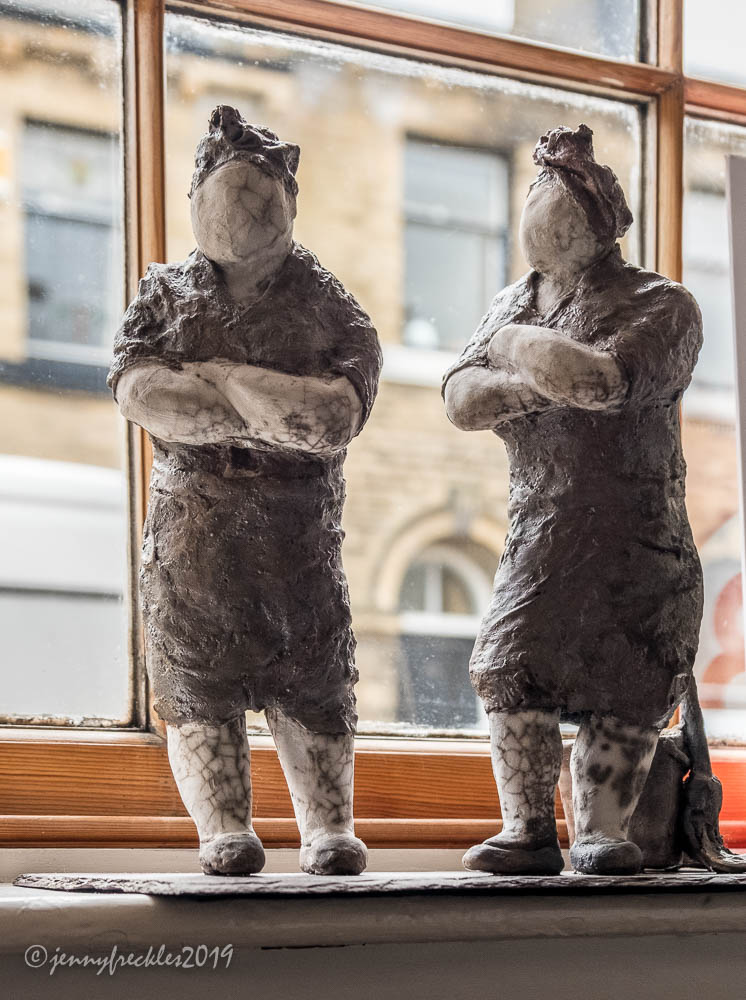
The ceramic sculpture above was in the window of a house on Titus Street. It's called 'Landladies' and is the work of Leeds-based artist Mandy Long, pictured right. I loved the way she has caught the pose of these women. Even without faces, they are still hugely expressive and the piece really tells a story, I think.

Other exhibits displayed were also powerfully expressive, like the one below - the Hurdler. Seemingly suspended mid-leap, the athlete's muscles are straining to clear the hurdle. Much of Mandy's work depicts the physicality of sport in its various forms, allowing her to fuse grace and power very eloquently in her sculptures. The pieces are raku-fired, causing random crackling and blackening of the glaze.

I loved it - and I loved that I dared ask Mandy if I could take her photo and she said 'yes'! I'm getting braver. Look at her website for the full range of her beautiful work - HERE.


Saturday, 1 June 2019

Saltaire Arts Trail 2019


There's always something happening in Saltaire... The film company left and the shops and cafés have all been returned to their usual look, with little remaining of their exciting BAFTA-seeking performance (see here), save traces of dusty gravel on the road.

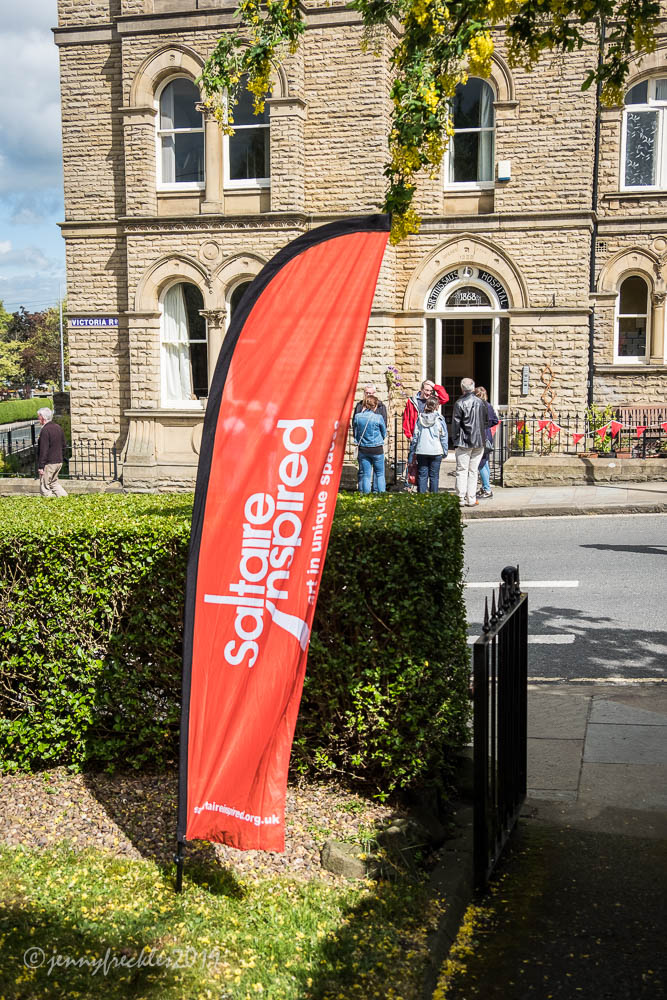
Then it was the annual Saltaire Arts Trail over the bank holiday weekend. Residents in the village houses open their homes as mini art galleries, there's a huge Maker's Fair in the Victoria Hall and the art cognoscenti, both local and from wider afield, descend on Saltaire to enjoy some of the best art and craft imaginable, in one of the most interesting settings you could find.

The café in my top picture has had a number of re-imaginings in the recent past (not least as a pub during the recent filming). It is now Nordish, a café dedicated to good Scandi fika and smorrebrod. It operated as a 'pop-up' initially, with limited opening times. Recently it's been closed for an extensive refurbishment and now plans to build up to a more regular opening schedule and a wider menu. It was open for the Arts Trail, with artwork on show by Liz Tolan and Salma Patel.


'J Chadwick and Sons, Fruit and Potato Sales' has been turned back into Massarella's Café Bar and Gallery, where (even on an ordinary weekend) you can enjoy a coffee and a light snack whilst browsing their range of pictures and photographic prints.

Up in the residential zone of the village, various houses and some gardens were colourfully marked out with bunting, with a wide range of attractive and sometimes quirky artwork on display. This house had a selection of 'Sac pots' for sale, knitted plant pots that I featured on my blog last year - see here.


When the sun came out, so did the children, busily engaged in sculpting a willow lion with the guidance of Todmorden-based willow sculptor Joevanka Gregory.