I HAVE CLOSED DOWN THIS BLOG. Please click the photo above to be REDIRECTED TO MY NEW (continuation) BLOG.
Showing posts with label Port Sunlight. Show all posts

Monday, 8 May 2017

Sundial


Liverpool trip
In Port Sunlight's memorial gardens there is this sundial. It celebrates the Diamond Jubilee of HM Queen Elizabeth II in 2012. I've never seen one like this before; it is analemmatic, using the shadow cast by a person to indicate the time of day. You have to stand on the relevant month as marked on the paving stones and read the time from one of the two rings of markers, the outer being GMT and the inner British Summer Time. So it was almost two in the afternoon when I was taking the photo. 

Sunday, 7 May 2017

War memorial


Liverpool trip
The Port Sunlight war memorial is as fine as any I have ever seen, and one of the largest in the UK. It was unveiled in 1921, after WWI, but now carries the names of all the Lever Brothers employees killed in both world wars. It was designed by the Welsh sculptor Sir William Goscombe John. It's theme is 'The Defence of the Realm' and it includes figures of women and children, as well as military personnel. Lever had been concerned that Britain would be invaded during WWI and, despite being 63, he joined a local volunteer corps (forerunner of WWII's Home Guard).

Saturday, 6 May 2017

The Leverhulme Memorial


Liverpool trip
Saltaire's founder, Sir Titus Salt, is honoured by having a statue of himself in Roberts Park. William Hesketh Lever, the founder of Port Sunlight, has a memorial in his model village too, though it is not his own likeness. The figures at the top and the base represent Inspiration, Industry, Education, Charity and Art, a fitting tribute to the visionary, philanthropist businessman. Unveiled in 1930, it is a work sculpted by Sir William Reid Dick. It was dedicated to the memory of the 1st Lord Leverhulme, who died in 1925, by his employees at the Port Sunlight works.


For want of anywhere better to place it, I include here also one of the first advertisements for Sunlight Soap, which was produced at Port Sunlight. Lord Leverhulme's business success came not only from recognising the need for good, sweet-smelling household soap (since, by mid-Victorian times, people increasingly had access to washing and laundry facilities at home) but also to his recognition of the importance of branding and advertising to create a market for his products. Lever Brothers were among the first to sell bars of branded, wrapped soap. Prior to that soap was bought by weight, sawn off a block in the grocer's.


Friday, 5 May 2017

Sunlight glass


Liverpool trip
The stained glass in Christ Church, Port Sunlight, is rather special. It has huge east and west windows (too big for me to photograph effectively) but I also liked the windows in the transepts and side aisles too. As far as I'm aware, it is relatively unusual for a nonconformist church to have figurative stained glass. They are often quite plainly decorated. 

The window above represents the main streams of English church life since the Reformation and key figures within them: Episcopal (Thomas Cranmer), Congregational (John Robinson), Presbyterian (Richard Baxter) and Methodist (John Wesley).  The work is believed to be by a London company called Heaton, Butler and Bayne, who were very well known in the late 19th and early 20th century. Examples of their work can be found in hundreds of churches across Britain - and I am really pleased to have discovered this fact, as I believe they also made the beautiful windows in my own church

The windows below are the work of the Hungarian artist, Ervin Bossanyi (1891 - 1975), whose work, in a byzantine style, is highly prized.  


Thursday, 4 May 2017

Christ Church, Port Sunlight


Liverpool trip
Like Sir Titus Salt, William Hesketh Lever (he later became the 1st Viscount Leverhulme) who founded Port Sunlight, wanted his employees to have a place to worship where they "would learn that the way was clear and open between their souls and God". Christ Church, opened in 1904, was a 'free' church, open to all who confessed themselves disciples of Jesus Christ. 

It's a wonderful building, built from local red sandstone and open and spacious inside. The interior is much richer than many nonconformist churches, with wonderful stained glass, an Italian marble floor and English oak pews and screens.


Outside, in a open mausoleum, are the tombs of the 1st and 2nd Viscounts Leverhulme and their wives, with bronze and green marble sculptures by Sir William Goscombe John RA.


Wednesday, 3 May 2017

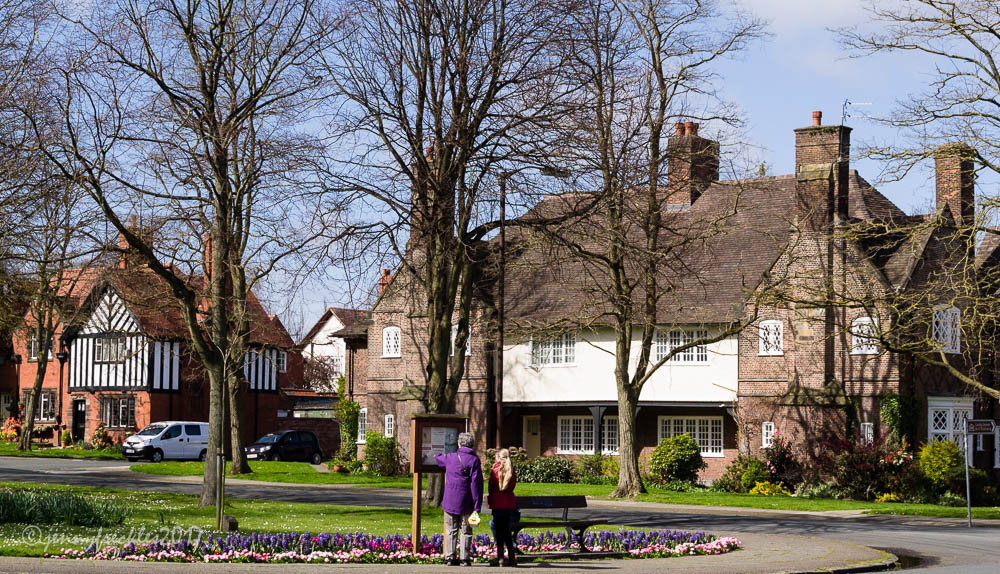
Port Sunlight's houses


Liverpool trip
Port Sunlight's 800 houses were built between 1899 and 1914, to house some 3500 people. Designed to provide a healthy environment for the workforce and their families, they form a pleasant garden suburb beside the adjacent Lever Brothers soap factory,  The designs, commissioned by William Hesketh Lever and produced by some 30 different architects, were influenced by William Morris and the Arts and Crafts movement.


As in Saltaire, residents were expected to conform to strict rules and regulations. Female employees at the factory had to stop work when they married. The Bridge Inn opened in 1900 as a temperance pub, since Lever himself was a strict teetotaller and non-smoker. Within a couple of years, representations were made to allow it to sell alcohol. Lever decided to hold a referendum and, unconventionally for the time, allowed women to vote too (perhaps believing that might influence the decision to stay 'dry'). In the event, 80% of voters wanted the pub licensed and Lever decided not to use his authority to stand in the way of that change.


Tuesday, 2 May 2017

Port Sunlight


Liverpool trip
Port Sunlight is another place that has been on my 'bucket list' for a while. It's on the Wirral peninsula, on the opposite bank of the Mersey estuary from Liverpool. It is an industrial garden village, founded in 1888 by William Hesketh Lever (1851-1925). He was a soap manufacturer, another wise and visionary Victorian businessman, philanthropist and politician. Inspired by similar values to Saltaire's Sir Titus Salt, he wanted a bigger factory and to provide decent housing for his workforce. He saw the potential of some marshy land and decided to build a new factory with a township around it, in much the same way as Saltaire had been developed some thirty years before.

Whilst the concept is similar, Port Sunlight differs radically from Saltaire in that it is a spacious parkland, with over 900 houses designed by 30 different architects, so that they are all different. There is none of the neat conformity of Saltaire's grid pattern, with houses and public buildings designed to a coherent whole. Instead, Port Sunlight has a romantic and almost rural feel, imitating a village that has grown up gradually over many years. It is really very pretty, with lawns and gardens and a wide boulevard at the centre.


It has many of the same facilities as Saltaire and, as with Saltaire, the housing and public buildings stock were eventually sold off (though not until the 1980s.) In addition to the housing and the huge factory (still producing soap, now part of Unilever), there was a church, a hospital, a school and various institutes for recreation and learning, including a theatre. Hulme Hall (below), the original dining hall for female staff, is now a venue for weddings, exhibitions and other events. Ringo Starr played his first concert with The Beatles here in 1962.


The wide central boulevard has a large war memorial and a garden dedicated to the 96 Liverpool football supporters who lost their lives in the Hillsborough disaster in 1989. At the far end, just visible in my photo, is a lovely art gallery, dedicated to Lever's wife Elizabeth, and opened in 1922 after her death in 1913. It houses some of Lever's personal collection of paintings, pottery, sculpture and furniture collected over many years.