I HAVE CLOSED DOWN THIS BLOG. Please click the photo above to be REDIRECTED TO MY NEW (continuation) BLOG.
Showing posts with label Skipton. Show all posts

Tuesday, 17 March 2020

Inside Skipton Castle


Skipton Castle is remarkably well preserved inside, as it still retains a good roof. You can follow a tour through all the main rooms. The Banqueting or Great Hall, above, was the main living area in medieval times, used for eating, socialising and ceremonial occasions. It is a vast space. Originally, the far end would have been raised for the top table, where the Garrison Commander or the Lord, his family and his guests would be seated when they were resident here. The doorway you can see leads to the Withdrawing Room or Great Chamber (below), where the Lord and his family would have spent much of their time and entertained guests. It is said that Mary, Queen of Scots was imprisoned here for a time. The window looks out over the valley of Eller Beck (where the Springs Branch canal is now). On this northern side, the castle sits on top of a huge and sheer cliff, which provides an excellent defensive barrier.


Next to the Banqueting Hall is the medieval kitchen (below), in use from 1300 to 1680. It has bread ovens at one end and, at the other, a massive fireplace big enough to roast an entire ox on a spit. You can also see a serving hatch in the wall.


Between 1680 and 1900, the 'new' kitchen (below) was used. It has an old charcoal stove by the window and a Victorian iron range in the fireplace.


One of the exhibits that interests children most (!) is the garderobe containing the privy. It juts out over the steep cliff to the north and simply has a seat with a hole over a long drop down to the water below (actually, the canal nowadays). (Better take your wallet out of your pocket before you try it!!)


Monday, 16 March 2020

Lady Anne Clifford


Born in January 1590, Lady Anne Clifford was the only surviving child of George Clifford, 3rd earl of Cumberland, Champion to Elizabeth I and a great sailor who fought against the Spanish Armada. He left the Skipton estate to his wealthy brother but his daughter, Lady Anne, contested that and, supported by her mother, won the lawsuits which followed. It was she who negotiated with Oliver Cromwell for permission to have the castle rebuilt after the Civil War. She is remembered for her many good works and the restoration of churches and castles throughout the north.  There is even a 100 mile long distance footpath named after her: Lady Anne's Way, from Skipton to Penrith, passing by many of the castles she owned.

The present entrance to Skipton Castle is known as Lady Anne's Steps, part of a Tudor remodelling.


The inner Tudor central court is known as the Conduit Court, because it was to here that the piped spring water supply was delivered. The windows were added in the 16th and 17th centuries along with the new entrance and a new Tudor wing beyond the watch towers, which is now a private residence.


Sunday, 15 March 2020

Skipton Castle


I had a late afternoon appointment in Skipton, to collect my new specs. It was a lovely, sunny day for once, with more than a hint of spring in the warm sunshine, so I decided to drive over there early and visit the castle, something I've been promising to do for ages.

Skipton Castle is one of the most complete medieval castles in England, though it has of course been remodelled over the years. There was initially a wooden fort here to guard against invading Scots, built by Robert de Romille and dating to 1090, just after the Norman invasion. Soon afterwards a stronger stone castle was built, which passed into the hands of the Clifford family in 1310. You approach it through a substantial gatehouse in the outer curtain wall, with the motto (in Norman French) of the Clifford family: Desormais (Henceforth!) carved in stone above. Once through the gate, the huge watchtower, the central feature of the original defences, towers above.


There was originally a moat, crossed by a bridge. You would have passed under a portcullis before entering the castle itself through the main door into an inner courtyard; you can still see the grooves of the portcullis and the Norman arch.


The castle withstood a three year siege during the English Civil War, the last Royalist bastion in the North. An ancient well has recently been discovered in the outer ward, which is probably how the garrison survived during the siege. In 1645 a favourable surrender was negotiated with Oliver Cromwell. It allowed the garrison to march out with 'colours flying' to rejoin the King's forces. Cromwell ordered the roof of the castle to be removed and the walls reduced ('slighted') but the castle remained in the Clifford family. He later allowed the redoubtable Lady Anne Clifford to arrange repairs (so long as the walls were built less strong) and she planted a yew tree in the central courtyard in commemoration. The tree is still there.


The Norman castle had very thick walls, as you can see below, which is one reason it withstood the siege. The arrow slits allowed crossbows to be fired at invaders. 


Within the castle grounds there is a 13th century chapel, dedicated to St John the Evangelist.


Sunday, 1 December 2019

Skipton


The town of Skipton, about 16 miles north of Saltaire, styles itself as 'The Gateway to the Dales' though you'll reach the Dales much quicker if you take the Skipton bypass around the town. The town has a very good market on four days of the week, which takes up all the space along both sides of the long and wide main street. The origins of the market are ancient: a centre for trading sheep and wool.  Nowadays, the sheep are traded at the auction mart on the edge of town and the market sells all manner of goods, from clothing to sweets, hardware and gifts. When it's not market day, as on the day I last visited, it is still a very congested town centre with a line of queuing traffic almost always inching its way through. That just demonstrates, however, what a thriving centre it is and how important for the surrounding rural communities. Skipton regularly comes near the top of 'the best/happiest places to live' in Yorkshire/England/the world. 

It has some good small shops, with a fair few independents as well as some of the usual high-street names. At the north end of the main street (behind me as I took the top picture) sits the large parish church of Holy Trinity (below) and, behind that, Skipton Castle. (I keep promising myself to visit the castle again... Not made it so far.)  The main street is a bit tricky to photograph as it runs due north-south and the best view, from the slightly elevated churchyard wall, is always into the sun. You can get the general feel of the place from the top photo: a nice mix of very old buildings (several old pubs and coaching inns) and some solid, provincial Victorian edifices like the library in my photo and and the town hall opposite. The war memorial doubles as a roundabout at the top end of the street, where the road splits east and west round the castle. 

The Leeds-Liverpool Canal runs through the town parallel to the main street before turning west, giving an extra layer of interest around the canal basin, where there are always plenty of colourful boats. 
(Photos taken in October, before my eye op). 


Friday, 25 October 2019

Autumn woods


Here are a few more photos from my walk in Skipton Castle Woods, just because it was so beautiful.


Thursday, 24 October 2019

Skipton Castle Woods


My camera club had our last outing of the season, meeting up in Skipton to explore the woods behind Skipton Castle. As I've mentioned before in other posts, the Springs Branch of the Leeds-Liverpool canal passes behind the castle (see left) for about half a mile. It was built for the Earl of Thanet in 1773 to transport limestone from his quarry, which was brought by tram through the woods and dropped down chutes into canal barges. The busy industrial history of this area is long gone and it's now a peaceful oasis behind the town of Skipton. The waterfall is nothing more exciting than a large drainage ditch that pours into Eller Beck, alongside the canal. After all the rain we've had, there was a lot of water.                                     
Up until recently, the Springs Branch canal was still navigable and a small boat conducted tours up here from the marina in central Skipton. A huge rockfall from underneath the castle has now blocked the canal, and it doesn't look as though it could be reopened without a lot of expense. Rather worrying too, is that the fall was below the foundations of Skipton Castle on the crag above. Nasty! 


The 9' high willow sculpture The Huntress looks even better against the autumn leaves than it did in March when I last walked here. A little further along, Eller Beck falls away in a ravine and the ground was covered in fallen leaves. Autumn seems to be hastening on.


Thursday, 15 August 2019

Jump!


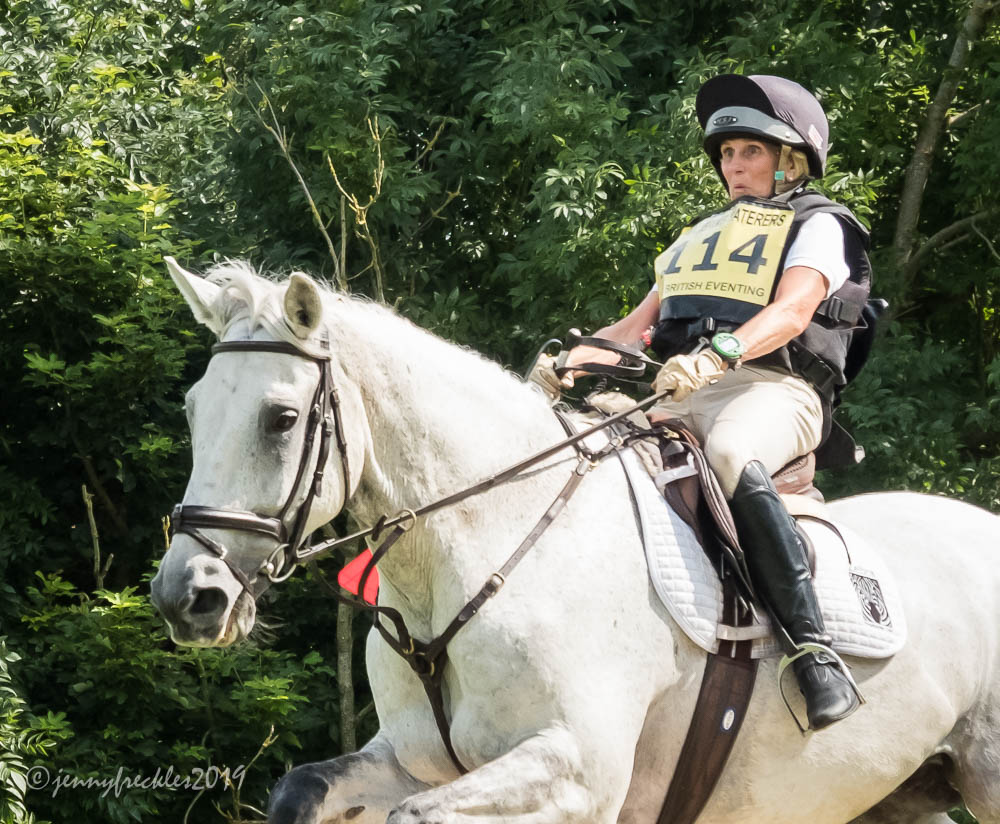
At Skipton Horse Trials, I found it wasn't too difficult to get good shots of the cross-country event, though much harder to get a 'great' shot. (I think you need someone to fall off into the water, to make a really great shot!) Spectators were free to wander the course, though you had to listen for the whistle that indicated a rider coming and make sure you were well-out of the way. I found it tricky to get the exposure right; a lot of my photos were underexposed. Ideally, you need light on the competitor's face and the horse with its ears pointed forwards. I was taking 'burst shots' where the camera takes a few frames in quick succession. Those with the horse beginning its leap were, on the whole, more successful than those where it was landing. They often look very awkward coming down.


There were several pro photographers, employed at strategic sites to get a shot of each rider. I think it must be fairly boring to just keep taking the same shot over and over. At least we amateurs could move around. Sadly, pros can apparently be a little bit selfish. We'd been waiting by the water jump for ages for the afternoon class to start. A pro came along and plonked himself right in everyone's sightline and refused to move, despite being asked politely to do so!


The white poles had signs to indicate to the riders which jumps were to be used. They proved to be a bit of a photographic nuisance! I cloned out two on the photo below, as they looked as though they were penetrating the horse's abdomen and made it look like one of those prancing horses on a fairground carousel. Other than that, I quite like the angle I got on this one:


Wednesday, 14 August 2019

Skipton Horse Trials


I've never attended a gymkhana or horse trials before, so, when my camera club fixed up an outing to Skipton Horse Trials, I decided to go. It turned out to be a most enjoyable day out. The format is a one-day event where competitors complete three phases: dressage, showjumping and cross-country, picking up penalty points for faults. The one with the least penalties by the end wins the class. There were classes for different skills-levels and I gather there are both amateur and professional riders competing. To be honest, I can't really tell a novice from a pro, as I don't know what to look for, beyond the obvious ability to stay on the horse's back!


Plenty to see, though nothing, apparently, as fascinating as their phones!


The cross-country event meandered through the farm's fields, uphill and downhill, over a series of jumps. For much of the time, we were watching near the water jump as that added some spice to the shots.


The expressions on some of the riders' faces were priceless. I'm not sure this lady (below) was enjoying herself!


Saturday, 6 April 2019

Polish Airmen's Memorial


Near the village of Bradley, I came across this memorial, which I didn't know about before. It marks the site where in 1943 a Wellington Bomber, apparently on a training flight, crashed, killing all seven of the Polish airmen aboard. From what I've read, one of the main wing struts failed and the plane lost a wing and engine before ploughing into the canal bank. There is a wooden cross on the towpath but a larger, more permanent memorial was erected in 2007 on the other side of the canal, beside the swing bridge. One of the men had married an English girl from Blackpool only three weeks before and another of them had a son, born only four weeks before the accident. Rather poignant...                                                                                                                                                                You can read more about it HERE.

Friday, 5 April 2019

A fine day for a walk


I took my car to the garage in Silsden for its annual service and first MOT. (It passed!) Since I had several hours to kill and it was a glorious, though chilly, day, I went for a long walk along the canal. (Ten miles!)  Silsden is a small town up the Aire valley on the way to Skipton. It is expanding fast as new properties are being built and some of the old mills are being converted to housing. As I walked west out of the town, I noticed there's a new estate growing up on both sides of the canal. From here, Silsden Boats hires out its canal cruisers. At this time of year, out of season, the canal is lined with all their narrowboats. 


My route took me through the village of Kildwick and on to Bradley, another old village that has expanded with lots of new houses. I'd never actually been there before, as it sits off the main road up a lane that really only leads to the village, so one tends just to whizz past in the car. Here again, the textile mill that led to Bradley's original growth in the 19th century from an agricultural hamlet, has been converted to apartments. 


There seemed to be few amenities in the village apart from a chapel, a village shop and a cricket field but it seemed a nice little place. 


There was a small park, nicely cared for, beside the canal so that was a good place to stop for a rest before I retraced my steps to collect my car.


Sunday, 17 March 2019

Skipton Castle and woods


I had a trip to Skipton with a friend. We did look round the shops (of course!) but we also had a pleasant walk up through the woods behind the castle. The castle stands at one end of the high street, next to the church. I haven't been in there recently and we didn't go in this time, though the entrance through the huge gatehouse arch always beckons. I realise, though, that I have never featured the castle on my blog - a bit of an omission that I must remedy sometime, as it's quite an interesting place.  

The walk we followed took us behind the castle, along the little canal known as the Springs Branch, which forks off from the Leeds-Liverpool Canal in the centre of the town. It was constructed to ferry limestone from local quarries. Beyond the short canal, the path meanders through woods between a small stream called Eller Beck and a channel that takes water from a mill pond down to a corn mill. The mill still exists; it is now a retail and business centre, and its waterwheel has been restored. 


The walk is a pleasant circular trail of about 2.5 miles - described as 'strenuous' but it isn't at all. There's just one significant uphill stretch and some steps. (My uphill walk to church on a Sunday is more strenuous!)  We passed this magnificent 9 ft high willow sculpture of a female archer: The Huntress, crafted by Anna & the Willow and installed last year. I've seen several willow sculptures but this one is one of my favourites. I love the way her skirt swirls round and she looks as though she has grown from the woodland floor.  They do inevitably deteriorate over time, but this one is still very beautiful. (Read more about how it was made HERE.)