I HAVE CLOSED DOWN THIS BLOG. Please click the photo above to be REDIRECTED TO MY NEW (continuation) BLOG.
Showing posts with label Thornton. Show all posts

Thursday, 12 December 2019

The Brontës' birthplace


After we'd visited the Christmas Tree Festival, we went in search of the house on Market Street in Thornton where most of the Brontës (Charlotte, Branwell, Emily and Anne) were born. It was the parsonage in their day, since their father Patrick was the minister at the Bell Chapel. It later became a butcher's shop and had the curious projecting frontage added. There was a short-lived attempt to turn it into a museum, before it became a private residence again.  Last time I visited in 2012 you couldn't go in but for the past few years it has been Emily's café/bistro. We were able to have a coffee there, right beside the dining room fireplace in front of which the Brontë children are said to have been born. I wonder if they had stockings hanging up at Christmas when they lived there?


Some of the tables in the café had been ingeniously fashioned from old-style school desks.


It had a nice ambience, full of books and memorabilia  - and very good coffee and cake (though I managed to resist the cake!)


Wednesday, 11 December 2019

St James and the Bell Chapel, Thornton


St James Church Thornton, where the Christmas Tree Festival was (see yesterday), is an imposing church with a huge spire, on the road leading to the village of Thornton, a suburb of Bradford. The existing church dates from 1870. With all the Christmas trees inside, I couldn't really see the interior properly but it has some fine William Morris & Co stained glass.

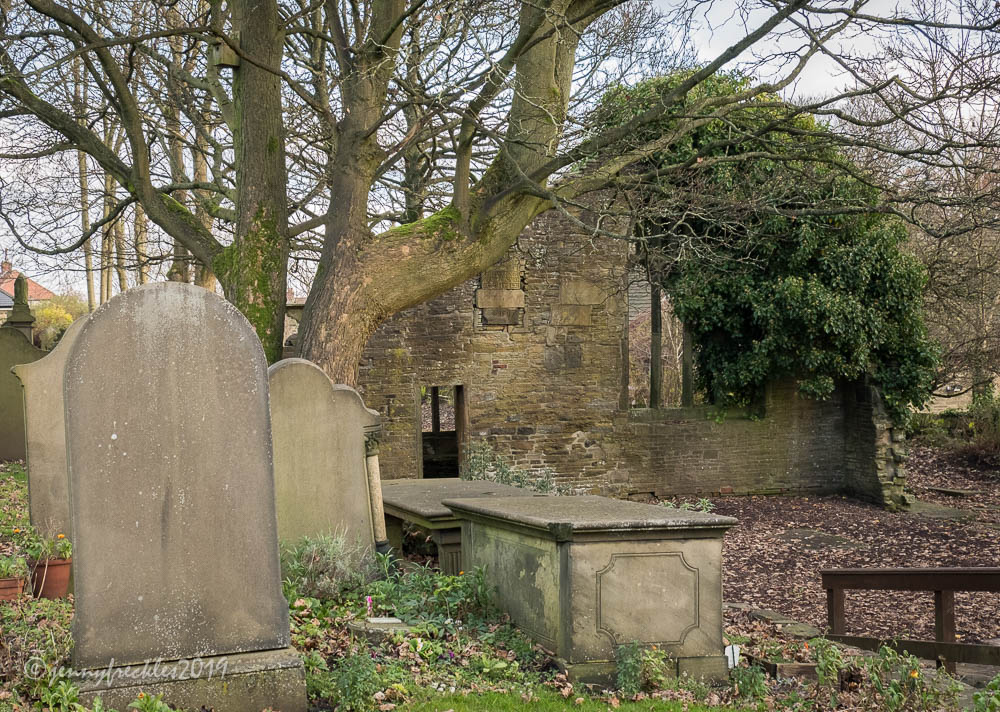
Across the road is the Bell Chapel, which has Brontë connections. Charlotte Brontë and her sisters were born in Thornton and baptised in the Bell Chapel, where their father Patrick was minister for five years from 1815-1820, before they moved to Haworth. The chapel is now ruined. I thought you could explore it, but it was roped off so I assume it is considered dangerous. The octagonal bell tower, covered in ivy, looks like a romantic folly and the surviving east wall, with the tracery of a window and a date stone showing 1612 is also being overgrown by ivy. The late medieval chapel was rebuilt in 1612 and again in 1818 when Patrick Brontë was in charge. It's a pity it is now in a poor state again, as I know that a few years ago a group of volunteers did a lot of work to restore it and make it safe for visitors.


Tuesday, 10 December 2019

Christmas is coming


Christmas is coming! Everywhere is starting to sparkle, with lights in our towns, lots of festivals and markets. I must admit I can get a bit 'Bah, humbug' about it on occasion, when I focus on how consumerist it has become. I do, however, try to get into the spirit of it, so when friends suggested we visited a Christmas Tree Festival, I decided to go with them. It was held in the church of St James, Thornton. There were 49 trees, each one decorated by a local group, organisation or charity. Each had a donation bucket for the relevant cause, so it is a way of raising money for good - a worthy aim at this season.


It proved to be quite tricky to photograph but I did my best, so here is a selection of shots to give a flavour of some of the innovative themes.


I couldn't decide whether I liked the football club gingerbread men best or the rather cute little cricketers, representing Thornton Cricket Club.

Sunday, 25 March 2012

Light and shadow


(Hover mouse over image for the black and white version)

Because I'm me, when I download a day's worth of photos from one of my photographic explorations, I generally have a couple of attempts at more 'arty' shots, alongside the plethora of general record and landscape pictures.  I try to keep my eyes open for patterns and textures. This is Thornton Viaduct again.  I noticed in the strong, low sunlight that there were good patterns of light and shadow.  Then I couldn't decide if it looked best in black and white or if I preferred the colour.  See what you think.

This is the final day of the Thornton Challenge photographic experiment in which Alan Burnett and I agreed to explore the same village at different times and from our own perspective and then share what we each 'saw'.  For Alan's eye view, please go to his blog NEWS FROM NOWHERE.

I've had a lot of fun exploring Thornton, taking photos, writing the posts and, of course, seeing what Alan came up with too.  I hope you've enjoyed it as much as we have.  I think it proves the original hypothesis. (See here). Certainly in this series I think you can read, 'between the lines', quite a lot about the photographers as well as about Thornton.  I approached it like some kind of enthusiastic tour guide, picking out the highlights, bombarding you with historical titbits and determined to make you overlook the fact that your hotel is right next to a building site.  Alan, on the other hand, approached the assignment like a seasoned reporter, homing in on the underlying essence of the place and, with a journalist's flair for words, neatly summing up a world of truth in each pithy phrase.  Perhaps you need both of us really, to get a balanced picture.  The good news is that both of us will continue, in our own blogs, to explore our lovely home county of Yorkshire and we hope you'll continue on the journey with us.  Thanks Alan, and thanks to everyone who read and commented, for sharing this with us.  I've made some new friends and that's lovely. Maybe we should do it again sometime?

Saturday, 24 March 2012

Quaint


A quaint row of old houses on Alderscholes Lane in Thornton, typical of the area with their solid stone walls and slate roofs.  I'm not very good at dating property but I imagine these were built in the mid 1800s, making them similar in age to the early parts of Saltaire.  When built they didn't have bathrooms. Just across the lane there are what were originally stone 'privvies' - draining directly into the little beck (stream) that runs through the valley.  I imagine facilities are rather better now!  The railway viaduct beyond was built in 1873.  It must have been quite a sight to see steam trains chuffing along overhead.

This is the Thornton Challenge - in which Alan Burnett and I agreed to explore the same village at different times and from our own perspective and then share what we each 'saw'.  For Alan's eye view, over the past few days, please go to his blog NEWS FROM NOWHERE. Though today he's taking a break to post his usual 'Sepia Saturday' entry - and that's well worth a look too.

Friday, 23 March 2012

City meets country in a village


Thornton is part of the City of Bradford Metropolitan area but is situated right on the edge, where countryside meets suburbia.  Consequently it only takes minutes to access green space with a more rural feel, where old cottages are clustered into tiny hamlets and you can glimpse views of the city beyond the fields.   Thornton Viaduct is a notable feature, its 20 arches snaking across the Pinch Beck valley.  Once part of the Great Northern Railway network, it has been disused for 40 years or so.  It is now a listed structure and there are apparently plans to open it to walkers and cyclists as part of the Great Northern Railway Trail. (The little pointy bit apparently on the viaduct is actually the tip of Thornton St James' church spire!)

This is the Thornton Challenge, Day Five - in which Alan Burnett and I agreed to explore the same village at different times and from our own perspective and then share what we each 'saw'.  For Alan's eye view, please go to his blog NEWS FROM NOWHERE.

Thursday, 22 March 2012

South Square, Thornton


The other 'must visit' place in Thornton (as well as the Brontë birthplace) is South Square, a visual arts resource centre and gallery.  It is the base for a coalition of artists and also holds meeting rooms, a print workshop and studio space, a craft shop and a very good vegetarian café. (I had the cheesy potato wedges with tomato salsa: tasty, filling and warming on a chilly day.)

The centre is housed in 19th century millworkers' cottages, which are now Grade II listed buildings.  It's a good place to wander round, quite quirky really... in parts of it you almost feel as though you're walking through someone's home that just happens to have artworks on the walls.  It has lots of entrances through the various cottage doors rather than one main entrance, and then all the rooms run into one another, so you are not quite sure if you've seen all of it or not!

The nature of the space allows several different artists to show at the same time so there is a wide variety of styles and types of work - including some photographs of Bradford's mills by Gemma Doyle, when I visited.  One of her photographs was shockingly similar to my own 'Saltaire's New Mill at night' - gave me a bit of a turn! - but it's such an oft-photographed scene and doesn't change much from day to day so I suppose there are probably quite a few similar images out there!

This is the Thornton Challenge, Day Four - in which Alan Burnett and I agreed to explore the same village at different times and from our own perspective and then share what we each 'saw'.  For Alan's eye view, please go to his blog NEWS FROM NOWHERE.

Wednesday, 21 March 2012

Ginnels and alleys


I really enjoy 'being a tourist' in my own area, exploring with my camera and getting the feel of a place.  Although I lived on the Thornton side of Bradford for a few years, Thornton village is somewhere that I have only ever driven through on the main road.  So it was fun to have a good old poke around.  I ended up with mixed feelings about the place.  It has a lot of history.  Some of the buildings are clearly very old and you can see, with close observation, how newer ones sprang up and gradually filled in the spaces (and continue to do so).  


This photo shows quite clearly how an old (18th century?) stone-mullioned window and a doorway are now almost buried beneath the road surface, which must have been laid much later, but is itself probably mid-19th century.

One of my main impressions was of how this ad-hoc development has left the village with no real centre and with a maze of little winding alleys (ginnels, in local terminology) and streets.  You can quickly get lost!  It's quite a contrast to the carefully planned layout of Saltaire, though many of the buildings date from around the same time.  In general it isn't a wealthy area and it has to be said that some of it would look better for a bit of sprucing up.  Somehow in these cool northern climes, decay looks simply grimy and (to me anyway) lacks the charm of those narrow old streets you find in, for example, Mediterranean areas.  (See here for one that Malyss recently featured.)  Or maybe I'm just not enough of a 'tourist' in my own patch.

This is the Thornton Challenge, Day Three - in which Alan Burnett and I agreed to explore the same village at different times and from our own perspective and then share what we each 'saw'.  For Alan's eye view, please go to his blog NEWS FROM NOWHERE.

Tuesday, 20 March 2012

The Brontë birthplace, Thornton


My usual start point in a place I haven't visited before is its history.  Thornton's main claim to fame is its Brontë family connection.  Four members of the literary family were born here at 72-74 Market Street.

In 1815 Reverend Patrick Brontë, father of the writers Charlotte, Emily and Anne, moved into this house (built in 1802 and at that time the parsonage) with his wife Maria and their older daughters Maria and Elizabeth.  In those days Thornton was little more than a hamlet; in 1800 it had only 23 dwellings (and three of those were pubs!)  The Brontës stayed for five years and then moved  to Haworth, and it is Haworth's parsonage that has the more famous association, as it is now a museum.

In the mid-1800s Thornton started to grow, as the local handloom weaving trade gave way to textile mills.  Stone quarrying and the mining of coal and fireclay were also important industries.  Growth demanded more local services.  The Thornton house was altered in 1898 when the front extension was built and it was then used as a butcher's shop.  It has also been a restaurant. The house was restored in the 1990s by the crime novelist Barbara Whitehead, and was opened to the public, but it is now a private residence.

For those of a curious mind, the Haworth Village website has pictures of the interior - see here.

This is the Thornton Challenge, Day Two - in which Alan Burnett and I agreed to explore the same village at different times and from our own perspective and then share what we each 'saw'.  For Alan's eye view, please go to his blog NEWS FROM NOWHERE.

Monday, 19 March 2012

Who'd have thought it...?


Some time ago, I happened to write on this blog:  "It's interesting, isn't it, how we all 'see' different things?  Take any two photographers and put them in the same place at the same time and, the chances are, each will interpret the scene quite differently.  I think that's half the fun of blogging, to see what others see through different eyes from our own."  My dear blog-friend, Alan Burnett, who lives not so far from here, responded promptly in the comments: "OK here is a challenge for you. Let us pick, at random, some village which is within a given radius of Saltaire/ Brighouse: both make our way there independently and record what it says photographically to us. We co-ordinate the subsequent post and test out your theory."  Well, I couldn't resist that, could I? - so we agreed to carry out the experiment, visiting a village called Thornton (on the edge of the city of Bradford) which is more or less equidistant between us.

Many moons passed... and a premature baby in my family and various commitments for Alan meant that it has taken us some while to achieve the assignment.... but, finally, we haveOver the next few days I will post some photos of what caught my eye.  (All were taken on February 19th).  Alan has agreed to do the same on his blog - go to NEWS FROM NOWHERE to see his side of the bargain. We visited separately and neither of us knows yet how the other approached the challenge.  It must be stressed that it's not a competition, more of an experiment.  I am looking forward to seeing the results and, indeed, to testing out my theory.

For starters, the above photo (self -portrait!) was taken in a tiny little park that does its best to be the centre of a village that really rather lacks a focal point.  It suggests that Thornton is perhaps rather a surprising place - and, in many ways, I would agree.  See what you think....