I HAVE CLOSED DOWN THIS BLOG. Please click the photo above to be REDIRECTED TO MY NEW (continuation) BLOG.
Showing posts with label Wharfedale. Show all posts

Monday, 2 March 2020

Wharfedale views


Upper Wharfedale is the Yorkshire dale I am most familiar with and I love the sweeping views once you climb up the valley side. One afternoon I walked from Scargill House to Conistone Pie (not a pie! Just an outcrop of rocks.) Part of the path follows the Dalesway long distance trail. The stormy weather made for some fabulous and quickly changing cloudscapes. It was very windy, with a high chill factor, but I only got hailed on once.


Hardy Yorkshire sheep and dry stone walls are a feature of the valley. The sheep often seem as curious about us as we are about them.


Sunday, 1 March 2020

Kettlewell St Mary's


The Anglican Parish Church of St Mary's in Kettlewell is a favourite of mine. Modestly sized and well-kept, it sits attractively on the edge of the village, in a large churchyard that is managed for wildlife and wildflowers. The tower is Georgian but the church itself is Victorian, a replacement for a previous building that was found unsafe and demolished.

You arrive up a little lane to a lychgate, a covered gateway. Lychgates were traditionally where coffins (or shrouded bodies) were laid to await the funeral. (See HERE for more info). This one only dates back to 1921, although I suppose there may have been an older structure.

The church interior is relatively light and bright. It has some lovely stained glass. (You know I adore stained glass!) Some of the themes are rather sombre, since several of the windows are memorials to military personnel, including two sons of the Holdsworth family. (The Holdsworths originally owned Scargill House, my accommodation for the week). I featured the East Window on my blog HERE.


Saturday, 29 February 2020

A Dales village in winter


I had a mooch around Kettlewell in the rain and hail. The Dales villages have a very different character in winter than in summer. There are few, if any, tourists (though the conference and retreat centre at Scargill House does bring visitors to Kettlewell). There isn't the summer buzz but the quiet has its own charm.

Kettlewell still has a traditional red telephone box (probably quite necessary, as cellphone coverage is very patchy) and it adds a touch of brightness to the centre of the village. The photos above and below show the views along Kettlewell Beck, up and down stream, as it flows down to join the River Wharfe.


At the top of the village, the old maypole sits in a little garden and the road leads up to St Mary's church, which is set back on the right.


Kettlewell Beck was fast-flowing but not overfull or doing anything nasty.


It was dull enough to take a few slow-shutter speed photos of the churning water, even without a filter.


Friday, 28 February 2020

Bench with a view


Scargill House (where I was staying on my break) sits in a small estate: a series of limestone terraces, mostly wooded, climbing up the hillside behind. There are traces of a couple of very old, ruined stone dwellings up there, believed to be post-Roman, possibly shepherds' huts or small cottages, evidence that the valley has been inhabited and farmed for centuries. Scargill House itself dates from the 18th century. It was originally a gentleman's residence used for hunting and fishing.

In the late 1950s, it was sold to the Church of England and became a Christian community, run as a conference centre and retreat house. In 2008 that venture folded and the house was put up for sale again. Under the leadership of a close friend of mine, a new charitable trust, the Scargill Movement, was formed and the property was bought and has since been revitalised, initially by a team of dedicated volunteers and eventually developed into a residential Christian community. Like Lee Abbey in Devon (where I have also stayed several times) many in the community are young people from many different countries, who volunteer for a year or two. It is a wonderful place to stay, to study, to rest and recharge, with rather a wonderful story behind it too.

The views from the corner of the estate, looking over Kettlewell village, are stunning. If it hadn't been so cold, I could have sat on that bench for hours!


Thursday, 27 February 2020

Wintry scenes


I thought when I booked it many months ago that it was either mad or inspired to take a break in mid-February in Kettlewell, up in the Dales. In the end it turned out to be a bit of both. I was staying at Scargill House on a Christian study break, which proved to be a wonderful and thought-provoking experience. The house itself is welcoming, comfortable and cosy. Some of the lounges have huge windows, from which you can watch, in comfort, the weather as it sweeps down the dale.

I took these photos within a minute or so of each other, looking from the main house down the drive. Sandwiched between the weekend storms Ciara and Dennis, the skies were unpredictable and dramatic, jumping from calm to gusty, with bursts of excoriating hail (and snow on the tops) and the occasional breath-taking shaft of sunlight slicing through. Great weather for photos and I did manage a few lovely - if muddy - walks.

Friday, 7 February 2020

Do not cross


The stepping stones across the River Wharfe at Burley were barely discernible. Last summer I watched people skipping happily across (see HERE) and you could walk back along the river bank almost up to the weir. Now the river is thundering over the weir and filling the whole width of its channel. The river level can, apparently, rise up very quickly here, so I was careful. There wasn't really anywhere to stand to look back upriver and I couldn't haul myself up high enough to look over the wall so I didn't manage a photo of the weir this time. The resident heron flew away too, before I managed to snap him!

Tuesday, 7 January 2020

Linton Falls


Just upstream from where it curls around Linton churchyard, the River Wharfe thunders over Linton falls. I've posted photos from here before. It is a popular spot, a short and pleasant walk from Grassington village centre. In winter it can be a fairly bleak, dark, colourless scene but the roar of the water adds drama, so that it is worth visiting in any season.

There are two weirs. You can just see the upper weir in the background of the photo above. The weirs built up a head of water to power Linton Mill, originally a medieval corn mill and, from 1788, a worsted and cotton mill, which was sited alongside the lower weir. The mill went out of business in the 1950s and was demolished in the 1980s, after which housing was built on the site (see third photo).

The upper weir is harnessed for hydro-electricity. The original hydro plant opened in 1909 to power the nearby village of Grassington. In 1948, when the National Grid took over, it became redundant and closed. The plant was reopened in 2012, using the original building and fitted with two screw turbines.

Below the weirs, the river is constricted by limestone outcrops and, particularly after rain, it sweeps down in a dramatic cascade. The bridge across the river is known as the Tin Bridge and was originally constructed so that mill workers could get to work from the village. The current wooden footbridge was built in 1989.


Monday, 6 January 2020

New Year's Eve excursion


I went out with some friends on New Year's Eve, for a gentle ramble around Grassington. We stopped at the church of St Michael and All Angels in Linton, a long name for quite a compact church! It nestles very attractively in the Wharfe valley, where a bend in the river cradles the church and its graveyard in a kind of a hug. The church has Norman origins, as the two rounded arches (above on the left) inside suggest, but was rebuilt in Victorian times (1861).


It's not very fancy inside, but has a few interesting features including some attractive stained glass windows:


It also holds this royal coat of arms from George III's reign. After the reformation, Henry VIII wanted to assert his authority over the Church and royal coats of arms began to be displayed, to remind congregations of the link between church and state. When King Charles II was restored to the English throne in 1660, ending Oliver Cromwell's 'Commonwealth' period, it became accepted practice for churches to display them. This ceased in Victorian times and this particular board was, I gather hidden away in the back of a cupboard until it was rediscovered.


The roof of the church has some interesting carved bosses, two of which are of 'green men' with foliage spewing from their mouths. Originally a pagan image, green men are found in many of our churches and cathedrals. 


Some of the furniture has more recent symbolism: a characteristic mouse carving, that shows it was made by 'the Mouseman of Kilburn', Robert Thompson - a renowned ecclesiastical furniture maker from North Yorkshire, who 'signed' all of his pieces in this way.

Saturday, 30 November 2019

Leathley


On my regular jaunts to RHS Gardens at Harlow Carr, I drive through a pretty little village called Leathley, near Otley. I always think I'll stop and explore... and I never do. Well, one day in early November I did, because the sun was shining and bringing out all its beauty. I used my phone to take a picture of the church and the sun promptly disappeared behind a cloud - and then the rain started! So I didn't get far in my exploration.

The building that catches my eye when I drive through is the row of almshouses (above) which have a beautiful view across the Wharfe valley. I've found online a conservation area study, which tells about the history of the area. This has aways been predominantly an agricultural area. It has various links over the years to nearby Farnley Hall (see HERE). The almshouses date back to 1769, when a school house (the two-storey bit in the middle) and four almshouses were built in memory of Henry Hitch, the lord of the manor, to care for the poor of the parish and to educate the children.

The church of St Oswald sits proudly on a hillock. It originally dates back to the 1100s with additions in the 1470s and Victorian renovations. The beautiful carved cross is a war memorial.

(Note to self: make sure you take a proper walk in this area next Spring! There seems to be lots more to discover.)


Saturday, 5 October 2019

Almscliffe Crag


Almscliffe Crag lies some 14 miles from Saltaire, between Leeds and Harrogate, overlooking the Wharfe valley. It is a prominent outcrop of millstone grit, visible for miles around. I've often seen it, and never ventured up there until recently. Once you get to the top of the hill, the views are stunning - across the Vale of York in one direction and over to Otley Chevin in the other. It's a popular spot for rock climbers and film makers. There were several of the former there when I visited, but the only film makers were me and my friends.

The evening light was beautiful, picking out landmarks like the railway viaduct that carries the Harrogate line over the River Wharfe at Arthington.  You may also be able to see, in the picture below, the communication masts at Leeds-Bradford Airport, on the horizon.

(I stand corrected... the masts are TV masts, at Holt Park and the one in the very background is Emley Moor, which is about 30 miles away! Very deceptive. Thanks to my friend for clarifying this.)


Thursday, 3 October 2019

Parcevall's gardens in late summer


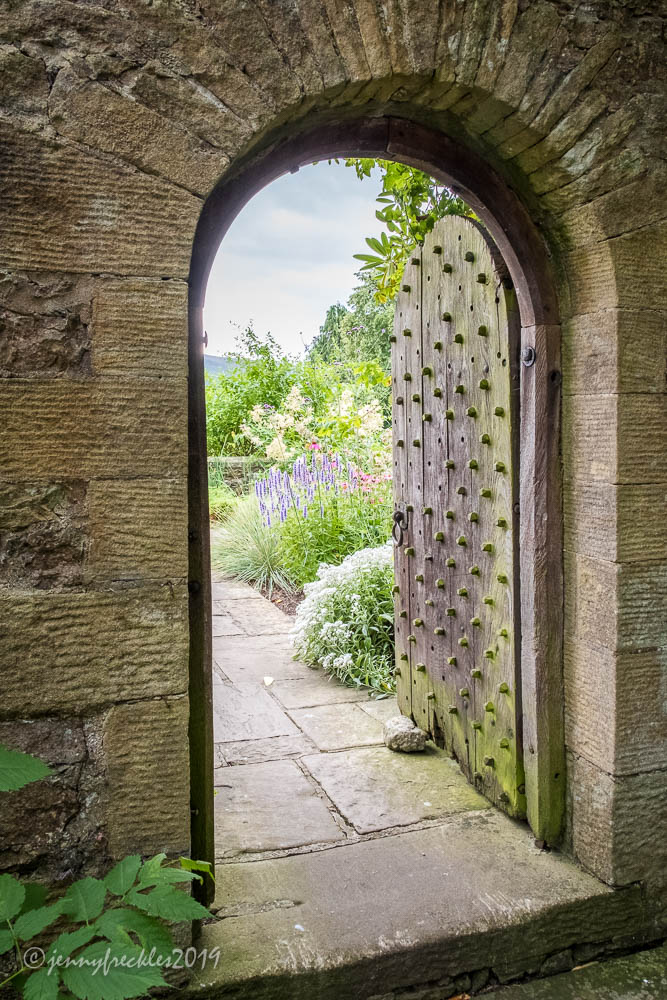
Come with me through the arched doorway and explore the beautiful gardens at Parcevall Hall.


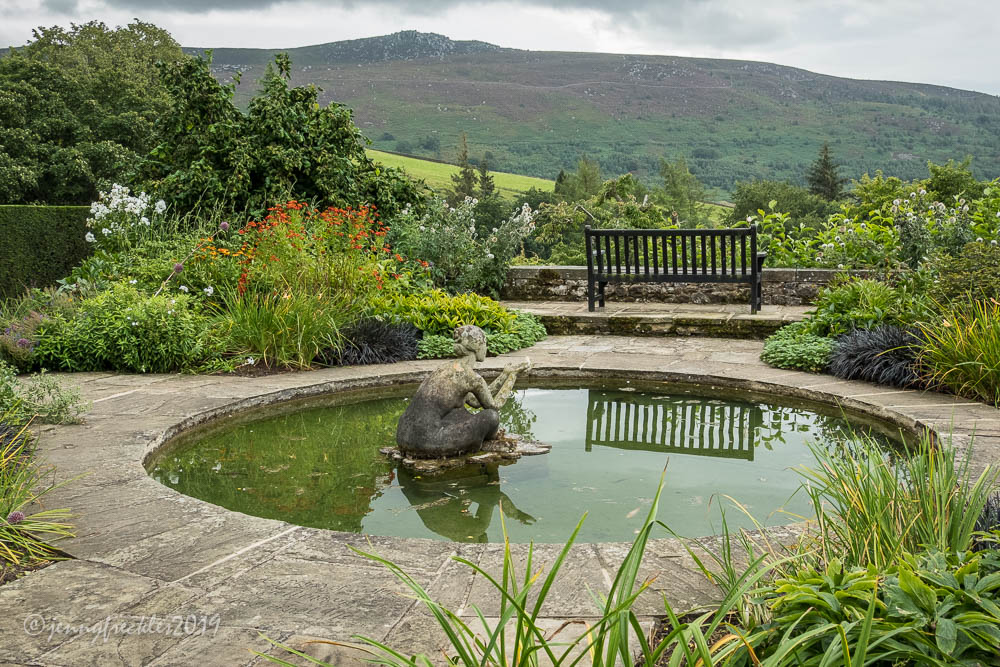
There are a series of terraces at the front of the house, with a focal point of a round pond and a statue of a seated lady. Here too there are many seats and stone shelters, ideal places to settle down out of the wind and enjoy the wonderful views of the surrounding fells. 


Behind the house there are walled gardens, and a rock garden that extends up the hillside around a stream that cascades down into a pool. Below and to the side of the house is a large area of mixed woodland, containing a lake, and to the other side are orchards and a camellia walk. There's something of interest to see in most seasons, though when I went the herbaceous planting was a little past its best.


I wasn't sure what the tree above was. It had pretty cup-shaped white flowers. The guide book tells me it is an evergreen Eucryphia x nymansensis 'Nymansay' - but honestly I'm none the wiser! The garden has, I think, some unusual plants. I don't know the red one below, with maroon leaves, but it may be a Lobelia Cardinalis, which appears to be a N American plant.


Those below are easier: red nasturtiums, though I don't know the blue one.


The purple ones are a kind of autumn crocus.


The red-hot pokers looked good against the purple leaves (?) and on a south-facing wall I even spotted a grape vine, which is certainly not what I'd expect to find in this kind of upland area.


Lovely silver birch bark in the woodland, so metallic shiny that it might actually have been crafted from silver:


Wednesday, 2 October 2019

Parcevall Hall


Parcevall Hall lies just over the hill from Trollers Gill (see yesterday). It has an interesting history. It was originally a farmhouse, owned by nearby Bolton Priory. After the Dissolution of the Monasteries by Henry VIII in 1539, monastic assets were seized and the property passed into private ownership. During the 17th and 18th centuries it was owned by yeoman farmers, and one of them, Christopher Lowson, made some additions to the farmhouse. These and the oldest (pre-1600) parts of the house are in the photo above. Later in the 18th and 19th centuries, agriculture took a downturn and the house appears to have deteriorated until the 1920s, when it was bought by William Milner. He set about transforming Parcevall into a fine gentleman's residence and a comfortable home. He added a substantial wing, seen in the picture below, in the fashionable Arts and Crafts style.  


He also created a garden, remarkably, given that the surrounding land is largely treeless, high, limestone moorland. He planted trees all around the estate and created a series of substantial terraces, almost like extra rooms to the house. This blurs the boundary between house and garden, and then the severity of the stone is softened with planting. After his death the gardens deteriorated but have been nursed back to health over the last twenty years by a dedicated team of gardeners. The Hall is now used by the Anglican Diocese of Leeds as a retreat house. It's such a beautifully peaceful place to spend time.


The house and terraces face south and have wonderful views across to the hill known as Simon's Seat.