I HAVE CLOSED DOWN THIS BLOG. Please click the photo above to be REDIRECTED TO MY NEW (continuation) BLOG.
Showing posts with label Liverpool. Show all posts

Friday, 16 March 2018

Warriors all


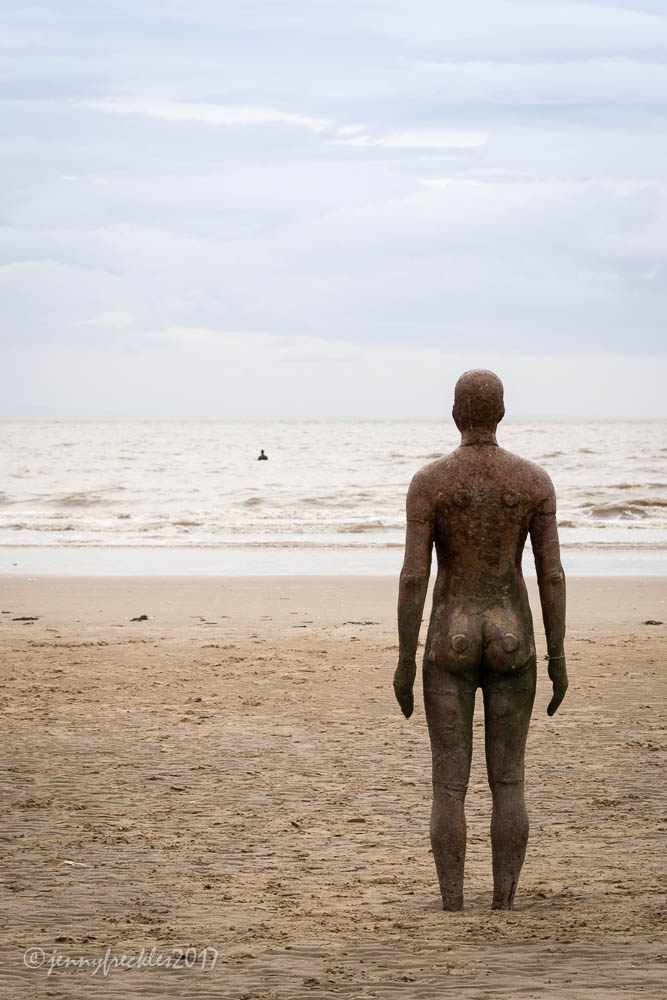
Although I took lots of photographs of Anthony Gormley's art installation 'Another Place' on Crosby beach when I first visited last year (see HERE), I could not resist a few more shots this time. The iron men look so different in different lighting conditions and according to the height of the tide. They are also being corroded by the sea as time goes on. Some of them are now tilted at drunken angles, as they have been shifted by the currents.

It was somewhat poignant to have seen China's Terracotta Warriors and the Iron Men in the same visit. They were conceived for very different purposes, over 2000 years apart and at different ends of the earth, and yet perhaps there are invisible threads connecting them.


'Courage, above all things, is the first quality of a warrior.'    Carl von Clausewitz

Thursday, 15 March 2018

Seaside shadows


A couple of shadow pattern pictures that I spotted whilst out in the sunshine by Crosby beach, near Liverpool.


Wednesday, 14 March 2018

Beside the seaside


I stayed once again with some friends near Liverpool, in a house that overlooks Crosby beach. We had a lovely beach walk, in the sunshine, though there was a biting wind. It's a refreshing novelty to have so much sky and light. Living in a valley, I'm used to the horizon being quite high up. You might just be able to see, in my photo, one of Anthony Gormley's Iron Men (see here) as well as the wind turbines out in the Mersey channel.

Tuesday, 13 March 2018

62 Falkner Street


Recently on TV (BBC2) there was a wonderful programme called: 'A House through Time', presented by David Olusoga. It traced the history of a house in Liverpool: No 62 (formerly 58) Falkner Street, and the stories of its inhabitants from when it was built in the 1840s right through to the present day. Of course, I went to find the house.

Built as a home for a well-to-do merchant, when Liverpool was a great trading port for the British Empire, the presenter traced its owners and tenants and told their fascinating stories. There was a customs clerk with a taste for fine furniture and a lavish lifestyle, who went bankrupt; a young couple who rose from being servants, through hard work and clever financial deals, to having great wealth. There was a cotton broker who made a fortune from the slave trade, ended up in a debtors' prison and then fled to America, abandoning his family to the workhouse. Then it became a boarding house and there were many tenants, as the house and area (and Liverpool) suffered in the Great Depression. The series uncovered divorce, family violence, honourable people and ne'er-do-wells. The house was almost flattened by a bomb in Liverpool's Blitz during WWII and then almost demolished in the 1970s. Saved by an enterprising group of local activists, the house was converted into a home where creative people lived: a successful playwright and a young, gay restaurateur who died of AIDS/HIV in the 1980s.  Nowadays it is a single dwelling once again, home to a middle-class family, as the area has been cleaned up and gentrified. The research involved was amazing and I found it a most educational and enjoyable programme, a very painless way of learning history.

I hope they do another series about another house somewhere. If you get chance to watch the series, do. I'm sure it will be repeated sometime.

Monday, 12 March 2018

Liverpool doors


There is often something appealing about doors (and windows) and I like taking photos of them. Maybe it's wondering what lies inside or the fact that, although they all serve the same purpose, there are so many different designs. Even among those ostensibly similar, each one is unique. There are some grand old houses in Liverpool with grand old doors on them. Here are a few.


The door above belongs to The Hardmans' House, a property now owned by the National Trust. It is a Georgian house that was the home and studio of a 1950s society photographer. I'd have liked to visit but it was closed for the winter and anyway, as it's so small, one has to book ahead. 

For some reason, I'm particularly fond of yellow doors. I was going to paint my front door yellow at one time - until my mother told me the colour attracts flies and that put me off that idea!


Sunday, 11 March 2018

Art in the Cathedral


Like most of our cathedrals, Liverpool holds some interesting art and sculpture and continues to invest in modern pieces. I very much liked the installation above. It honours former Bishop of Liverpool (and professional cricketer), David Sheppard (whom I mentioned yesterday), and bears the text from Jeremiah 29:7: 'Seek the welfare of the city where I have sent you... and pray to the Lord on its behalf.' I've included the full description below, with apologies to those reading on phones! (Incidentally, the former Dean, Justin Welby, is now our Archbishop of Canterbury.)


The towering west 'Benedicite' window is stained glass designed by Carl Edwards. It has underneath it a pink neon sign that reads: 'I Felt You And I Knew You Loved Me.' That is a work called 'For You', by the artist Tracey Emin, first displayed in 2008 when Liverpool was the European Capital of Culture and now a permanent installation. 


On the exterior, above the West Door, is 'The Welcoming Christ', a huge bronze by Dame Elisabeth Frink, installed in 1993 and one of her last completed works.

Saturday, 10 March 2018

Liverpool Cathedral


In complete contrast to the bright, light, Roman Catholic cathedral, Liverpool's Anglican cathedral is a huge, solid, sandstone edifice, the largest religious building in Britain. It was designed by Giles Gilbert Scott (grandson of Sir George Gilbert Scott, the man behind many famous structures in London such as the Albert Memorial) and constructed between 1904 and 1978, progress made slow because of the impact of two World Wars on supplies and manpower and the heavy bombing of Liverpool in WWII, which damaged what had been built.

Inside it is dark, majestic and cavernous, with soaring windows, arches and pillars and a gothic influence. It is by no means my favourite cathedral in style but it has the capacity to inspire awe. David Sheppard, who was its Bishop from 1975 to 1997, worked tirelessly, along with the RC Archbishop, Derek Worlock, on issues of poverty and social reform and made a huge and lasting difference to the city of Liverpool. The two cathedrals stand tall on the skyline, at opposite ends of the (aptly named) Hope Street, almost giving the feel of guarding the city.

Friday, 9 March 2018

Modern stained glass


Liverpool Metropolitan Cathedral holds some wonderful stained glass, designed by the celebrated artists John Piper and Patrick Reyntiens (who also worked together on glass for Coventry Cathedral). The central circular lantern above the altar is particularly breathtaking, designed in three colours: red, blue and yellow, to represent the Trinity.

There are many panels of stained glass between the side chapels and within them too.

Traditional or modern, stained glass always appeals to me. The light patterns made when the sun shines through are sublime. Not much of that on the day I visited though. It was snowing, on and off, outside!

There are also some stained glass (or resin) panels outside the cathedral, lending some colour to the predominantly white concrete and Portland stone building.

Thursday, 8 March 2018

Liverpool Metropolitan Cathedral


Liverpool's modernist Roman Catholic Cathedral, the Metropolitan Cathedral of Christ the King, is affectionately known as 'Paddy's Wigwam' as it looks very much like a great 'tent of meeting'. It was designed by Sir Frederick Gibberd and constructed in the mid 1960s. The idea for a great cathedral to serve the large Irish Catholic population of Liverpool had been conceived in Victorian times and various plans were drawn up, some work even started, but each time finance became problematic and the plans were shelved. A design by Sir Edwin Lutyens for a huge building was terminated with only the crypt built, and this modern design sits on top of that crypt. This building itself has suffered from severe structural problems, so much so that the architect was sued. Nevertheless, to look at, if not to maintain, it is pretty awesome both without and within. 

The circular design has the great altar in the centre, under a baldachin like a crown, and there are small side chapels all around the perimeter, each different and boasting some beautiful modern art, stained glass and textiles. 


Wednesday, 7 March 2018

Treasures of China


Here are some more of the artefacts that particularly caught my eye, displayed in the Terracotta Warrior exhibition. The figure above was (as far as I could see) the only depiction of a woman in the whole exhibition.  She and the figure of an infantryman below are from another tomb site, that of a general from the Han Dynasty (China's second Imperial dynasty, 206 BC to 220 AD ). They're about 12 inches high, not life-sized like the Qin figures, but they are exquisite.


The stunning jade disc, below, is also from the Han Dynasty. Its circular shape represents heaven and it is decorated with dragons. Discs like these adorned the coffins of high-ranking individuals, allowing the spirit of the deceased to travel in and out. 


Finally, a beautiful Qin bronze goose (life-sized) from the First Emperor's burial site. It is one of 46 birds discovered alongside 15 terracotta musicians in a pit, thought to represent an imperial garden for the enjoyment of the Emperor in the afterlife.


The Exhibition continues at the World Museum in Liverpool until 28 October 2018 and tickets are on sale online. Well worth a visit, if you can make it. 

Tuesday, 6 March 2018

The Terracotta Army


These are some of the other Terracotta Warriors from the burial site of China's First Emperor, Qin Shi Huang. They were handmade by craftsmen, from thick coils of clay, with sculptural detailing added by hand. The life-sized figures were then fired in huge kilns, before being painted. (The paint pigment has mostly weathered away, only traces remain.) Each figure is unique in their facial features and styling. They represent different ranks: infantrymen, archers, generals, cavalrymen, charioteers. They were arranged in military formation in the tomb and originally held real bronze weapons.


Monday, 5 March 2018

China's Terracotta Warriors


The main purpose of my recent visit to Liverpool was to see the exhibition of China's Terracotta Warriors, at the World Museum. I'm sure most people have heard of these incredible treasures, first discovered by chance in 1974 when a farmer, Yang Zhifa, discovered pottery fragments when digging a well in Xi'an. For over 2200 years, the figures have secretly guarded the tomb of China's First Emperor, Qin Shi Huang. There were no historical records pointing to them, so their discovery was a complete surprise and the scale of the find is astonishing: more than 2000 warriors and horses, each unique, have been excavated, with another 6000 estimated still to be buried. The burial site covers 56 square kilometres and was intended to provide the Emperor with everything he needed in the afterlife - palaces, an army for protection, horses, chariots, food and entertainment (terracotta musicians and acrobats have been uncovered - and some of the Emperor's concubines were slaughtered and buried with him). 

The jury is out as to whether Qin Shi Huang was a far-sighted and innovative ruler or a brutal tyrant. He followed a philosophy of Legalism, bringing in standardisation, rules and laws and appointing officials on merit rather than hereditary right. He united China after many years of war by defeating the various other warring tribes. He built the original defensive wall along the Northern border that eventually became the Great Wall of China. He is viewed by some to have exhibited tyrannical eccentricities and extreme paranoia. (Remind you of anyone?....)

There are ten life-sized figures from the Qin dynasty (221-206BC) in the display, along with 180 other objects, including jewellery, weapons, armour and other artefacts, covering 1000 years of Chinese history. 


This figure is a terracotta horse-keeper, one of eleven found in an area of the First Emperor's Mausoleum believed to represent the royal stables. They were found with coffins containing the remains of real horses, ritually slaughtered.

The cavalry horse is one of the terracotta army protecting the First Emperor. Cavalry was lighter and faster than horse-drawn chariots in battle and was an important military force in the Qin Dynasty.


The figure below was perhaps my favourite, touching in its simplicity. It is a terracotta kneeling figure of a stable boy, buried alongside the dead horses' remains, together with pottery basins and hay, presumably to care for the horses in their afterlife. 


Sunday, 4 March 2018

Neo-classical gems


So... where have I been? Anyone recognise this famous city?


Another clue.


Yes, it's Liverpool. This magnificent collection of buildings, in the neo-classical style, is known as Liverpool's 'cultural quarter', the William Brown Street conservation area. It is one of six locations in the city that together make up Liverpool's UNESCO-designated World Heritage Site. The top photo shows the Walker Art Gallery, affectionately known as 'the National Gallery of the North' for the quality of the works it holds and because it is part of the National Museums Group, rather than being a locally administered gallery. The beautiful rotunda is part of the Liverpool Central Library. The bottom image shows part of the World Museum - which was my destination. The area also holds St George's Hall, Liverpool Lime Street (rail) station and the Great North Western Hotel, all equally elaborate structures that originally date back to the 1850s to 1870s, though with many alterations and refurbishments since then.

Wednesday, 15 November 2017

The old and the new


Liverpool trip 
A final selection of photos of Liverpool, showing the way history has been preserved, particularly around the docks, by a visionary usage of the older buildings alongside eye-catching new developments. It really is an exciting and vibrant city.


This is the Albert Dock, opened in 1846. At that time it was a revolutionary development, where ships were unloaded directly into secure warehouses built of brick, stone and cast iron with no combustible wood. Now it's a major tourist draw and the largest collection of Grade I listed buildings in the UK.  It has been transformed into offices, shops, galleries (including the Liverpool branch  of The Tate), two hotels and many bars, cafés and restaurants.


There are a couple of 'tall ships' permanently displayed in Canning Dock. One, Kathleen and May is the only remaining three masted topsail schooner of her type in the world. I'm not sure of the name of the one in my photo but it's a beautiful ship.


The Port of Liverpool building's domes contrast sharply with one of the newest additions to the Liverpool waterfront, the Mann Island buildings. Opinion is wildly divided as to whether these statement glass edifices add to or detract from the area. Me... I liked the reflections in them!

Tuesday, 14 November 2017

Remembered


Liverpool trip 
Liverpool's waterfront holds some splendid statues. I particularly liked the horse, a work by Judy Boyt, unveiled in 2010.  Entitled 'Waiting', it honours the 250 years of working horses in Liverpool. In the heyday of the docks there were many thousands of horses and their carters, hauling goods from dockside to warehouse, warehouse to railway or canal barge and often then on to wherever those goods were destined. During WWII, they ensured the flow of food and fuel through the port. Immensely strong but easy to handle, Liverpool cart horses were considered the best in the land. Of course, motorisation and then containerisation spelled the end for the traditional docks and their workers and horses. Nowadays, ships are loaded and unloaded by cranes in hours, rather than days.

I have a soft spot for working horses. One of my great grandfathers was a blacksmith and supplier of hay and straw for working horses in Sheffield.

The other statue I particularly like in Liverpool is 'Legacy' (2001) by Mark de Graffenreid. It shows a young family migrating from Liverpool to 'the new world', America.  Something like nine million people, from all over Europe, are thought to have emigrated through Liverpool, undertaking a brave and pioneering voyage to start a new life. The sculpture was given to the people of Liverpool by the Mormon church.


Monday, 13 November 2017

Museum of Liverpool


Liverpool trip 
The new award-winning Museum of Liverpool sits right beside where the Leeds- Liverpool canal terminates, in Liverpool's Pier Head. Opened in 2011, it explores Liverpool through its geography, history and culture - the port, the people and their economic, creative and sporting legacies. I only had time for a quick visit but I was fascinated to read about the docks and their development, and to see old photos and newsreel footage. The history is both good and bad; the docks were a cornerstone of the 'slave triangle', taking goods such as guns and liquor to Africa to trade for slaves, who were then shipped across the Atlantic to the West Indies and North America, the ships then returning with sugar and rum to sell in England. So much to learn about. I must go back!

Sunday, 12 November 2017

The Fab Four


Liverpool trip 
This statue, unveiled in December 2015 on Liverpool's waterfront, really needs no explanation. It is The Beatles, Liverpool's most famous export. Paul McCartney, George Harrison, Ringo Starr and John Lennon were all Liverpool born and bred and started their playing career as a band in Liverpool's Cavern Club. The statue commemorates their last public appearance in their own city on 5 December 1965 - over fifty years ago now. I must admit to being a bit horrified when I read that! I was brought up on them, the first pop group I really fixated on. Paul McCartney was my idol as a young teenager but I have come to appreciate just how talented and unique they all were. Their music lives on too. There was no shortage of tourists wanting a 'selfie' in front of the group.

Saturday, 11 November 2017

The end of it all


This photo shows the end of it all... that is, the end of what I think of as 'my' canal, the Leeds-Liverpool, which runs from Leeds through Saltaire's World Heritage Site and then across the Pennines to Liverpool. Until recently, the navigable canal ended at Stanley Dock in Liverpool. It has recently been extended by 1.4 miles so that boats can go right into the heart of the old docks, now a thriving tourist area that is part of the Liverpool Maritime Mercantile City, another UNESCO World Heritage Site. The canal terminates in front of the buildings known as The Three Graces - that is, the Royal Liver Building (Liver birds atop its domes), the Cunard Building and the Port of Liverpool Building (not shown in my photo) and passes the Mersey Ferry terminal (the modern building to the left) and the new Museum of Liverpool.

It was nice to say hello to 'my canal' at the other end of its journey.

For the next few days, I'm posting some photos I took in Liverpool earlier in the year. I've hit one of those patches where I've run out of interesting current photos so I'm going to have to trawl the archives...

Saturday, 29 April 2017

The Iron Men


I had a wonderful holiday with some friends recently, on the west coast just outside Liverpool, a surprisingly interesting and attractive area. They were puppy-sitting for some relatives, necessitating many windswept walks. I took loads of photos!

It so happens that the house we were staying in overlooks Crosby beach, which holds a huge art installation, Another Place, by Sir Anthony Gormley (who also designed The Angel of the North). It consists of 100 cast-iron figures, each weighing 650 kilos, cast from Gormley's own body. They are spread out over 2 miles along the coast and reach more than half a mile out to sea. At this location, across a shallow, sandy foreshore, the tide ebbs and flows with a huge reach, so that sometimes the figures are submerged and sometimes revealed. Some are half buried in the sand as it gets blown around, and each is different due to the gradual weathering of tides and wind. (One or two have even had clothes added, by jokers, but the ripped and trailing fabric adds its own pathos.)

Early morning puppy walks meant I could catch the beach with no-one else on it and the lonely figures staring out to sea have a melancholy, even sinister, air.  It's a little unnerving to see a still and silent figure apparently watching another figure walk under the waves. 


This was another item on my 'bucket list' to see and it is satisfying to be able to tick it off, though I'd love to go back again to see the figures in different lights and weather. It is a powerful and moving sight.