I HAVE CLOSED DOWN THIS BLOG. Please click the photo above to be REDIRECTED TO MY NEW (continuation) BLOG.
Showing posts with label museum. Show all posts

Thursday, 12 March 2020

When it's grey


You'll recall the press photo exhibition at Cartwright Hall that I visited in January (HERE). Well, there have been a couple of associated talks by press photographers and I went to hear Danny Lawson speak. He is the photographer who took that amazing photograph (HERE) of Meghan Markle, caught in a shaft of sunlight on her way up the aisle at her wedding to Prince Harry, as well as many more instantly recognisable and incredible photos that have appeared in our newspapers and magazines. It was fascinating to listen to his stories and to see some of the camera equipment he uses too. Let's just say that I couldn't have lifted most of his cameras and lenses!

Seeing such brilliant work can either make me feel a little disheartened or inspired. February was such a very wet and grey month, I started to feel a little desperate to get out and find some decent photos. Half the time I didn't want to take my 'big' camera out because of the wet. I came out of the talk and got my phone out and took a few random shots, just to satisfy my urge to 'make something'.

There were plenty of puddles in which to find reflections. I liked the way the tarmac glittered, giving the appearance of stars in the sky. Then I spotted what must be the longest bench in the world. (!) The back of Cartwright Hall has rather lovely windows - and finally I found some colour in a winter flowering heather.


Tuesday, 11 February 2020

Industrial quirks


The Calderdale Industrial Museum showcases some of the more unusual local industries. Halifax is famous for being the birthplace of the now ubiquitous 'cat's eye' reflective road studs. They were invented in 1934 by Percy Shaw, who patented the invention and set up a company to manufacture them, which is still in production. There are several stories as to how they came to be invented. Most seem to relate to the steep and precipitous road between Halifax and Queensbury, which Percy Shaw often drove along. It has a steep drop on one side and it is said that he got the idea to light it with reflective studs, having seen a cat's eyes shining in the light of his car headlamps or, possibly, from navigating through the fog by the gleam from tramlines picking out the route. He sounds to have been quite an eccentric, but in 1985 he was made OBE for his services to export.

Halifax also manufactured heavy earthenware used in sewage pipes, drainage and domestic sanitary ware. There were clay mines locally as well as coal mines, and there are exhibits in the museum related to mining, with heart-rending tales of children (boys and girls) as young as 5 or 6 spending their days crawling along narrow, filthy tunnels hauling carts full of coal, or sitting alone in the dark by the ventilation doors, to ensure a supply of air. This was stopped in 1847 by the Mines Act, after which only boys aged 10 and up could work in the mines.


Cast iron lamp-posts, taps and pipes were made in Calderdale:


Halifax also made - and still makes - confectionery. There is a factory near the railway station, originally Mackintosh's, now part of Nestlé, that produces Quality Street, After Eight Mints and other goodies. The museum has a large tin of Quality Street that appears to be falling in through the ceiling - to the delight of at least one small child that I saw there.


Monday, 10 February 2020

Industrial colour


There was plenty of wonderful colour in the threads on the weaving looms. This particular model was a moquette loom. Moquette is a thick, woven, velvety, short pile, hard wearing fabric with distinctive patterns, used traditionally for upholstery, in particular the seats on public transport: our trains, buses and London Underground trains. Holdsworth Fabrics in Halifax still make it, one of the very few manufacturers left. Wherever you are in the world, if you get on a coach, you're likely to be sitting on Holdsworth of Halifax moquette.


Sunday, 9 February 2020

Industrial monochrome


I was drawn to the details in the exhibits in Calderdale Industrial Museum. Boxes of bolts and blacksmiths' tools seemed prime candidates for a monochrome treatment.


So too did the fine wires hanging from the carpet looms - the means, I think, by which the carpet pile is pulled up into loops.


The engines and machines had intricate cog wheels. Cogs always have a fascination for me. Whether huge like these or tiny and delicate, they are finely engineered to fit and turn accurately to transmit power from one shaft to another. Such a clever idea!

Saturday, 8 February 2020

Calderdale Industrial Museum


I'd heard good things about Calderdale Industrial Museum in Halifax. It's only open on Saturdays so it has taken me a while to fit in a visit but it proved to be a real gem. Much smaller and more intimate than those of Bradford and Leeds, it is nevertheless packed full of interesting exhibits and there are some experienced and enthusiastic volunteers, very willing to share their knowledge with visitors. It is something of a community success story. The museum was opened in 1985 by Calderdale Council to promote the industrial heritage of the Calder valley; budget cuts led to its closure and mothballing in 2000. Since 2011, a team of volunteer enthusiasts have worked hard to reopen it and they have enabled it to open one day a week, with many of the exhibits now working and able to be demonstrated to visitors. I think it is still a work in progress but it's a very heart-warming story and it's worth a visit. It's well situated, right next to Halifax's famous Piece Hall. I can recommend its café too. I had an excellent pot of tea, served with a smile, for just £1. That's about a third of the price of one in the Piece Hall itself.

One room is dedicated to the story of the manufacture of carpets, which was one of Halifax's major industries in the 1800s and 1900s. Crossley Carpets at Dean Clough Mills was one of the largest carpet factories in the world, covering 20 acres and at one time employing over 5000 people. It ceased production in 1982. In the museum they have a working Wilton-Brussels carpet loom. Wilton carpet weave is made with the pile threads woven through as a continuous thread, raised above the backing by means of wires or hooks. It can be cut or left as loops.


Wooden, horse-drawn carts like the one below would have been a common sight on the streets of our towns and cities, carrying produce and raw materials and often taking goods to be transported by barge on the canal network.


Thursday, 21 November 2019

The preserved village


Harris, day five
On our trip to Lewis, we also paid a short visit to Geàrrannan blackhouse village. These traditional blackhouses were abandoned in 1974, when the residents were moved to more modern social housing nearby. They are only about 150 years old, but built in a very traditional croft style that was once common in the Scottish Highlands, Hebrides and Ireland. Since these at Geàrrannan were the last blackhouses in Lewis to be vacated and they sit in such an attractive setting overlooking a stony beach, the decision was taken to make this a conservation area. In 1991 a programme of restoration was undertaken. Now, there is a museum and some holiday accommodation within the carefully restored village, where modern amenities have been discreetly integrated.

The buildings have double-skinned drystone walls with earth packed between them, and roofs made of straw thatch and turf, anchored with ropes and stones to withstand the harsh Atlantic gales. Fires would have burned peat and originally the smoke was left to find its way out through the thatch. The houses are long and would have accommodated families at one end and animals at the other, separated by a thin partition.


Wednesday, 12 June 2019

Age old tasks


Wales: Archaeological excavations have uncovered numerous tools and artefacts that give an insight into how the Iron Age people at Castell Henllys actually lived from day to day. Our (personal!) tour guide showed us different methods of grinding grain to make flour. She had a concave rock that enabled her to rub hard at the grain with a stone, work clearly needing strong arms and a lot of stamina. She also had a simple corn mill: two flat stones with the upper one rotating around a wooden post. Grain was poured down the centre and distributes out through grooves. The action of the stones rubbing together grinds it down into flour.


They have not found any cloth still surviving but they have found stone weights that were used to hold the warp threads on a rudimentary wooden loom. Spun threads of wool and flax were used to weave cloth, dyed with herbal decoctions.


In the grounds of the fort, there was a simple wood-turning lathe, powered by a foot paddle.


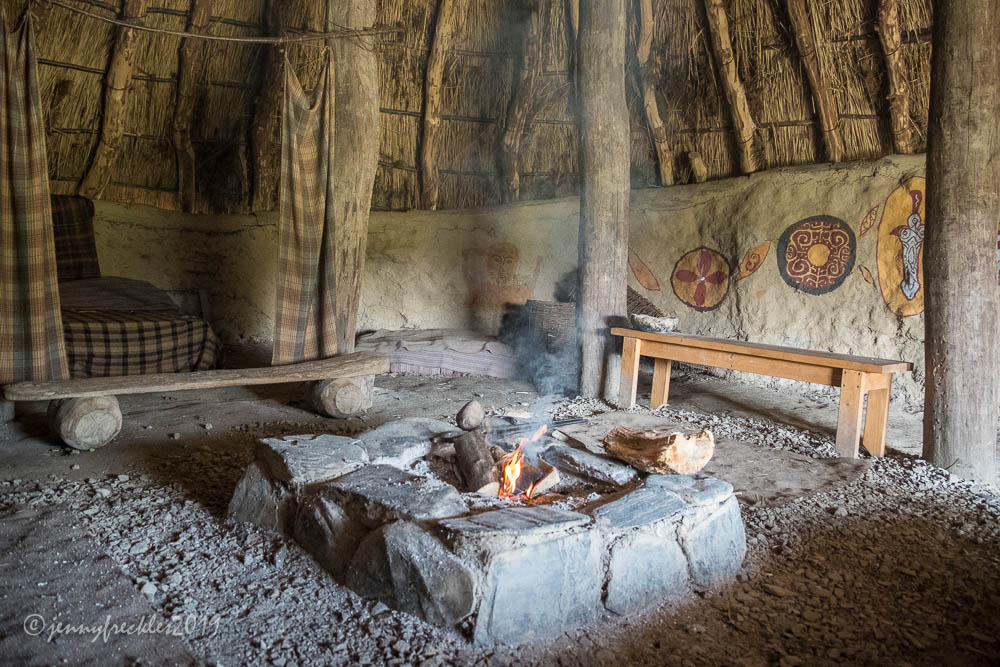
Some of the roundhouses were decorated with painted designs: shields, knots and wild animals like this powerful wild boar. The warriors would have killed deer and boar for their meat and skins.


We had such a good time on our visit to Castell Henllys. It is a kind of living history and seeing, touching and smelling makes it all come alive. It must be a super place for children to learn. It's all in a lovely setting too, with a path by a stream tumbling through a wooded valley and leading up to the hill fort. There's a very good visitor centre with a shop, an excellent café and some interactive information boards and videos. Highly recommended if you're in the Cardigan/Pembrokeshire border area.

Tuesday, 11 June 2019

Building Castell Henllys


Wales: The first roundhouse was reconstructed on the Castell Henllys site in the 1990s. The original buildings are beginning to deteriorate and are now being renewed, which gave us a good insight into the building methods.

A company that builds using timber frames has started to put in place the wooden structure of a new hut. Then the walls will be constructed using hazel rods woven through timber posts (the wattle) - see example above left. Once the reed-thatched roof has been added, the walls will be finished with dried mud (the daub). The guide told us that the circular structure is built around a central post. Once the structure is balanced  and self-supporting, roped and jointed together, the central post is sawn off up in the roof, to provide an open living area.


There's a great beauty in the roof structure, being at once organic and ingeniously engineered. The photo below is looking more or less directly up to the apex in the middle.


This is a more detailed view of the thatch overhang at the entrance, showing the timber and ropes.


Monday, 10 June 2019

Iron Age village


Wales: Whilst in Wales, we had a most interesting tour of an Iron Age village, at Castell Henllys, which has been excavated and studied for the past twenty years by archaeologists from York University. They have reconstructed several roundhouses on the actual foundations of a hill fort, belonging to the Demetae tribe, dated to between 500 and 100 BC. Their work has enabled a greater understanding of the Iron Age period, as well as providing training for archaeology students and a wonderful visitor attraction. Luckily, we visited when it was very quiet and had a personally guided tour, which was really fascinating.

The roundhouses are built of wattle and daub on a wooden framework, with reed thatched roofs. The granary (the smaller hut in the photo above), where food was stored, is built on stilts off the ground to mitigate against damp and vermin. The settlement was protected by a complex of earthworks and ditches, including a 'cheveaux de frise' - a stony ditch (right) designed to protect against horses and chariots.

Heat, light and cooking were provided from a central fire within the roundhouse, whose smoke was drawn out through the thatch.


The roundhouses were home to extended families and some have private sleeping quarters separated by woollen curtains. It's estimated that the village could have housed over 100 people, led by a wealthy and influential chieftain. The people were very resourceful and skilled: coppicing woodland, growing crops and keeping livestock;  spinning, dyeing and weaving cloth; turning wood; weaving baskets; grinding grain to make bread and generally living a healthy and sustainable lifestyle. Some would have been warriors and hunters, protecting the settlement from wild animals and human enemies.

The hill fort seems to have been abandoned during the 1st century BC, possibly due to the Roman invasion.


Thursday, 9 May 2019

The forge


One of the buildings at the National Coal Mining Museum is used as a working forge by Nicholson-Harris Blacksmiths. It's a happy arrangement whereby the buildings and tools are used and the blacksmiths are able to carry out conservation work on some of the museum's objects, as well as producing items for sale and for commissions. You can also book a 'Be a Blacksmith for a Day' experience course, to learn the basic skills and create a few hand-forged items yourself. That sounds great fun!

Wednesday, 8 May 2019

Life in the mines


Most of the men now greeting and educating visitors at the National Coal Mining Museum are ex-miners. It makes it very interesting as they have real stories to tell and real expertise to share. On the day I visited, Alex was stationed in the Hope Pit Store, which holds much of the museum's archive of heavy machinery and tools. It is situated at the far side of the museum site, and you can either ride over there on a little train (that used to carry miners to their work stations) or walk along a nature trail. It was fairly quiet when I was there, so he kindly agreed to pose for a photo.

Canaries were used in mines right up until the 1980s, to detect dangerous gases like carbon monoxide. The birds would react much more quickly than people to the presence of toxic fumes, and acted as an early warning system. Eventually the use of 'electronic noses' meant the birds were phased out, but many miners felt this was a loss as they treated the birds as pets. Caphouse has an aviary full of the pretty yellow birds.


Pit ponies were once used extensively underground as well as above ground, to haul coal and equipment. At the peak in 1913, 70,000 were employed underground but by 1978, thanks to mechanisation, there were only 149 underground and the last of them retired in the 1990s. The sturdy, hardy little ponies lived underground for many months at a time, enjoying occasional holidays above ground. They were a vital part of the mine's operation and as such were well-cared for, and much loved by the miners.

Capstone has this model (below) showing how they would have pulled the coal tubs along rails, but there are also four real horses, including a couple of little Welsh ponies and a lovely Clydesdale heavy horse. They do a short 'day shift' in the stables to delight and educate visitors to the museum and are then led out to fields to graze and rest.


Tuesday, 7 May 2019

Our coal heritage


The last deep coal mine in the UK, Kellingley in Yorkshire, closed in December 2015, bringing to an end an industry that had sustained many communities since the 17th century. (There are a few open-cast mines still working.)                                                                                                               I've been doing some research on my family tree, and I know that my maternal grandfather and his father were miners in the Nottinghamshire/Derbyshire coalfields. I was interested therefore to revisit the National Coal Mining Museum for England, near Wakefield. I last went there in 2014 (see here) but it has expanded quite a lot since then. Colliery headstocks and buildings were a familiar sight in my childhood and have now mostly disappeared, so to see the preserved remains of Caphouse Colliery and Hope Pit is quite nostalgic. The big wheels and cables operate the lift cages taking men up and down the shaft at the start and end of their shift and bringing the coal out. 
Mining ceased at Caphouse in 1985 but the mine workings have been made safe for tours, so you can get a hard hat and a lamp and go down in a cage to walk through the excavated tunnels and see some of the machinery still down there. It is truly fascinating. Tours are led by ex-miners who have a fund of stories to tell, both funny and poignant. No photos are allowed underground (things with batteries: cameras, phones etc are confiscated because of the risk of explosion from sparks). The tours operate as if you were a miner. You are issued a numbered metal check (see below for a collection of them), which miners used to have to hand in in exchange for a safety lamp before they went underground. In that way, they could tell exactly who was down in the mine, crucial information in the event of an accident. 


Sunday, 28 April 2019

Ilkley Camera Club Exhibition 2019


Local people, may I warmly invite you to visit 
Ilkley Camera Club's biennial exhibition
in Cliffe Castle Museum, Keighley 
from 4 May - 14 July
It's free and open during the museum's normal hours (see HERE). I have several prints exhibited, alongside all the wonderful work from my fellow members. 

Club members are also offering a series of 90 minute workshops, at 12 noon on eight weekend dates, as shown below. These are a great opportunity to learn and improve your own camera and processing skills. Also free. 


You may also like to note that there is an exhibition of photos by the Yorkshire Photographic Union in
Bingley Arts Centre, from 5-19 May (10am-4pm), 
which is a wonderful opportunity to view some of the very best images from photographic clubs across Yorkshire, including a number from Ilkley CC.

I'd be thrilled if you took the time to visit either or both of these events.

Sunday, 10 March 2019

In the glasshouse


A Bird of Paradise plant, Strelitzia reginae. You can see how they got their name! 


The extensive glasshouses at Cliffe Castle were rebuilt as part of the recent renovations, and follow a similar plan to the original Victorian ones. It was fashionable for well-to-do Victorian gentry to have glasshouses on their estates for growing exotic plants and fruit, and the Butterfields' were more vast and ostentatious than most. The planting now is lush and exotic and there is a whole shed full of cacti and succulents, which look extremely well cared for. I'm not a huge fan of them but, looking at those on display, I was actually fascinated by the many different shapes, sizes and intricate structures. I began to understand their appeal to collectors.