I HAVE CLOSED DOWN THIS BLOG. Please click the photo above to be REDIRECTED TO MY NEW (continuation) BLOG.
Showing posts with label Addingham. Show all posts

Monday, 1 July 2019

Dawdling on the Dalesway


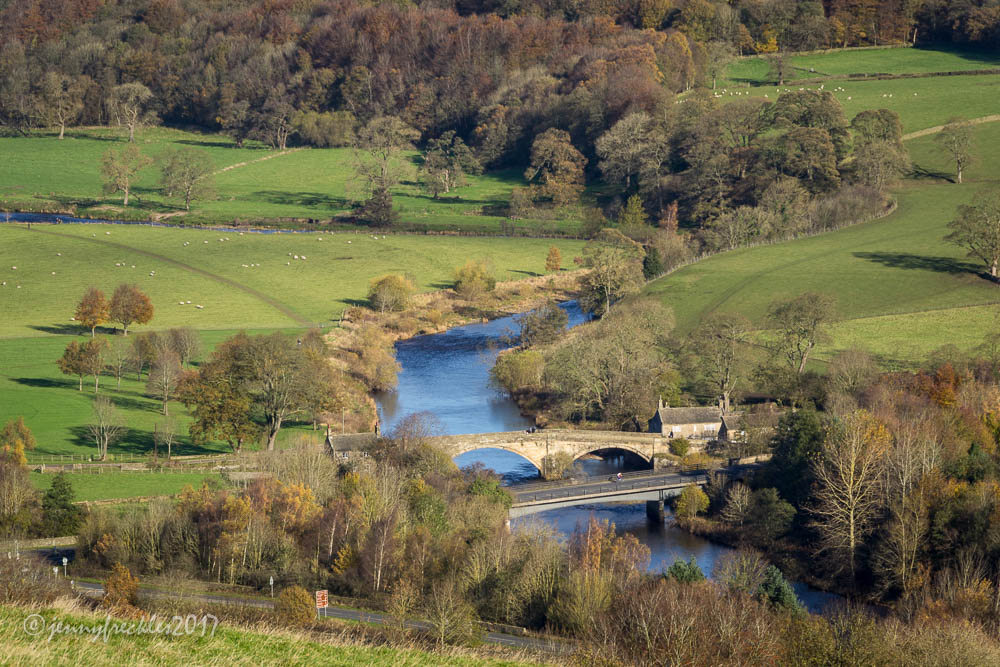
Early summer must be the best time of year to attempt the Dalesway long-distance footpath. It runs from Ilkley to Bowness on Windermere in the Lake District, 80 miles of glorious Yorkshire Dales scenery. I walked just the first few miles with a friend recently. To be honest, we were too busy chatting to take in much of the scenery but when we did stop to look, the wildflower meadows and the River Wharfe beside the path were beautiful, even on an overcast day.


We tip-toed among the buttercups...


Little lambs are rapidly becoming big ones, though they were sleepy in the warm humidity.


The river, whilst not overfull, was showing the results of recent rain up in the hills.


The weir is related to the adjacent mill, Low Mill, which was built in 1788, harnessing the river's power to become the first successful wool worsted mill in the world. Before that, wool cloth had been produced by hand spinners and weavers. Mills initially were largely devoted to cotton production. The mill finally stopped production in 2002. Nowadays the site and the adjoining cottages and buildings have become an attractive little housing development on the edge of Addingham village.


Tuesday, 16 April 2019

St. Peter's Church, Addingham


My camera club meets weekly in the church hall of St. Peter's, Addingham throughout the autumn and winter, taking a break in the spring and summer. For most of the season, it's dark by the time I arrive there but for a couple of weeks at either end of the programme, when our clocks are on BST, it's still light. On the last evening this season, the sunshine was bathing the church in a golden glow. With the churchyard full of daffodils, it made a pretty scene. (These are phone shots... I don't take my camera to the camera club!) 

The church is in a lovely setting on the edge of the village of Addingham in open fields. It's an ancient site, where people have worshipped God for over 1100 years. Much of the present building dates back to the 15th century. I've never been inside - a bit of an omission. 

The nearby church hall where we meet is a modern building, which was extended and rededicated in 2000. It has some Celtic inspired bas-relief carvings on the outside wall:
"We cannot be so wise that we have no need to consider what will be decided for our souls."


Sunday, 26 November 2017

River Wharfe at Addingham


Addingham walk
The stretch of the River Wharfe from Bolton Abbey to Ilkey is really pleasant so, once I accessed The Dalesway path, it was an easy stroll back to my car, parked in Addingham. The sun played peek-a-boo behind a bank of low cloud, which was a bit annoying. When it came out, the colours in the water and autumn trees were beautiful. There were a few birds about, although had I stopped and watched awhile I'm sure I might have seen more. I saw some grey wagtails bobbing on the rocks, a few mallards lazily cruising and a female goosander. She was busily diving for food; they stay underwater for ages and then pop up again, sometimes quite a way from where they disappeared.


Saturday, 25 November 2017

Farfield Friends' Meeting House


Addingham walk
Once out of Lob Wood, my walking route joined The Dalesway long-distance path, following the River Wharfe as it meanders into Addingham.

Beside the road at Farfield, I came across this lovely little Quaker Meeting House and burial ground. It was built in 1689, the year that the Act of Toleration first allowed freedom of worship to nonconformists in England. (Prior to that, dissenters had to meet in secret and were persecuted.) The land was given to the Quakers (Society of Friends) by the Myers family of Farfield Hall, yeoman farmers, who were members of the Society. It is relatively unchanged and, although not considered to be a sacred place (Quakers consider everywhere to be sacred), it has a simplicity and charm that give it an undoubtedly peaceful atmosphere. It was a delight to spend a few minutes in silence here, enjoying the peace and sunshine.


Inside, there are simple wooden benches, where Friends gathered every week for their meetings, seeking together to come close to the spirit of God. They have neither clergy, liturgy or music and simply wait in expectant silence until anyone present might feel moved to offer witness or prayer.


The burial ground is unusual as it has a few engraved stones and some elaborate box tombs (see top photo), the graves of the Myers family, who gave the land and may have helped with the actual building of the meeting house. Originally Friends were discouraged from having gravestones, though now plain stones of uniform size and simple wording are accepted. There are a few of those too, Victorian and marked with the surname Lister. (Maybe they are connected to the Samuel Cunliffe Lister who owned mills in Addingham? See last Sunday's post.)  


I was unable to decipher the swirly writing on the stone shown below... Here lies (?) interred the body of..? wife of .?


The Meeting House is no longer used, though Quakers still meet in nearby Ilkley and Skipton. The building and burial ground are now in the care of the Historic Chapels Trust.

Friday, 24 November 2017

Lob Ghyll Viaduct


Addingham walk
My walking route descended the valley side, through fields of grazing sheep, who were not much interested in me. I then entered Lob Wood, where you unexpectedly come across this impressive viaduct. Built in 1888, it is now disused and getting overgrown but at one time it carried the Midland Railway from Ilkley to Skipton. The line closed as a result of the infamous Beeching cuts in 1965, though four miles of the line from Embsay to Bolton Abbey station were later reopened and now run as a volunteer-led heritage steam railway.

It was a bit hairy trying to negotiate the path underneath the viaduct. The banking seems gradually to be getting eroded and the drop is very steep. It was muddy and slippery and I started to wonder how long it would take for someone to find me if I fell!! Luckily, I safely gained a wider and flatter path on the other side. Phew. The perils of walking alone...


Thursday, 23 November 2017

Bolton Abbey


Addingham Walk
Climbing over a steep stile in a stone wall, at the highest point of my walk, I was quite suddenly treated to this stunning panorama of the Wharfe valley, with the ancient half-ruin of Bolton Abbey (see HERE) at its heart. 

This is where my long lens comes in useful, picking out some of the detail of the scene: 


Bolton Bridge, both the old and new crossings, looks pretty from this vantage point.


You can pick out Bolton Abbey itself, which has one end in ruins since the Dissolution of the Monasteries in 1536. The other end of the nave was spared and allowed to continue as a church because it was used for worship by local people as well as the monks. It is still used to this day (see HERE).

Wednesday, 22 November 2017

Golf, anyone?


Addingham walk
Bracken Ghyll Golf Club may enjoy some of the best views in England! I'm not sure what green I was standing beside but the view over to Beamsley Beacon is stunning.

A little further on I passed a beautiful old house called Highfield House, which dates from about 1780 and has unusually large windows for its period. Sadly the surrounding hedges were too high for a decent photo. A little further on though, I came to Highfield Farm, a laithe-house, where the farmhouse and barn are connected in one long-house. It dates back to about 1800, and to be honest it looked like it could use a bit of TLC. An ancient house like this, in such an exposed spot, must take a lot of looking after. A gaggle of geese and some hens in the yard didn't take any notice of me, thankfully.


Crossing the fields beyond the farm, the views are extraordinary. A stile crosses the ancient medieval boundary of Addingham Parish, which was marked by a serpentine wall and ditch. The path then follows a farm track, and the area is dotted with crumbling old barns and drystone walls. 


Tuesday, 21 November 2017

On the way to Highfield


Addingham Walk
I was quite soon walking in open countryside, up a gentle incline with lovely views back down to Addingham and Rombalds Moor in the distance. The autumn colour has not been particularly outstanding this year round here but it's nonetheless pleasing to see the warm bronze tones, especially when the sun lights up the last remaining leaves. 

I was glad that the path was very clear and I just had to head for the next stile in the walls separating the fields. When I reached the stile in the photo below, which had stone steps and a little gate, I had to duck down under the low-hanging tree branch just at the other side. It made me wonder which came first, the stile or the tree...


This ruined 18th century building is called High Laithe. Laithe means 'barn' or 'granary' and this barn seems to have been for hay storage and winter shelter for cattle. It has some interesting old gateposts, with huge holes that once would have held timber 'crooks' as gate hinges, when iron was in short supply.

Monday, 20 November 2017

A walk from Addingham


I took advantage of a crisp, though bitterly cold, day to explore the area around Addingham. My walk took me out of the village up to Highfield, down to Lob Wood and back along the River Wharfe.

I started in the village centre, in the communal park called Hen Pen Garden. Perhaps there was a hen pen here once... but now it is one of several attractive little areas of colour and greenery in the village, cared for by volunteers (Addingham Garden Friends).


The walk took me up the interestingly named Sugar Hill. As far as I can discover, the building on the right (above) was once a bakehouse, which perhaps led to the name.

Further out, one of the last village houses I passed was obviously once inhabited by textile weavers. It has a bricked up 'taking-in door', where yarn and cloth could be winched in and out of the loomshop, above the living accommodation.

I love noticing these small details of history when I'm out walking, though sometimes (even with our wonderful and magic 'Google') it can be hard to piece together the information.

Sunday, 19 November 2017

Addingham


Addingham is a sizeable village near Ilkley, on the banks of the River Wharfe, not far from the boundary of the Yorkshire Dales National Park.  There have been settlements in the area since the Bronze Age but the oldest part of the existing village dates back to a farming settlement of the 17th century. The village really grew in the late 18th and early 19th century, as the textile industry developed, at first with small loomshops and later with mills. Samuel Cunliffe Lister (of Lister's Mill in Bradford) owned several mills in Addingham. Nowadays the village has swelled with modern housing and is a popular location for commuters and retired people to settle.


A walk round the village's network of streets reveals many ancient buildings and other things of interest... though the only ducks I saw were those painted on the road to celebrate the Tour De France cycle race when it was routed through Addingham.  The right hand side of the lovely old building above is, I believe, Lister's Barn. It was at one time a milking parlour and is now a residence. 

There are lots of little alleyways and steps connecting the principal streets. Along the Main Street itself, the imposing classical style building (above right) is, I believe, known as the Piece Hall. Thought to have originally been where pieces of woven cloth were traded, it later became retail premises (at one time a butcher's shop) and is now a residence.