I HAVE CLOSED DOWN THIS BLOG. Please click the photo above to be REDIRECTED TO MY NEW (continuation) BLOG.
Showing posts with label Brontës. Show all posts

Thursday, 12 December 2019

The Brontës' birthplace


After we'd visited the Christmas Tree Festival, we went in search of the house on Market Street in Thornton where most of the Brontës (Charlotte, Branwell, Emily and Anne) were born. It was the parsonage in their day, since their father Patrick was the minister at the Bell Chapel. It later became a butcher's shop and had the curious projecting frontage added. There was a short-lived attempt to turn it into a museum, before it became a private residence again.  Last time I visited in 2012 you couldn't go in but for the past few years it has been Emily's café/bistro. We were able to have a coffee there, right beside the dining room fireplace in front of which the Brontë children are said to have been born. I wonder if they had stockings hanging up at Christmas when they lived there?


Some of the tables in the café had been ingeniously fashioned from old-style school desks.


It had a nice ambience, full of books and memorabilia  - and very good coffee and cake (though I managed to resist the cake!)


Wednesday, 11 December 2019

St James and the Bell Chapel, Thornton


St James Church Thornton, where the Christmas Tree Festival was (see yesterday), is an imposing church with a huge spire, on the road leading to the village of Thornton, a suburb of Bradford. The existing church dates from 1870. With all the Christmas trees inside, I couldn't really see the interior properly but it has some fine William Morris & Co stained glass.

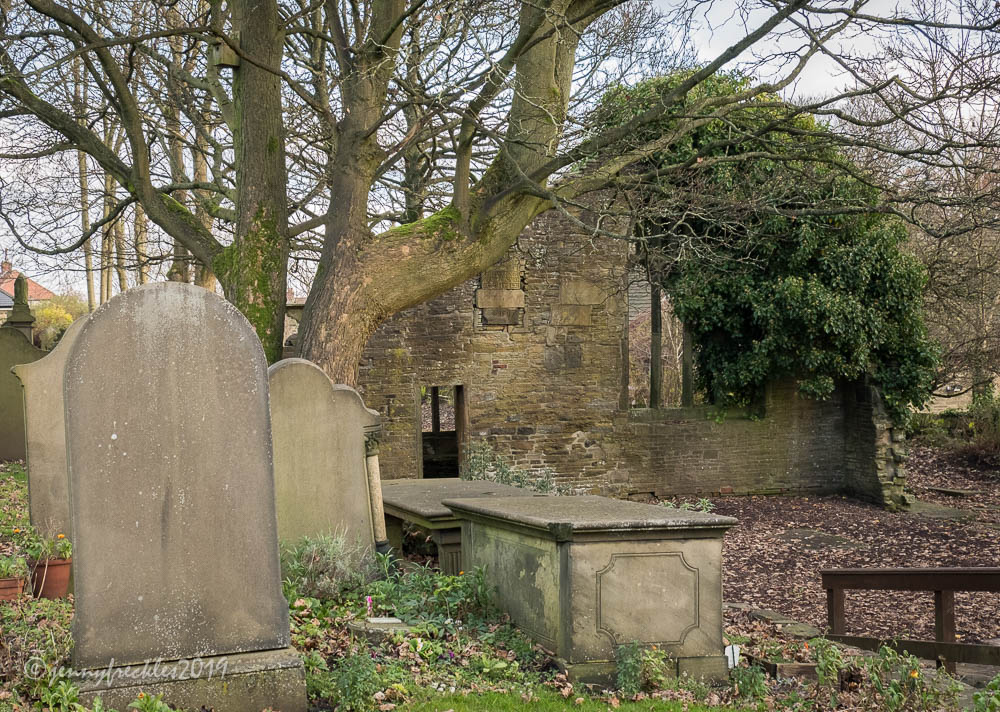
Across the road is the Bell Chapel, which has Brontë connections. Charlotte Brontë and her sisters were born in Thornton and baptised in the Bell Chapel, where their father Patrick was minister for five years from 1815-1820, before they moved to Haworth. The chapel is now ruined. I thought you could explore it, but it was roped off so I assume it is considered dangerous. The octagonal bell tower, covered in ivy, looks like a romantic folly and the surviving east wall, with the tracery of a window and a date stone showing 1612 is also being overgrown by ivy. The late medieval chapel was rebuilt in 1612 and again in 1818 when Patrick Brontë was in charge. It's a pity it is now in a poor state again, as I know that a few years ago a group of volunteers did a lot of work to restore it and make it safe for visitors.


Sunday, 25 August 2019

Top Withins


From the Brontë Falls, if you follow the rough track that climbs the valley side, you can walk on to Top Withins, the ruined farmhouse that is reputed to have been the inspiration for the Earnshaw home in Emily Brontë's novel 'Wuthering Heights'. It is spelled 'Withins' on OS maps and most signs but seems to have become 'Withens' in popular culture. Most of the online links I found spell it that way. It is a popular literary shrine. The signposts to it are in English and Japanese!


There are plaques explaining a little of its history. The land here was farmed for at least 400 years, until the 1890s. In 1591, William Bentley divided his estate between his three sons, and that probably led to the origins of the three farms: Top, Middle and Lower Withins, all now ruined. This kind of divided inheritance was common in the area and meant that families were forced to support themselves with ever dwindling parcels of land, resulting in much poverty and distress. The land was hard to work anyway and only supported a few dairy cattle, sheep and small fields of oats. Families supplemented their income by hand loom weaving and the men worked in the many stone quarries on the moors.

The views from up here are bleakly beautiful. It's rarely warm, with keen winds sweeping across the moors. It must have been a difficult place to live, even though in those days there was a lot more activity, with people living and working on the moorland.


There are a few hamlets and villages nearby but Haworth, the nearest place of any size, is about four miles across the moor. In my photo below, it lies in the dip beyond the trees on the hill. Although the area looks rather flat in the photo, that is deceptive. This is a high moorland plateau, dissected by deep V-shaped valleys cut by small streams and sloping gradually down in the distance to the broad valley of the River Aire, which was originally gouged out by a glacier 12,000 years ago. The steep and narrow gorge where the Brontë Falls is situated is the zig-zag, bracken-filled line on the right. 


Saturday, 24 August 2019

The Brontë Waterfalls


A couple of miles from Haworth, as the moors rise up, there's a pretty spot, nowadays called the Brontë Waterfalls. It is described in some of the writings of the famous literary sisters, who lived in the parsonage in Haworth, so it is known that they visited it. Charlotte described the water as 'a perfect torrent racing over the rocks, white and beautiful'. Sometimes when I've been it's been a mere trickle but, as we'd had recent rain, there was a cascade of peaty water, if not exactly a torrent.


The stream that tumbles down off the moor over the falls joins a slightly larger beck at this point, spanned by a little bridge (no longer the original clapper bridge, which was washed away in a flood some years ago). The Brontës called it 'the meeting of the waters'.  It's a popular spot for picnics and there is always someone sitting in the most photogenic location. At least this couple's clothing blended in with the scenery!


If you have the stamina, you can walk on from here up to the ruined farmhouse at Top Withins. You can perhaps just see it in the photo below, under the lone tree on the skyline. It's not that far, perhaps a further two miles from the falls, but it is not the easy stroll some people imagine. In fact, the route from Stanbury along the Pennine Way is rather easier, with a wider, flagged path.


Friday, 8 February 2019

Haworth's church


This is the quintessential view of the Brontë Parsonage, the one that all the tourist brochures show: taken from the crowded graveyard that surrounds the church, with all its lichen covered gravestones. In the wall separating the two, there's a stone that notes that when the Brontës lived there, there was a gate and path that connected the house directly with the church.


The church, St Michael and All Angels, is still Haworth's parish church and tries to balance its duties as a spiritual centre with its role as a tourist attraction. It is currently undergoing some extensive restoration. The present church is not actually the building the Brontës would have known, as it was rebuilt in 1879, after their deaths, when the old church was found to be unsafe and unsanitary - water from the graveyard was seeping in through the floor.


With the exception of Anne, all the Brontë family are buried in a vault under the church, over which a memorial chapel has been constructed. Anne died of TB in Scarborough and was buried there.


Thursday, 7 February 2019

The Brontë Parsonage


Back to Haworth - 
 I'm sure most people are aware of the connection between Haworth and the Brontë sisters: Charlotte, Emily and Anne. Their father, Revd Patrick Brontë, became the minister in Haworth in 1820 and the three sisters lived and wrote their famous novels in the Parsonage there. It is now a museum, still furnished much as it was in their time, though the wing on the right with the gable was added by Patrick's successor and there is now a visitor centre round the back. 

Walking from the village centre, up the cobbled lane, past the church and the schoolroom that the Brontës built and at which Charlotte, Emily, Anne and Branwell all taught, you could well imagine yourself back in the 1840s. 


Saturday, 6 October 2018

Gawthorpe's Brontë connection


I loved this rather beautiful tryptych showing different views of Gawthorpe Hall. There was no explanatory label but it obviously depicts the Hall after its renovation by Sir Charles Barry in the 1850s.

What is now the drawing room (below) was at one time a dining room, and has original 1603 Jacobean panelling, though the fire surround and some of the furniture date to the Victorian restoration. The inlaid table on the right, a teapoy that held a tea chest (when tea was such a valuable commodity that it was kept under lock and key), is by A W N Pugin, who collaborated with Barry on this private house, as well as more famously on the Houses of Parliament.

The Hall has connections with Charlotte Brontë, whose home in Haworth was about eighteen miles away. She visited Gawthorpe in 1850 and again in January 1855, where it is said she caught a chill from walking around the grounds, from which she never recovered. She died in March 1855. Apparently the green sofa in the drawing room dates back to that time and the Brontë bottom may have settled upon it! (Wow!)


There are many wonderful portraits displayed in the Hall, many loaned by the National Portrait Gallery. There are also some touching family photos. The grouping below shows members of the Kay-Shuttleworth family, whose two sons (in the heart shaped frame) were both killed in the Great War.


The magnificent four-poster bed (below) was a 21st birthday gift to Miss Rachel Kay-Shuttleworth, the last of the family to live in Gawthorpe Hall. She was an accomplished needlewoman, and from 1905 to 1918 she made the bedspread and hangings, embroidered in crewel work. They were finished on Armistice Day 1918, commemorated with a little palm tree and the date. During her life, she amassed a huge collection of textiles from all over the world, as a means of preserving them and disseminating information about the traditions and skills involved in their production. Some of these are on display in Gawthorpe Hall. See here for an interesting blog post about the Gawthorpe Textile Collection.


Sunday, 29 May 2016

School Room


On the Haworth film set, they have also built a replica of the old School Room, which occupies the lane beyond the Parish Church and leading up to the Parsonage. Rev'd Patrick Brontë was a passionate social reformer and he fought for and eventually built a school to educate the poor children of Haworth, which in the early 1800s was a dreadful, disease-ridden and impoverished village where people's life expectancy was well below that of the rural area around it. Almost half the children born there died before reaching their fifth birthday. The school opened in 1832. All of the Brontë sisters taught there at one time or another. It was also the venue for the wedding celebration when Charlotte married Arthur Bell Nicholls in 1854. It closed as a school in 1903 and has since been used as a community hall. It (the real one!) was hosting a sale of vintage clothes and wedding dresses on the day I visited. 


Saturday, 28 May 2016

Real or fake?


This is what they have been building up on Penistone Hill above Haworth. It is a replica of Haworth Parsonage, where the three Brontë sisters, Charlotte, Anne and Emily, lived with their clergyman father, Patrick, and their brother, Branwell.

When they lived there, the house lacked the additional gable that the real building now has. That was added by the clergyman, John Wade, who lived there after the Brontës. (He had 'private means' and was considerably better off than the impoverished writers.) Furthermore, the actual Parsonage is now deep in trees, which have also been planted since the family lived there. The film makers have decided to create something more authentic to the period (1840s) rather than try and film round the Parsonage itself, though they are, I believe, going to film some scenes in Haworth's actual main street too.

When I went to look, they were still busy painting the railings and adding the finishing touches to the set. Considering it is a light wooden structure, I think it looks astonishingly realistic, don't you?

I have added a photo below of the Parsonage as it is today, for comparison. The graveyard is still there but it was behind me in the photo below, beyond the garden wall.


Friday, 27 May 2016

Close up clues


Walk a little closer to the strange structures that have appeared on the moors above Haworth and all becomes clearer.

They are constructing a huge film set, which is now almost complete. The film, 'To Walk Invisible', will tell the story of Haworth's famous Brontë family, in particular the increasingly difficult relationship between the three celebrated writers, Charlotte, Anne and Emily and their brother Branwell, who in the last three years of his life and following a tragic love affair, descended into drink, drugs and wild behaviour.  It is written by the brilliant, award winning Yorkshire writer and playwright Sally Wainwright (who also wrote 'Last Tango in Halifax' and 'Happy Valley'). 


I believe they are due to start the actual filming next week, after the Bank Holiday weekend. There were huge trucks moving into one of the carparks on the edge of the village when I was there. They will be filming in the village itself; Haworth Main Street is being reverted back to the 1840s. However, their home, the Brontë Parsonage and its surroundings have been irrevocably altered over the years - not least because they are now surrounded by huge trees. So they are building replicas on the moors above the village, to be closer to the originals as they were in the time of the Brontës.Interior scenes will be filmed in Manchester. Such a massive undertaking to create one 120-minute drama....


I understand the drama will be aired on BBC TV around Christmas. It is one of a number of events marking the 200th anniversary of Charlotte Brontë's birth (on April 21st this year).

The cast has recently been revealed (see here) - and it is good to know they will have 'luxury loos' whilst filming up on the moors!


Thursday, 10 September 2015

The meeting of the waters


  Here are some photos for all the Brontë fans. This place, above Haworth and close to the home of the famous writers Charlotte, Emily and Anne Brontë, is now known as Brontë Falls. The sisters themselves apparently referred to it as 'the meeting of the waters', where a tiny moorland stream tumbles down a series of small waterfalls towards a slightly bigger beck. The beck is straddled by a clapper bridge, recently restored after flash floods swept the original away. There is no doubt that the sisters visited it and Charlotte referred to it in her diary.


There were few people about when I visited quite early on a Sunday morning but it is a place of pilgrimage for some. The moorland signposts are in Japanese as well as English!  If you have the stamina you can continue further, up to Top Withens, an old farmhouse which may have inspired the setting for Emily Brontë's novel Wuthering Heights.


Friday, 9 December 2011

Rose & Co


Rose & Co's famous Apothecary shop in Haworth is like a step back in time.  Lit by sparkling chandeliers and always beautifully fragranced, the shop has old-style, rich mahogany and glass display cabinets.  It sells high-class bath, beauty and household products, some still manufactured to old-fashioned formulations.  The shop is a restored Victorian druggist shop and is reputed to be where Branwell Brontë bought the laudanum (tincture of opium) to which he was addicted.  He was also an alcoholic and sadly these addictions masked the tuberculosis from which he suffered, until it was too late to save him.  He died at the age of 31 and his sisters Emily and Anne also died of the disease within a year of his death.

Wednesday, 7 December 2011

Haworth in festive mood


When I'm trying to get into the mood for Christmas, a trip to Haworth often helps.  Its cobbled streets and olde-worlde charm somehow seem right for the festive season.  Most weekends in December they have some kind of theme going on.  Last weekend there was a wartime flavour, with a 1940s vintage fair and a Wartime Christmas Ball on Saturday in the Community Centre.  Next weekend will be even more spectacular, with carol-singing and a torchlight procession up the Main Street.  The Christmas decorations are cheery and even the red phone box seems to add a festive touch.

Haworth, of course, was the home of the literary Brontë family.  Patrick Brontë, father of Charlotte, Emily and Anne, was the parish priest of Haworth's church.  Branwell, their brother, used to frequent the Black Bull pub, seen in my photo.  He was a freemason and was the secretary of the local Lodge, which at one time used to meet in the pub.

Saturday, 28 August 2010

Haworth

This is the main street in Haworth, still very olde-worlde and cobbled, although the village itself is far from being 'a museum'. It's a lively modern community, which cheerfully makes the most of the throngs of tourists who arrive at weekends. The steps on the right lead up to the church and the Parsonage behind. The pub (behind the phone box) is The Black Bull, famed as being one of the places Branwell Brontë frequented. Brother of the Brontë sisters, Branwell was an artist and writer. He held several different jobs but managed to be dismissed from all of them - one of them for having an affair with Mrs Robinson, his employer's wife. He died aged only 31, from drink and opium abuse.

I now have some more photos of Haworth and the surrounding moors on my other blog 'Seeking the Quiet Eye'.

Friday, 27 August 2010

Brontë Parsonage, Haworth

Haworth, sitting on the edge of the Pennine moors about eight miles west of Saltaire, is famous as the home of the Brontë sisters - Charlotte, Anne and Emily - all of whom wrote novels that have become classics. The family arrived in the village in 1820 when their father Patrick became the vicar, and they lived in the Parsonage behind the church. They had, in many ways, a very tragic life - their mother died a year later and the two oldest daughters died in 1825. The three remaining girls and their brother created a rich imaginary life, writing in tiny books. Later, to earn much-needed income, the girls trained as teachers and all three published novels under male pseudonyms. Their story is in itself the stuff of novels - there is a lot of information about them on the Haworth website.

The Parsonage is now a museum, furnished much as it would have been in the 1800s, although the gable wing on the right was added by Rev Brontë's successor. Even on a sunny summer's day it has an air of melancholy, overlooking the graveyard and the church where the Brontës are interred.

Thursday, 26 August 2010

Brontë Falls

About halfway between Top Withens and Haworth the path passes through this little valley, past the Brontë Waterfall. Referred to by the Brontës themselves as 'the meeting of the waters', it is usually quite a tranquil spot. But when heavy rain has soaked the surrounding peat moorland, huge torrents can pour down the stream. One cloudburst swept away the old stone footbridge, which has now been replaced by a replica.
"We set off, not intending to go far; but though wild and cloudy it was fine in the morning; when we got about half-a-mile on the moors, Arthur suggested the idea of the waterfall; after the melted snow, he said it would be fine. I had often wished to see it in its winter power, so we walked on. It was fine indeed; a perfect torrent racing over the rocks, white and beautiful!"

Charlotte Brontë, 29 November, 1854
The surrounding moorland seems very wild and isolated these days but at one time there were many dwellings around the Falls and the moors were dotted with farmhouses and weavers' cottages. There are many 'erratics' - large boulders that litter the moors, brought down here from the Dales and the Lake District by glaciers in the Ice Age. These were crushed and burned in kilns to make lime to fertilise the acidic moorland. The moors were also mined for coal until the coming of the railway in 1867 meant it was cheaper to bring in coal from the bigger mines further south. So these moors were a hive of activity, with many people living and working in the area.