I HAVE CLOSED DOWN THIS BLOG. Please click the photo above to be REDIRECTED TO MY NEW (continuation) BLOG.
Showing posts with label Yorkshire. Show all posts

Sunday, 1 December 2019

Skipton


The town of Skipton, about 16 miles north of Saltaire, styles itself as 'The Gateway to the Dales' though you'll reach the Dales much quicker if you take the Skipton bypass around the town. The town has a very good market on four days of the week, which takes up all the space along both sides of the long and wide main street. The origins of the market are ancient: a centre for trading sheep and wool.  Nowadays, the sheep are traded at the auction mart on the edge of town and the market sells all manner of goods, from clothing to sweets, hardware and gifts. When it's not market day, as on the day I last visited, it is still a very congested town centre with a line of queuing traffic almost always inching its way through. That just demonstrates, however, what a thriving centre it is and how important for the surrounding rural communities. Skipton regularly comes near the top of 'the best/happiest places to live' in Yorkshire/England/the world. 

It has some good small shops, with a fair few independents as well as some of the usual high-street names. At the north end of the main street (behind me as I took the top picture) sits the large parish church of Holy Trinity (below) and, behind that, Skipton Castle. (I keep promising myself to visit the castle again... Not made it so far.)  The main street is a bit tricky to photograph as it runs due north-south and the best view, from the slightly elevated churchyard wall, is always into the sun. You can get the general feel of the place from the top photo: a nice mix of very old buildings (several old pubs and coaching inns) and some solid, provincial Victorian edifices like the library in my photo and and the town hall opposite. The war memorial doubles as a roundabout at the top end of the street, where the road splits east and west round the castle. 

The Leeds-Liverpool Canal runs through the town parallel to the main street before turning west, giving an extra layer of interest around the canal basin, where there are always plenty of colourful boats. 
(Photos taken in October, before my eye op). 


Wednesday, 18 September 2019

The church treasurer and the church treasures


I enjoyed noticing the smaller treasures in the seven churches we visited as part of the 'Sculpt' Arts Trail. The little bear above made me smile; the church treasurer, perhaps? 

Elsewhere, there was a pretty little angel, made out of the folded pages of a book:


All the churches had floral displays, some more elaborate than others but all bringing a breath of nature into the interior. 


There were interesting carvings in the choir-stalls: dogs, birds and all manner of strange gargoyles.

In one church there was a small brass plaque in the floor, with a Latin inscription to a Thomas Sutton, a former rector, who died in 1492. It was quite worn away by polishing and brass rubbings over the years. 


I found a piece of Roman mosaic, from a Roman villa and bathhouse that was excavated nearby,


In Snape Castle Chapel, there were several of these ornate gas lamps, now superseded by electric lights but still looking fairly intact. They are on brackets that could be folded out away from the wall.


Church doors are often rather beautiful, with studs, scrolled ironwork and large handles:


I love stained glass windows of all kinds, ancient and modern. In one church porch there was a pair of these trefoils, one either side, which I thought were very attractive.


In the church in Healey, they had thoughtfully placed a floor mirror to enable a view of the cocoons hanging overhead, without craning one's neck.  Depending on where one stood, it provided a variety of interesting shapes and patterns to amuse a photographer.


Finally, a couple of pieces of apparently lost property made me laugh, casually placed on a pew end that could, at a quick glance, have been the profile of a face.


Tuesday, 17 September 2019

The Seven Colours


'Sculpt' Arts Trail
Our final destination on the Arts Trail was the church at West Tanfield. The installation here, 'The Seven Colours' by Eduardo Niebla, was a sound recording. It blended sounds the artist had recorded locally - church bells, the church choir, school children, the local blacksmith and the sound of water in the River Ure - with global sounds like a steam train, Gregorian chant and musical rhythms from around the world. The resulting collage of sound played for about 15 minutes and was strangely soothing. It was intended to symbolise and celebrate community and connection across all seven continents.

Though there was no artwork to photograph here, the church of St. Nicholas is filled with interest and history. It dates to the 14/15th centuries, with Victorian restoration. It holds the tombs of Sir John Marmion, a knight who died fighting in Spain with John of Gaunt in 1387, and his wife Elizabeth. The tomb has an unusual iron canopy, known as a hearse, with prickets for candles that would be lit on special occasions. It is believed to be the only one of its kind in England. The alabaster statues show Sir John with his feet on a lion (signifying a knight) and his wife with her head on a pillow held by angels.


The Marmion family lived in a manor house near the church. It is now vanished but its crenellated gatehouse, known as the Marmion Tower, remains, adjacent to the church. See it in my top photo. 

Monday, 16 September 2019

Rock of Ages


'Sculpt' Arts Trail
'Rock of Ages' by Harriet Hill is a huge sculpture like a hovering rock, suspended by cords. It is made of wool from local Masham sheep, along with straw, hay, baler twine and netting. It represents the layering of history, linking the people who have lived and worked the land in this area through the 1000 year history of the church in Well.


The church of St Michael the Archangel, in Well, dates back to the early 14th century though there were churches on the site prior to that. It holds many treasures including the tomb of Sir John Neville, last Baron Latimer of Snape, who died in 1577. There is also lots of 16th century graffiti defacing the tombs!


Sunday, 15 September 2019

Wonder and War in Heaven


'Sculpt' Arts Trail
'Wonder and War in Heaven' by Jon Gabb takes its name from a fresco, by Antonio Verrio (1636-1707) on the ceiling of the chapel. Twisted branches and knotted cords, in the original colours of the now-decayed fresco, form a tangled web across the whole chapel. They are supposed to depict the casting out from heaven of Satan (Rev 12:9).


This installation was in Snape Castle Chapel, a fascinating place with a sadly damp and mouldering atmosphere, rather 'Miss Havisham' in its ambience. The castle dates back to the early 15th century and was once the home of Katherine Parr, sixth wife of Henry VIII. It has a wonderful and interesting history (see HERE) but, trusted to the care of an agent, all but one wing were left to decay. During the 18th century the chapel (on the right of the photo below) was used as a grain store, which is thought to have been what ruined the painted Verrio ceiling, now just a blackened mess.


Much of the castle itself is a rather romantic ruin, set at the edge of the very pretty village of Snape. 


Saturday, 14 September 2019

Neons from Heaven


'Sculpt' Arts Trail
'Neons from Heaven' by Silvia Lerin was a striking installation of 100 blue tubes with reflective bases, suspended centrally in the church. It is apparently about times we need guidance in our lives, looking for enlightenment. Heavenly blue light is suggested by the tubes and we see ourselves reflected as we look up at the bases. The guidance you need is potentially within you.

I'm not always sure that my interpretation of an artwork is anywhere near that of the artist's... It was an impactful piece, nevertheless and picked up nicely the touches of blue around the church, in the stained glass windows and furnishings.


The church is question was the large church of St. Mary in the centre of the market town of Masham. I've visited it before, on a rather nicer day (see HERE).  It's lovely and has the air of a well-used and well-loved church, the hub of the community.


Friday, 13 September 2019

Le Bon Temps Viendra


'Le Bon Temps Viendra (The Good Times Will Come)' by Ana Rosa Hopkins. This was an installation of six large cocoons, made of silk, woven metal thread and glass balls. They hung from the central tower of the church and represent the potential of human beings to change and transform: our outer facade and our inner soul, where change must start. Glass butterflies represented our fragility and hope. 


The artwork's title is the motto of the Harcourt family, who built Healey St Paul's Church, completed in 1848. It is an unusual design, by Edward Buckton Lamb, with its central spire supported on well-disguised buttresses. It is reputed to have been financed by the winnings of a racehorse, Ellington, trained in nearby Middleham. It won the Derby - but not until 1856, after the church was built. 


Thursday, 12 September 2019

Cloud of Unknowing


'Sculpt' Arts Trail
'Cloud of Unknowing' by Alexandra Carr was a large perspex cube with coloured lighting, hanging in the church's nave. When we first went into the church that is all we could see, but as we moved around, after several minutes, a fog erupted from the cube, slowly wreathing the church in its vapour. The fog represents our human quest to understand our place in the cosmos and our fleeting, ephemeral comprehension of 'the unknown'. It was intriguing, anyway, and rather beautiful as it unfolded.


It was installed in the small church of St John the Evangelist in Mickley, another church dating from the early 1800s. It is constructed of cobblestones from the nearby River Ure. It has an unusual memorial window of etched glass, in memory of Lt-Col Samuel Hutchins DSO, Royal Irish Regiment, who lived locally in his later years.

Wednesday, 11 September 2019

Every Small Difference


'Sculpt' Arts Trail 
A friend and I spent a fascinating day touring seven churches in the area between Ripon and Masham, in North Yorkshire. They were each hosting an artwork as part of an arts trail called 'Sculpt', an Arts Council-backed project. It is part of the 'art in the churches' initiative, a voluntary effort aiming to bring contemporary art to the countryside and to utilise and showcase some of England's vast treasury of small, often ancient, village churches. The installations are site-specific, inspired by the church in which they are displayed. The trail continues until 28 September.

It was a dismal day of incessant drizzle and low cloud, not the best for photography. That didn't dim our enthusiasm (nor prevent me taking photos!) and anyway, the artworks were all inside the churches.

Our first stop was  to see 'Every Small Difference' by Sarah Williams. This was an oil-painted triptych, with reflective domes. It represents, apparently, 'the vulnerability of our planet to climate change and our responsibility to protect it'. It had painted bubbles, suggesting the delicacy of the planet and our own fragile lives. Somewhat underwhelming, we thought. I'd have liked it better if the painted bubbles had contained reflections of trees or nature.


It was hosted in the church of St Mary, North Stainley, a small and unpretentious church. It was built in the early 1800s after the passing of the Church Building Act in 1818 that was designed to provide the growing population with access to a church nearby. Like most churches, it has been added to and altered since then.


It was neatly kept and had some nice stained glass windows, including the one (left) that appears to depict the story of Jesus' raising of Jairus' daughter. Sadly, the glass panels were in urgent need of conservation, I thought. They were horribly bowed, particularly the lower panels.

I also liked the unusual mosaic memorial in the wall.


Thursday, 8 August 2019

Brontë Country


I love the drive over to my daughter's home in the summer, across the moors between the Aire valley and the Calder valley. I had to stop the other day just to drink in the wonderful view. This is truly 'Brontë country', as the tourist brochures would have it. The village of Haworth, where the famous writers, the Brontë sisters, lived in the parsonage in the early 1800s, is in the dip in the middle right of the picture below. Some of the village is visible from this viewpoint but the oldest part is hidden by the trees right in the centre of the photo. In the picture above, the water on the left is Leeshaw Reservoir, one of a series built in the late 1800s/early 1900s to provide fresh water for the town of Keighley and its environs. It wasn't there when the Brontë sisters roamed the moors, and the rough moorland made famous in their novels may well have extended further than it does today. In the picture above, you can see a dark patch on the left beyond the reservoir, which is just the edge of the heather moorland that is Haworth Moor, leading up to the ruined farmhouse at Top Withens, reputed to have inspired Emily Brontë's novel 'Wuthering Heights'. 


Monday, 5 August 2019

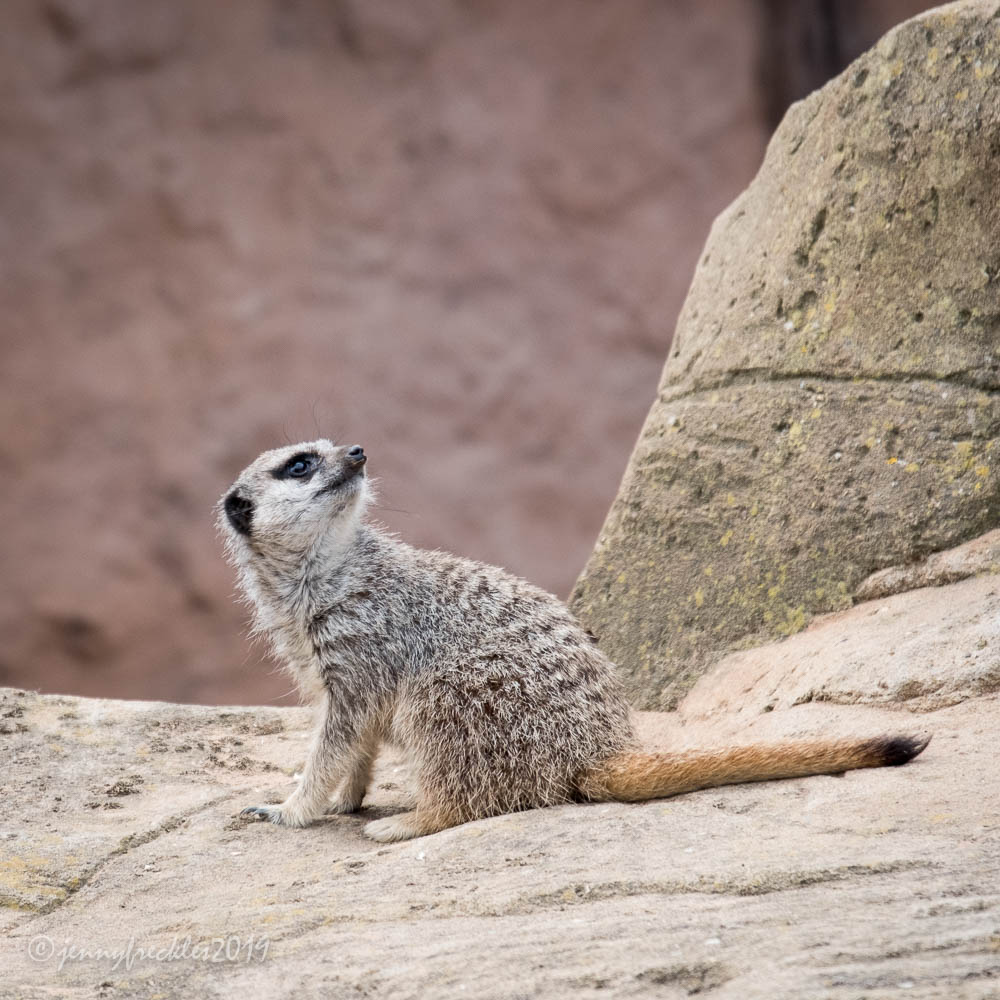
Compare the meerkats


As well as the big beasts, there are plenty of smaller creatures at the Yorkshire Wildlife Park  - cuter, if not exactly cuddly. Meerkats are much more popular since the rise of the insurance comparison site featuring them! They are rather sweet and very funny, alert and active, standing sentry and warning the rest of their clan with alarm calls when danger is lurking.

Squirrel monkeys are highly intelligent, with the highest brain-to-body ratio of any primate, including humans. The one in my photo was figuring out how to use a piece of plastic pipe with holes in. It seemed fascinated by it.


Lemurs are creatures somewhere between a cat and a squirrel, with very long tails. There are two different species at YWP: red-bellied and ring-tailed. Both are native to Madagascar, endangered by land clearance, hunting and climate change. They like to live in groups and were playing and grooming each other.


Wallabies are kept at YWP just, I think, for their cuteness factor. Coming from Australia and Tasmania, they are not particularly at risk. They are kept in a grassy compound, among trees, where visitors can walk through on a central path and watch them at close quarters. The animals weren't bothered in the least. The mother below had a tiny Joey (baby) in her pouch, here with its head and a foot poking out, but an older sibling was also constantly trying to stick its head in to suckle. The mum was very patient in dealing with the constant demands.


There are so many species of antelope and deer in the world and I can't identify most of them. I don't think I've ever heard of the ones in the photo below. They are Kafue Flats lechwe, which are found only in the Kafue Flats area of Zambia. I thought them very pretty, with their big, dark eyes. 


Well, I had such a good day out at the Yorkshire Wildlife Park. I highly recommend it to anyone who lives within travelling distance.