I HAVE CLOSED DOWN THIS BLOG. Please click the photo above to be REDIRECTED TO MY NEW (continuation) BLOG.
Showing posts with label National Trust. Show all posts

Monday, 12 August 2019

Ducks and bread


We had a super day out at East Riddlesden Hall, my local National Trust property (despite twice getting drenched in sudden heavy rain showers. The kids thought that was fun!)

They have some thoughtful activities to keep children amused over the summer holidays. Of course, the ducks are always there and they sell proper duck food in the shop, so you needn't worry about giving them unsuitable fare. My granddaughters were brave enough to hold seed on their hands and the ducks all came running to peck at it. Such a quacking and jostling going on! It was really very funny to watch.

The girls then had a happy time inside, hunting round the house for tiny wooden mice that were hidden in each room. When they had found and counted them all, they got a sticker. In the gardens, there were wooden bees hanging from the trees, each having an interesting fact about bees. The girls had to memorise at least one fact and, when they quoted them on the way out, they were given miniature pots of bee-friendly wild flower seeds to take home, adorned with a tiny bee. They were both rather thrilled with that.

Even better was the activity in the barn, where they were shown how to mix yeast, flour and water to make bread. Much kneading and shaping went on. When the dough was prepared, it went into a plastic bag to take home to bake. By the time we'd played in the adventure playground for a while, then had coffee and cake and were ready to go home, the dough (stored in the car boot) had already doubled in size. They later made pizza with the dough... and they had a great time making it.

All the staff/volunteers at the Hall were kindness itself and took pains to chat with the children and make them welcome. It was a truly delightful experience. Well done, National Trust East Riddlesden.

(And yes, my granddaughter does have pink hair! Temporarily anyway. A summer holiday treat.)

Friday, 17 May 2019

Inside Nostell

The State Dining Room, designed by James Paine
Sitting room lined with tapestries
Bedroom with tester bed, most likely designed by James Paine
The interior of Nostell Priory is jam-packed with fine architectural details, priceless furniture and objects, utterly breath-taking. Of particular interest is the plasterwork, crafted by two generations of the Rose family of plasterers: Rococo designs by James Paine and later the Neo-Classical designs made famous by Robert Adam.

Plaster ceiling by James Paine in the State Bedroom.

Plasterwork in the Top Hall by Robert Adam

Robert Adam ceiling in the Top Hall
It is likely that Robert Adam introduced the Winns to Thomas Chippendale, a Yorkshireman (born in Otley) who made his name as a furniture maker and designer, largely by producing the innovative "The Gentleman and Cabinet-Makers Director", a luxurious catalogue of furniture designs. With this judicious advertising and by making connections to some of the wealthy elite, he became one of the most celebrated furniture makers Britain has ever produced - a kind of 'Shakespeare' of the furniture world. He not only supplied individual items but designed whole room schemes. His relationship with the Winns was not always straightforward and there were arguments over unpaid bills and unfinished work. When Rowland Winn was killed in a coach accident in 1785, Chippendale was left with huge unpaid fees.

Nostell is home to some of Chippendale's best pieces and last year (2018), being the 300th anniversary of his birth, there was a special exhibition exploring his life, work and relationship with Nostell.

Chippendale cabinet


Thursday, 16 May 2019

Nostell Priory


I've just returned from a holiday, so I need a few days to sort out my photos. In the meantime, I've just realised that I never shared any photos of one of the expeditions I made last autumn, to Nostell Priory near Wakefield. I'll remedy that now. It gives us an excuse to enjoy those lovely autumn colours, so different from the current bright spring shades.

Nostell, a Georgian mansion built between 1727 and 1785, was the home of the Winn family, who had originally made their money from the London textile trade in Tudor times and then added to it by investment in property and land. They bought the Nostell estate in 1654. By the 18th century, as a high status family and now with a knighthood, they wanted to replace the original house with a new one that would demonstrate (and increase) their status and wealth. Over two generations, they employed James Paine (who was only 19 when he began the work) to create an imposing and fashionable Palladian mansion, and craftsmen like Robert Adam and Thomas Chippendale to create and furnish the interior. Waning family fortunes and early deaths meant the project was never completely finished, until the discovery of ironstone and coal on the family's various estates revived their wealth. By the late 19th century, Nostell was finally fulfilling the grand vision for which it had been conceived. It was given to the National Trust in 1953 and is hailed as one of the great houses of the North of England.

There is plenty to explore inside the house and also a huge estate of gardens, lakes and parkland for visitors to enjoy.


Saturday, 4 May 2019

A sense of ownership


After my walk round Low Wood, I popped in to visit my local National Trust property, East Riddlesden Hall, a 17th century manor house. It's a smallish property by NT standards, but nonetheless very pleasant to wander round. I love the sense of ownership I experience since I joined the National Trust. I just flash my card at the door and feel like I live there!

I didn't go in the house this time as I wanted to see how the gardens are coming along in the spring sunshine. They have large herb gardens and hold workshops in the use of herbal plants in the home, in cooking, medicine and for making dyes. The plant below is Angelica, just coming into bloom. It is not commonly seen these days. Its root is used for flavouring gin and vermouth.


Monday, 1 April 2019

Mount Grace Priory - The Manor House


After the dissolution of the monastery, in 1539, Mount Grace was leased to various landowners, who were seemingly mainly interested in using the land for farming. In the 1600s, the ruined guesthouse was converted into a residence and then in 1900 it was bought by Sir Lowthian Bell, who extended and restored the house in the Arts and Crafts style, with William Morris wallpaper and furnishings. The Bell family continued to live there until 1953, when the house and the ruined abbey behind it were given to the National Trust in lieu of death duties.

The surrounding 13 acre Arts and Crafts garden, with its formal terraces, dells, lakes and orchards was rejuvenated last year, with borders redesigned by the award-winning gardener Chris Beardshaw. There were plenty of spring bulbs in flower and some blossom trees, but it is early in the year for gardens yet. A few more months should see it looking stunning.


Sunday, 31 March 2019

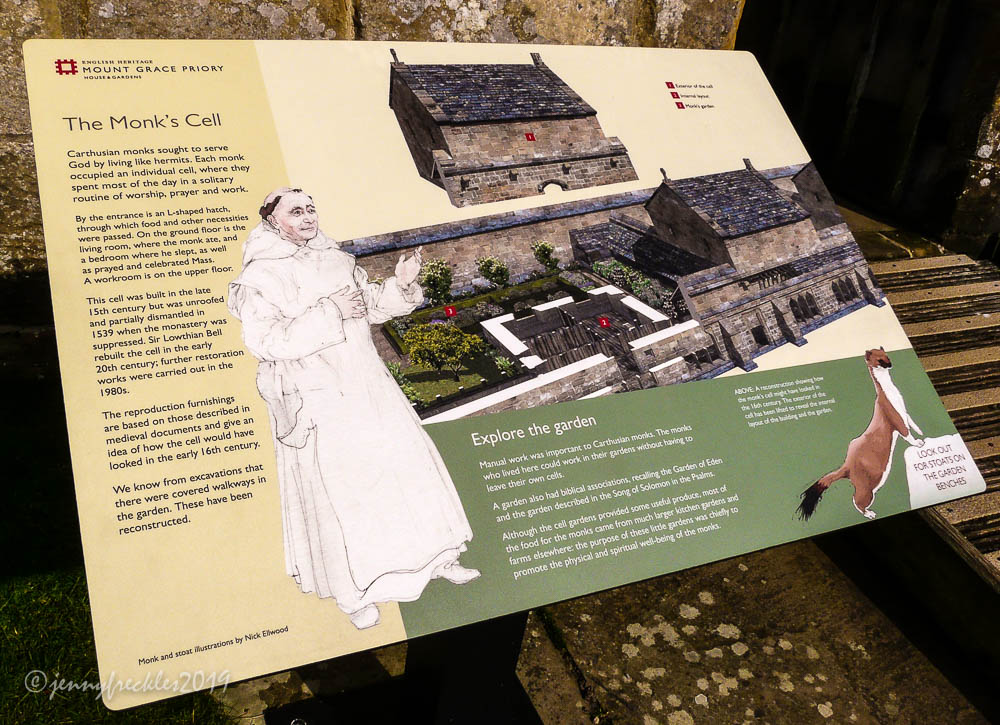
The monk's cell


One of the monk's cells at Mount Grace priory has been rebuilt and furnished as it would have been when the monastery was in use in the 1400s. Carthusian monks lived as hermits, spending most of each day alone in their cells, in prayer, worship and work. Though their cells were simple they were not, apparently, spartan. They were actually quite spacious houses, with a sitting room, bedroom, latrine and a sanctuary used for prayer and writing. They had a piped water supply. Upstairs was a workroom. Some of the monks were weavers, others copied and illuminated manuscripts and some were bookbinders. Each cell had its own walled garden with a covered walkway, where the monk could walk and pray. Here, they grew herbs and plants but its main purpose was the spiritual and physical wellbeing of the monks, since meals and other necessities were delivered to them through a hatch in the wall. I have to say I found it fascinating to learn about. The way historical places are set out and explained these days is often really good.


Saturday, 30 March 2019

Mount Grace Priory


It was the first day of Spring! After a week or two of rain and wind, it did actually feel quite spring-like and I felt I needed a day out to celebrate. I went to Mount Grace Priory, which lies on the edge of the North York Moors National Park near Northallerton, about 50 miles north-east of Saltaire. It is a ruined medieval Carthusian monastery, founded in 1398 and dissolved (as they all were) by Henry VIII in the 1500s.

Carthusian charterhouses were different from many of the other monasteries, which were strong and active communities. Here, the monks lived as hermits, in their own cells (small houses really), only coming together in the chapel for the nocturnal liturgies, and on Sundays and feast days. They were a silent order and strictly vegetarian.

The plan of the monastery, therefore (see model on left) was a church and individual cells arranged around a central cloistered courtyard. There were at least 17 monks and a small community of lay brothers who looked after them.


The site now belongs to the National Trust, and is administered by English Heritage. The church is ruined but some of the graceful archways and the tower still stand. 


Within the ruined sanctuary is a powerful, modern sculpture by Malcolm Brocklesby: The Madonna of the Cross. Here, 'the Madonna is portrayed not as a meek figure but as a determined young woman, who understands the wonder and importance of her calling and dedicates her child to the purpose of the Creator. The sculpture incorporates both nativity, crucifixion and resurrection - the three facets of Christianity that establish the atonement of mankind'.  


Monday, 4 March 2019

Inspired by...


There are two huge old barns in the grounds of East Riddlesden Hall, dating back 400 years to when it was a thriving farm estate. The Airedale Barn has been cleaned up and weatherproofed and is used for weddings and exhibitions. When I visited, there was a display of work by Barbara Greene, National Trust artist in residence. She has been inspired by fragments of china, glass, bone, fabric and nails found during the renovation of her 17th century farmhouse up the valley in Cononley. She has created small sculptures, artist books, boxes and textiles, displayed as a 'cabinet of curiosities' and tracing the connection between the objects and the lives of people who have lived and worked in the Aire valley. The exhibit shown was called 'Fibonacci sunflower' and I thought it was rather pleasing. 

The other barn, the Great Barn, remains in its rough state: dark and somewhat mysterious, despite the four sets of huge barn doors. I love just standing inside, allowing my eyes to accustom to the dark and then noticing the stone flags of the threshing floor, the old farm carts and the implements stored inside. Above it all, my gaze is always drawn to the massive oak beams, with their matching marks used when it was being put together (like a 400 year old 'flat pack'). The barn would have been used to thresh and store grain, as well as sheltering animals. It always feels very peaceful to me. I think it resonates with my links to the farmers and labourers that abound in the paternal line of my family tree. 


Sunday, 3 March 2019

NT East Riddlesden


Although it's quite expensive, I've decided to renew my National Trust membership for another year. It's often costly to get into NT properties anyway, so if I visit a few (like I did last year) I will get the most out of it. I've decided I like the feeling of 'ownership' that you get from being a member and contributor. It's good to be helping to care for the lovely places. It also means I can pop along to my nearest NT property, East Riddlesden Hall, anytime I like. It's quite a small property, a 17th century manor house - but 'perfectly formed', as they say. (Click the label at the bottom of this post to see more info and photos taken on other visits I've made here).

Despite the warm weather, the gardens are looking a bit bare as yet, though there were snowdrops and crocuses in the woodland garden.


The house sits on a ridge above the flood plain of the River Aire (which runs through the trees on the right) and there's a good view of the valley from the side garden. The property's estate includes the field lower down and there's a nature trail to explore beside the river.


Sunday, 14 October 2018

The gardener just popped out...


By the time we'd wandered round to the huge, walled kitchen garden at Clumber Park, it was raining heavily, which was a shame as it was the most interesting bit (to me). We had a quick walk up the main path, through the beautifully colour-graded herbaceous borders, to the vast glasshouses. It was too wet to explore the vegetable gardens and orchard though I understand that, like most of the National Trust properties with gardens, the produce grown there supplies the NT café on the site with fresh fruit and vegetables.

There are stores and offices behind the glasshouses, some used by the current gardening team and some set out with old tools and pots to suggest how they would have been used in the glory days of the estate. It was nicely nostalgic, bringing back memories of my grandfather (who was a keen gardener) and my dad, who was more a dutiful gardener than a keen one but who used to supply our family with potatoes, beans, rhubarb and suchlike from the plot at the back of our home.


Saturday, 13 October 2018

Clumber Park


Clumber Park is situated in the area of Nottinghamshire known as 'The Dukeries' because of the number of country estates found there. Once the home of the Dukes of Newcastle, it is now owned by the National Trust. The original mansion that stood there was demolished in 1938, but the Gothic Revival chapel of St Mary the Virgin remains, as do some of the outbuildings and a large, walled kitchen garden. The extensive estate is landscaped around a lake, and there are acres of woodland and heath to explore.

One of the entrances is famous for having the longest double avenue of lime trees in Europe. (I didn't manage to get a photo of it.) The recent TV coverage of the Tour de Britain cycle race showed the peloton streaming down the avenue and it brought back childhood memories of family picnics there, as it is only a few miles from where I was brought up. I suggested to my sister that we should revisit it and we had a happy few hours exploring, even though the weather was a bit dull and drizzly. Sadly, the chapel was closed for maintenance so we couldn't see inside.


Sunday, 7 October 2018

Gawthorpe's Great Barn


In the grounds of Gawthorpe Hall, there is the Great Barn which was built around 1603. The adjoining coach house, a Victorian addition, is now used as a tea room.


You can't enter the barn, which appears to be used for storage and events, so I took a photo through a window. It is rather magnificent, said to be one of the largest aisled threshing barns in Europe. The aisled design allowed greater space for threshing grain and for storage. Interestingly, in the 1950s the barn was used by Burnley Football Club as a training ground. The club now have modern facilities on the estate.