I HAVE CLOSED DOWN THIS BLOG. Please click the photo above to be REDIRECTED TO MY NEW (continuation) BLOG.

Thursday, 26 September 2013

Saltaire singing


Saltaire's famous United Reformed Church provides a lovely backdrop for this community choir, performing at the Saltaire Festival. The weather on the final day of the Festival was wonderful, sunny and warm. You can see, however, a hint of autumn creeping into the foliage.

Wednesday, 25 September 2013

Bollywood in Saltaire


This elephant is always a popular attraction. It used to stand on the roof of The Aagrah (a highly-regarded Indian restaurant) just down the road from Saltaire. Now it is brought out for special events.

It had a starring role in the recent BBC production of 'Bollywood Carmen Live', filmed in June in Bradford's City Park. Loosely based on Bizet's opera Carmen, this updated romantic tale had an Indian film star, Abhay Deol, in the lead male role.  He made a spectacular entrance, riding this elephant. With colourful costumes, pop-song mash-ups, a reworking of some of Bizet's classical music with a Bollywood twist and lively dance routines, it was a spectacular celebration of 100 years of Indian cinema and Bradford's status as UNESCO City of Film.

The elephant had a more sedate role as part of the Festival in Saltaire's Roberts Park, advertising the Aagrah food tents and cookery demonstrations.

Shipley is a great place to come if you like exotic food. As well as The Aagrah, another Shipley restaurant Shimla Spice has just won an award for Best Curry House in England.

Tuesday, 24 September 2013

Raku


If anyone ever wants to buy me a gift (!) I would gratefully accept one of these raku pots from Mary North and Brian Evans, The Old Brewery Pottery in Keighley. They were exhibiting outside Victoria Hall as part of Saltaire Festival's local Makers' Market. I adore the colours and subtle patterns produced by raku firing, a complex process that originated in 16th century Japan. (Read about it on the potters' website.) As well as making ceramics, they teach courses too. I'd love to have a go at it. (Another retirement project!)

Monday, 23 September 2013

Festival comings and goings


The second weekend of Saltaire Festival always sees the crowds out in force. This year, the main music stage was moved down into Roberts Park. No doubt many village residents were pleased, as it's not a lot of fun having people perched on your windowsill, drinking, whilst loud rock music throbs into every space. So the change was welcome in many ways but the downside was that I think it diluted the festive atmosphere in the centre of the village. Nevertheless, it didn't deter the crowds, as you can see from this shot of Victoria Road. There was still lots on offer in the village - the continental market, a few street artists, a vintage fair and music at Caroline's, among other attractions.

Sunday, 22 September 2013

Duck food


Duck soup food was for sale on the same narrowboat that was selling the painted canal ware. As most of us were growing up, going 'to feed the ducks' in our parks, canals and rivers on left-over bread and cake was often a family tradition. (I guess most of us tried eating the stale bread ourselves too!)  What people often don't realise is that bread and starchy food can actually be harmful to birds.  OK, so you might only be giving them a couple of crusts - but, especially in places like Saltaire, there is a steady day-long stream of people doing exactly the same thing.  The birds are stuffed full of bread and the canal is often littered with soggy rotting lumps, causing bacterial and algal growth. The bread is not good nutrition for birds (ducks, geese, swans, pigeons and little birds too) leading to obesity, bloating and difficulty flying. The young can grow up malnourished and it discourages the birds' natural feeding behaviours. The waste also encourages pests. So it's not 'Let them eat cake' but 'Let them eat grapes, oats, birdseed, defrosted peas' - and yes, £1-a-bag duck food too. See here for the full article from birding.about.com.


Saturday, 21 September 2013

Canal crafts


The Canal and River Trust volunteers usually bring a couple of boats and an information stand to the various festivals that are held in Saltaire. At this year's Festival, moored beside the entrance to Roberts Park, there was a narrowboat selling traditionally painted canal ware. The designs have a long history and often have local meanings. Many of them feature stylised roses like these colourful heart-shaped ornaments that the artist is painting.

Friday, 20 September 2013

Ivy


I do battle with the ivy to stop it climbing the stonework of my house, but in some parts of Saltaire it has been allowed to grow up unchecked - and it does look quite attractive, I think.

Thursday, 19 September 2013

Love and peace


Don't ask me why the hairdresser in Saltaire always has a 'quote for the week' written up outside... Thankfully, the power of love seemed to be triumphing in the queue outside the bakery.

Wednesday, 18 September 2013

Harvest festival


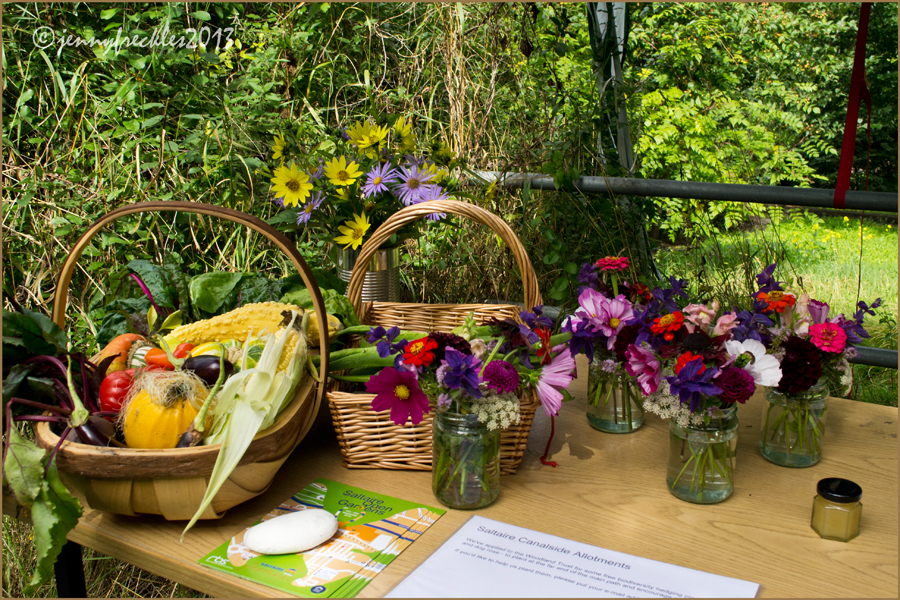
This display of flowers and produce from Saltaire's Canalside Allotments looked so colourful and inviting that I couldn't resist a photo. There was also an interesting display about honey bees; there are beehives right at the bottom of the lane. I know bees are vital to our social economy, as pollinators of crops. What I didn't know is that worker bees are all female, they only live for four to six weeks - and one bee will only produce about 1/12th of a teaspoon of honey in her lifetime!  See more fun facts here.

Tuesday, 17 September 2013

Bunting and bounty


Autumn's harvest is a good one this year after our fabulous summer. The apple trees are laden and the berries are ripe - and if you have a greenhouse on your patch, well, tomatoes are there for the picking.

Monday, 16 September 2013

Secret gardens


Suddenly we find ourselves in a secret garden... in fact, many gardens: the Canalside Allotments. These have been here since Saltaire was built.  The village houses have tiny gardens or yards but Sir Titus Salt and his architects wisely realised that people needed green space and a place to grow vegetables and flowers. These allotments are squeezed behind the church, between the railway and the canal. You might not even realise they are there. Privately owned, they are usually locked and out of bounds to casual visitors. There is a huge waiting list for one - hardly surprising, since they offer such a tranquil green oasis. I got talking to one lucky allotment-holder and she confessed to escaping down here on summer evenings, after a busy day, with a bottle of wine and a good book - so it's not all hard work!

They even feature in a book: My Cool Allotment by Lia Leendertz.

Sunday, 15 September 2013

Down the lane


Come with me on a little journey... We walk down Victoria Road and, just past the railway station, we turn up the drive beside Shipley College's Mill Building, once the old Saltaire Dining Hall. We follow the lane that leads past the church, pausing to nod to Sir Titus Salt, laid to rest in his mausoleum.  Soon you would not think you were right in the middle of the village...

Saturday, 14 September 2013

Stopped in my tracks


I popped into Bradford's Industrial Museum the other day to see an exhibition entitled 'Hard Graft: Yorkshire at Work'. It celebrates local history through the industrial technology, engineers and craftsmen who shaped our landscape. (Alan Burnett, I think you'd enjoy this too!) Based on a book written by photographer/illustrator Terry Sutton, paintings, photos and text are placed with key exhibits from the museum's collection. I found it surprisingly absorbing, so that I only had time for a brief trip into the museum itself.  I enjoyed this little corner of random but evocative bits of nostalgia. Those 'Halt' road signs used to be everywhere when I was a child. I never really noticed them disappear but they all got replaced by more modern Stop signs. The Esso sign reminded me of the Saturday job I used to have as a teenager, at an Esso petrol station - in the days before filling your car with petrol became a self-service operation.

Friday, 13 September 2013

Locked


'I thought how unpleasant it is to be locked out; and I thought how it is worse, perhaps, to be locked in.'
Virginia Woolf

Thursday, 12 September 2013

It's nearly time....


....for Saltaire Festival 2013. It starts on Saturday 14th for a whole week and there is LOTS going on!          

See here for details.

Wednesday, 11 September 2013

Listers Mill stands guard


The other end of the panorama started yesterday (missing out a significant proportion of what lies between the two images). This is the camera swung round 180º from the first picture.  The dominant feature is Listers Mill, now apartments. Unlike Salts Mill, it sits on a hill and can be seen for miles around. Around it clusters Manningham, once a smart residential area for Victorian gentry, now an interesting, racially-mixed area of bedsits, flats (in the large Victorian villas) and large terraced houses. The green area of trees in the middle is where Lister Park nestles; you can perhaps pick out the large building among the trees that is Cartwright Hall, the art gallery in the park.

To the left is the edge of Bradford city centre, which sits in a bowl surrounded by hills. I'm not too sure which church the tall spire on the left belongs to. I think it might be St Paul's Church in Manningham.

Tuesday, 10 September 2013

View from on high


Sunday was one of those good, clear days with interesting cloud cover. I happened to have to drive up to Wrose, a district of Bradford that sits right on top of a hill overlooking the Aire Valley. It's a good place from which to survey the area. From there you can see a 180º panorama, from Bradford city centre on your left to Saltaire on your right. I hadn't the necessary tackle (tripod etc) or time to make a 'proper' panorama, so I just took several shots of various parts of the scene. This is looking up the valley. You can see part of Gilstead/Eldwick sparkling in the sunshine on the hill, back right. The white blocks, back leftish, are what my daughter used to call 'the three flats of Bingley' - three tower blocks - with the town of Bingley in the dip behind.

In the middle ground, right, you can see the unmistakable bulk of Salts Mill, with the neat rows of Saltaire village houses behind and to its left. The immediate foreground is Shipley town centre. Maybe you can see the square modern clock tower, just down left from the mill chimney.

Monday, 9 September 2013

A relic


Someone's leaving 'do' at work had me gracing the VM Lounge, a bar in the centre of the Victoria Mills complex. I've shown photos of the complex before (click the Victoria Mills label below). It was a huge Victorian textile mill, built almost next door to Salts Mill but some twenty years later. After it finally closed as a business, the buildings and land were bought by a property development company. The old buildings have been transformed into loft-style apartments, with some new-build apartment blocks on the site as well. Some elements remain to remind of the buildings' original use. This is a rusty piece of mill machinery but it has a certain charm and is at least as attractive in its context as some modern sculptures.

Sunday, 8 September 2013

Pretty in pink


A delicate lisianthus - a gift from a friend. I love these flowers.

Saturday, 7 September 2013

A refuge of sorts


In the 1970s, the old Southwell Workhouse building was used as a temporary refuge for women and children, until they could be found more permanent homes. One of the rooms, used then as a 'bed-sit', has been left much as it was found when the National Trust took over the building in 1997. It has been furnished in line with what past residents and staff have recollected of this period of its history. When I visited, there was an exhibition telling some of the very moving stories of women who lived here in those days - battling through tough personal times but helped along by the friendship and support they experienced here.

My visit to The Workhouse really gave me food for thought. I've also been watching the TV series 'The Mill', a dramatisation of life in a Cheshire cotton mill in Victorian times. (It had poor reviews by the critics but I've found it watchable and interesting. It's based on the historical archive of a real mill.) It shows how closely the lives of some of the mill workers were linked to the old workhouses. When extra labour was needed, the mill-owners sent to the nearest workhouse to 'buy' people out. If you received an injury or proved otherwise unfit for work, you were likely to be sent back to the workhouse. Reasonably enlightened employers like Sir Titus Salt were not in the majority, and it made me realise afresh the importance of his vision for Saltaire, in the context of the times.