Local newspapers yesterday carried this slightly alarming headline. It seems strange... Reading blogs from various parts of the world, it seems that a lot of people are having the opposite problem, experiencing more rain than usual. But we in England have had an unusually dry start to the year. All that snow last winter didn't add up to much in terms of rainfall and the spring and summer have been markedly dry. The drought is especially affecting the north and west of the country, precisely where the reservoirs that top up the Leed-Liverpool Canal are situated. It's usually the wettest part of the country, but already the area has a hosepipe ban - and now this! The report says that a long stretch of the canal from Wigan in Lancashire to Gargrave (just beyond Skipton) could be closed by the beginning of August, unless there is significant rainfall between now and then.
They say that 'every cloud has a silver lining' (perhaps not a very apt saying in this case!). It could mean more holiday boating traffic comes this way along the canal, to explore the Gargrave to Leeds stretch that includes Saltaire, instead of the more rural mid-Pennine areas. I'm sure they won't be disappointed - it may be a bit more urban but it's a very fascinating journey through history.
PS: As I write this, it's raining heavily - so it could all turn out to be 'a storm in a teacup'. ;-)
 This garden in Saltaire's Alexandra Square makes a beautiful 'chocolate box' picture at the moment, with borders and pots full of colourful plants. Whoever lives there must love gardening and obviously takes great pride in how it looks. The other side of the house, overlooking Bradford Road, is equally pretty. It is one of Saltaire's Almshouses, originally built by Titus Salt in 1868 to provide homes for elderly and infirm residents of Saltaire. It's good to see one of the houses looking so attractive, as some of them look a little bit neglected these days. For more photos and information about the Almshouses see here and here
.
 Someone has been doing a little repair work to the windows at the Riverside Court Apartments. He was up in a cherry-picker for a few days, working along the building. It looked like he was redoing the seals between the windows and the stonework, as he had a trowel in his hand. Hot work - the sun was blazing down.
This building is on the opposite side of the Leeds-Liverpool Canal from the main Salts Mill. (See this photo for the whole facade of the apartments). It was an addition to Titus Salt's New Mill, which is at the far end of the block, with the ornate chimney. At one time there was a gas works and gasometers here. The land was redeveloped during 1907-09 (during the time the Mill was owned by Sir James Roberts). These later buildings are sympathetic to the style of Salts and the New Mill but are actually an early example of reinforced concrete construction, with stone facings. They were originally connected to Salts Mill by three covered walkways across the canal; only one of these now remains. The buildings were redeveloped again in the 1990s into 97 luxury apartments, retaining the external features. They are very pleasantly situated between the canal and River Aire, and close to the rail station - ideal for those commuting to Leeds or Bradford.
 There have been some lovely summer evenings in Saltaire of late, and some beautiful skies - though usually, by the time I notice, the sunset has all but gone. The terrace of houses behind mine obscures the western sky and I can only see a small patch from my study window (which is usually where I am in the evenings.) So I look up, see a pretty pink or orange sky, grab my camera and dash out and by the time I've legged it down into the village, the best of the show is over! That's happened a few times.... though I did like this rich amber glow I managed to catch behind the tower of Saltaire's lovely church.
 You seemed to enjoy visiting Ilkley - but meanwhile, what's been happening in Saltaire whilst we've been away? Well, proud Mama Mallard has hatched a SECOND brood of ducklings. The first lot are well grown up now - must be, because you can't tell which ducks they are. (They can't all have been eaten, can they? I watched them thrive until they got quite big.) One of my favourite things is to watch ducklings scurrying about. They move so fast, on land or in the water, and look so purposeful - but they aren't! Quite comic. It's also hilarious watching them trying to jump up onto the canal bank. Like most baby things, they're sweet.
 No trip to Ilkley Moor is complete without a photo of one of the most prolific moorland plants - Bracken (Pteridium aquilinum). It is at its most attractive at this time of year, when the new fronds are just unfurling like a baby's fist. (Apparently in some parts of the world the young shoots - appropriately named 'fiddleheads' - are eaten as a vegetable, even though the plant is carcinogenic!) I can remember studying the life cycle of ferns at school - and very wonderful and complex it is too.
As to my photo, I was quite pleased with this one. I use a bridge camera rather than a DSLR, and it's hard to get a nice blurry background. You need low light and to trick it into thinking you're taking a portrait! So here is my portrait of a bracken frond!
 And here is what some of you have been waiting for.....
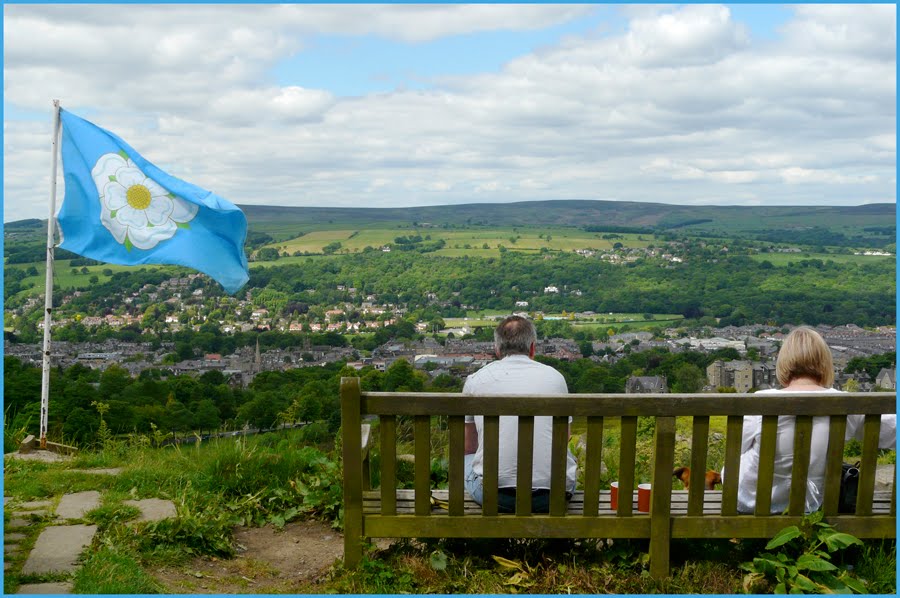
From the terrace of the small building that holds the White Wells Spa, you can sit beside the flag showing the white rose emblem of Yorkshire, and survey the view over Ilkley (with a cup of Yorkshire Tea, of course!).
Be careful if, like these people, you're not wearing a hat.... You could come to a dreadful end. "On Ilkla Moor Baht'at" is a famous comic song, sung in Yorkshire dialect, warning a lover, courting Mary Jane on Ilkley Moor, that he will die of exposure if he doesn't wear a hat. It then goes on to teach a very sound lesson about recycling! Click this link to see a fine You-Tube rendition or this link to read the words in Yorkshire - and in English!(Photo best viewed large)
 White Wells is situated half way up Ilkley Moor, above the little town of Ilkley. The story goes that in the 1700s a local shepherd badly hurt his leg, which refused to heal. He found that it began to do so after he bathed it daily in Ilkley's spring waters. Word spread, and soon other visitors came to bathe in the (cold) healing waters. Between 1840 and 1870, hydrotherapy clinics were built in the area and, taking advantage of the new railway, wealthy Victorians flocked to the town to 'take the waters', cementing Ilkley's reputation as a place of genteel elegance. Charles Darwin was famously a visitor, at the time that his book "Origin of the Species" was being published.White Wells was originally a two roomed cottage but was developed as a small spa. You can still see the spa bath - which nowadays seems to be used as a wishing well! It is owned by the Council, let to tenants and run as a tea room but these days it seems a bit neglected. It is a shame, as it's a lovely walk up to the viewpoint and a very pleasant place to sit with a drink. You would think that with an injection of cash to spruce it up and some entrepreneurial flair, it could be quite an attraction.
 Floral delights in Ilkley are not confined to the public displays in the town centre. On the road up to the moor, there are some beautiful old houses (my dream homes). I spotted this lovely arch of wisteria and honeysuckle over a door.
These are spacious, double-fronted houses dating back to the early 1800s.
 This one is currently for sale - a six bedroomed, stone-built terraced house... a snip at £675,000 (€814,000)! If you can't afford that but want the experience, The Rombalds Hotel is in the same terrace, so you could perhaps have a weekend break there instead.
 Ilkley is renowned for having wonderful floral displays. It has several times won the annual Britain in Bloom competition, in the category 'Town'. The last time was in 2004, I think. Even the local 'Pizza Express' has lovely hanging baskets and these make a welcoming sight when you arrive in the town by train, as the restaurant is adjacent to the rail station. You can sit outside on this covered terrace to eat your pizza (though I'm not sure I like the plastic roof!)
[As others are reporting too, I have comments but the number is not showing. You can still read them if you click on the comments tag, I think. And thanks to all who are commenting :-) I love reading them.]
 Wandering round the shopping centre in Ilkley is a delight. There are some lovely small shops and exclusive boutiques. You can also visit one of the original Victorian arcades - a forerunner, I suppose, of our modern day shopping malls. It has been attractively restored, with hanging baskets and a fountain.
 On a sunny summer's day, what could be nicer than to sit by the bandstand in Ilkey's little park and listen to the music? You can choose a bench in the sun or one in the shade... but be prepared to make room for someone else too! (I know what's even nicer - listening to the music whilst eating a 'Yorkshire Dales' ice-cream. I know because I tried it!)
(I hope the band will play something suitable to wish all my American friends a very happy 4th July.)
 Ilkley is one of four towns in Yorkshire that has a 'Bettys Café Tea Rooms'. (The others are in York, Harrogate and Northallerton.) Bettys is a family business dating back to 1919, when a young Swiss confectioner called Frederick Belmont came to England, intending to open a café on the south coast. The story goes that he took the wrong train and ended up in Yorkshire but, liking it, he decided to stay. There is a mystery over who Betty was, with several possible explanations.
Bettys prides itself on its traditional menu and attention to detail. The waitresses all wear uniform with white lace-trimmed aprons. It is THE best place for Afternoon Tea, with a selection of small sandwiches and cakes served on pretty china, and a wide range of unusual and specialist teas to choose from. It's also a good place for a leisurely Sunday brunch with the newspapers. (It is rather an expensive treat but one that I sometimes consider myself worthy of!) You can also buy their delicious breads and cakes to take home with you. The Tea Rooms in Ilkley has a very attractive dining room, with the largest marquetry picture ever made - a medieval hunting scene called La Chasse, made in Alsace entirely of unstained wood veneers.
In my photo, reflected in the shop window, you can see the Ilkley bandstand in the park opposite. For other participants in 'Weekend Reflections', hosted by James at Newtown Area Photo, click this link.
 There are some lovely - and interesting - places within easy reach of Saltaire, so this year I am going to 'travel around' a little more, to share some of these locations in words and pictures. I begin with Ilkley, considered by many to be the 'jewel in the crown' of this area.
Ilkley is a small spa town, in the valley of the River Wharfe, about nine or so miles over the moors from Saltaire. There was a settlement (Olicana fort) here in Roman times. It became a fashionable spa town in the 19th century and has attracted a high proportion of older and affluent inhabitants. The 2001 census recorded 20% of the population as being retired.
In consequence there are some beautiful houses in the area. The shopping centre has some lovely Victorian buildings and a high number of small 'independent' shops. There is also a Michelin-starred restaurant, The Box Tree, where Marco Pierre White trained.
 Some of you may remember back to early March, when I said they were digging up the children's playground near my house in order to revamp it. It has taken all this time for the new design to come to fruition but it opened the other day - without, as far as I know, any fanfare - and since then has been very busy and popular, particularly with parents/carers with younger children. Unusually, it has been turfed and then some kind of rubber matting laid over the turf around the swings and slides, through which the grass can grow. There are a few new trees, some colourful seats (seating was almost non-existent before), lots of bright exciting equipment... the most popular appears to be a circular net that swings....and a tarmac area for ball games - just out of my picture.
Overall it is an improvement, much more cheerful looking and it certainly seems well-used. But there are large signs forbidding entry to anyone over 14 who is not supervising a younger child. That means the youths who used to play football on the old playground are no longer allowed to, and all those young students from the local college who used to come and cuddle on the one seat (!) have been left out. (And I can't go and sit there either!) Not sure what the ban is meant to achieve - any paedophile need only stand on the other side of the perimeter fence! And the older ones used to play at different times from the little ones. I don't suppose a few signs will stop the teenagers though!
(Oh and by the way, I did buy the print of the old playground, mentioned in my earlier post.)
Some of you may remember back to early March, when I said they were digging up the children's playground near my house in order to revamp it. It has taken all this time for the new design to come to fruition but it opened the other day - without, as far as I know, any fanfare - and since then has been very busy and popular, particularly with parents/carers with younger children. Unusually, it has been turfed and then some kind of rubber matting laid over the turf around the swings and slides, through which the grass can grow. There are a few new trees, some colourful seats (seating was almost non-existent before), lots of bright exciting equipment... the most popular appears to be a circular net that swings....and a tarmac area for ball games - just out of my picture.
Overall it is an improvement, much more cheerful looking and it certainly seems well-used. But there are large signs forbidding entry to anyone over 14 who is not supervising a younger child. That means the youths who used to play football on the old playground are no longer allowed to, and all those young students from the local college who used to come and cuddle on the one seat (!) have been left out. (And I can't go and sit there either!) Not sure what the ban is meant to achieve - any paedophile need only stand on the other side of the perimeter fence! And the older ones used to play at different times from the little ones. I don't suppose a few signs will stop the teenagers though!
(Oh and by the way, I did buy the print of the old playground, mentioned in my earlier post.)
 It's hard to believe, but these meadows are almost next door to the new Titus Salt School (see yesterday). Between the school and the site of Milner Field, on the edge of Shipley Glen, lies an area of ancient woodland and meadow. It is very close to Saltaire itself - if you click my photo to make it larger, you can see the tower of Saltaire's Victoria Hall (and St Paul's church tower too). All this land used to belong to the Salt estate.
These particular fields - Trench Meadows - are a protected SSSI - a Site of Special Scientific Interest - since 1999. That means they are of national significance: 4.7 hectares of lowland meadow, a nationally rare habitat. They are south facing, on boulder clay deposits overlying Millstone Grit, forming 'unimproved species-rich neutral grassland'. I think that means the fields have never been cultivated and are kept short by grazing. They have some particular types of grasses and herbs including Black Knapweed (Centaurea nigra) and Devil's Bit Scabious (Succisa pratensis) and some orchids too, I think.It really doesn't look much at first glance - I have walked this way several times, thinking it an attractive area but not realising its significance. (In fact, some friends recently told me about it.) But it makes my heart sing to find an SSSI on my doorstep, and to know that there are people who are passionate to save and even improve these areas. It is listed as 'recovering', which means there is a management plan in place that should see the area slowly improve to its optimum state. That makes me happy!
 A recent late afternoon ramble brought me home past the new Titus Salt School. It is situated at the far side of Roberts Park, across the river from Saltaire. It opened in September 2008, one result of Bradford's £400m Building Schools for the Future programme. It replaced an older school - Salt Grammar School - on the adjacent site. I have not been inside (though I hope one day to have an opportunity to) but from the outside it looks an exciting building. It's a school for 11-18 year olds and specialises in Maths and Computing. It is, no doubt, packed full of new technology. I hope its students appreciate it!
This photo has not been heavily processed in Photoshop. The strong sunshine has rendered an almost poster-like effect to the building, which is long and low and rather art-deco in its design. The school was designed and built by a consortium called Integrated Bradford. Looks like they did a good job.
A recent late afternoon ramble brought me home past the new Titus Salt School. It is situated at the far side of Roberts Park, across the river from Saltaire. It opened in September 2008, one result of Bradford's £400m Building Schools for the Future programme. It replaced an older school - Salt Grammar School - on the adjacent site. I have not been inside (though I hope one day to have an opportunity to) but from the outside it looks an exciting building. It's a school for 11-18 year olds and specialises in Maths and Computing. It is, no doubt, packed full of new technology. I hope its students appreciate it!
This photo has not been heavily processed in Photoshop. The strong sunshine has rendered an almost poster-like effect to the building, which is long and low and rather art-deco in its design. The school was designed and built by a consortium called Integrated Bradford. Looks like they did a good job.
 This small border is a riot of colourful summer flowers. I came across it near Midgley Farm on Thomson's Lane, on the way to a little hamlet called Baildon Green. This area has several old buildings dating back to the 17th century, that were once farms and handloom weavers' cottages. In the 19th century the area had a small textile mill (Clough's) and stone quarries. Some of the land was eventually bought by Sir Titus Salt. After he built Salts Mill and started to build Saltaire around the mill, he continued to acquire large tracts of land in the locality. One of his sons, Edward, had a big house, Ferniehurst, further along the road, which is now demolished.
(I thought the flowers might cheer us up after England's World Cup disaster yesterday! I'm supporting Ghana now - I got that team in our office draw!)
 Another view of Shipley Wharf, which is along the Leeds-Liverpool Canal about half a mile east of Saltaire. You can see Salts Mill chimney in the distance - the one at the far right side.
Shipley Wharf is home to Apollo Canal Cruises and Dream Achievers, who run pleasure cruises along the canal, so there are always several boats moored here. "The Cut Waterside Restaurant" is tucked in behind the boats - you can dine at tables on a covered terrace, with a pretty view of the canal. I've never tried it but it has some recent very good reviews. (Its own website currently seems to be undergoing a remake and is unavailable.)
 I've been meaning for a while to post a 'Weekend Reflections' photo on my blog. [Click here for more, hosted by James at Newtown Area Photo.]
And now I have the perfect opportunity, as there were some great reflections on the Leeds-Liverpool Canal a couple of mornings ago. This is part of Shipley Wharf, about half a mile outside Saltaire. The old stone warehouses have been renovated into offices, a gym and a restaurant. The white wooden structures overhang the canal and, I guess, goods would have been dropped into the holds of barges from there. But the little boat is more reminiscent of a gondola than a traditional canal narrowboat....
Oh yes, the answer to yesterday's puzzle... on Wednesday afternoon 23 June, England were playing Slovenia in the football World Cup and HAD to win to stay in the tournament. (And we did, just! - phew!) So everyone went home, or to the pub to watch the match. It was only dedicated souls like me who stayed at work... and the streets were deserted when I walked home! Thursday saw things revert back to normal and the usual rush-hour traffic jam on Saltaire Road. You had some creative guesses. Malyss, I'm sure the kids would love to stay home on Wednesdays but sadly go to school like everyday. And yes, Vicki, we do some strange things here, like drive on the wrong side of the road!
Saltaire Road 4.45pm Wednesday 23 June 2010 Saltaire Road 4.45pm Thursday 24 June 2010
 I know these are crummy photos but - spot the difference? I'll leave you to work out the reason for the difference.... and which one is the more typical picture.
 Such a beautiful summer morning in Saltaire yesterday... I started taking photos on my way to work and didn't want to stop and go inside! The light had that limpid quality that I remember from holidays in hotter climes, and the gentle warmth of the morning promised a wonderful day to come - and it didn't disappoint. The air was particularly clear and I liked the early sunshine on Salts Mill chimney. It really is a landmark, standing like a sentinel, watching over the village and mill. It's a shame that its ornate top piece had to be demolished some time ago, as it was unsafe. The verdant trees make this plain little alleyway look like a country lane.
 Saltaire's Victoria Hall, formerly known as The Saltaire Club and Institute (see also my post of 8 July 2009) catches the evening sun quite beautifully.
The Institute was opened in 1871, as Sir Titus Salt wished to provide a social club and educational facility for the residents of his village of Saltaire (most of whom worked for him in Salts Mill). Like other buildings in the village, it was designed by the architects Lockwood and Mawson, in the Italianate style that was popular at the time. It is still used for the benefit of the local community - for meetings, evening classes, concerts, weddings, vintage and craft sales and all manner of other activities.
Click on the 'Victoria Hall' tag below to see other related pictures.
In response to T Becque's question in last Sunday's comments - Where is Saltaire in relation to London? - it's here: It looks quite a long way, but England isn't very big really! It is about 175 miles (281 km) from London and takes less than three hours to travel by train from London, via Leeds, to Saltaire.Saltaire, when it was first built, was a village (or township) in its own right. Sir Titus Salt deliberately chose a greenfield site, away from the centres of population at the time, because he was appalled at the poverty and disease-ridden slum conditions in the centre of the nearest city - Bradford - where his existing textile mills were situated. But gradually over the years, urban development has spread so that now Saltaire and Shipley, the nearest small town, have almost merged to become part of Bradford's suburbs.It takes about 14 minutes by train from Saltaire station, travelling south, to get into the centre of Bradford. It also only takes about 17 minutes to get to Leeds, which is to the east. Leeds is the other big city in the area, larger and more prosperous now than Bradford. Perhaps in the weeks to come I will show some photos of these two cities. They were both proud and important northern cities, growing as a result of the Industrial Revolution in Victorian England. They have very different characters and Leeds has developed and prospered very differently from Bradford in more recent times.
 I really haven't a clue what this attractive little flower* is, but it was quite happily clinging to a wall in the front garden of one of Saltaire's village houses. There's something that appeals to me about the rough stone counterpointing the fragile flowers. Even the shortest errand through the village can delight with little surprises like this. And each time I walk through the village I see something I haven't noticed before.
* Doing a Google search I've found this little Dalmatian Bellflower (Campanula portenschlagiana) which looks very similar to me - but I'm not a gardener at all! Perhaps someone can enlighten me.
 There's nothing more pleasant than a gentle stroll along the canal bank on a warm summer's evening - though the fishermen obviously think it better to sit, watch and wait. I have never tried fishing - looks like you need more patience than I possess. But as an excuse for doing not a lot, perhaps it's a good one! This is my favourite stretch of the Leeds-Liverpool canal, the half-mile between Saltaire and Hirst Lock.
 Just a few yards up Exhibition Road from where I took yesterday's picture, you arrive at the entrance to Shipley College's Exhibition Building. This was originally known as 'the New Schools of Art and Science'. The Schools of Art and Science housed in the Institute (now the Victoria Hall) proved so successful that by the mid-1880s more space was needed and the Salt School governors, with the encouragement of Titus Salt Junior, decided to build an additional facility behind the Institute. Money was raised by holding the Royal Yorkshire Jubilee Exhibition, opened by Princess Beatrice (Queen Victoria's daughter) on 6 May 1887, in the building and on the surrounding land. The building is less ornate than Saltaire's other public buildings and it lies just outside the designated World Heritage Site. Neverthless it is a pleasing building and still serves well as one of the bases of Shipley college.
The Exhibition Building holds most of the Saltaire Archive - a unique collection which includes books, newspapers, Salt family memorabilia, photographs, maps, plans, illustrations etc. on the history and present development of Saltaire. It is available to view by appointment and will also be open to the public during August this year: from 2 to 13 August 10am-4pm Monday to Friday.
 On Caroline Street in Saltaire, just opposite the Social Club (see my photo of 12 September), there is a high hedge of privet mixed with beech and hawthorn. What many people probably don't realise is that the hedge hides a rather nice garden, complete with large glasshouses. These belong to Shipley College and are part of their horticultural training department.
(What many people also don't realise is that the famous gardener, broadcaster and novelist Alan Titchmarsh started his horticultural training here, aged 18 in 1968, studying for a City and Guilds Certificate.)
Leaning over a gate and contorting myself a bit, I managed to get this photo of the garden, with Salts Mill in the background. In fact, Salts Mill sits in quite an oasis of greenery, since there are also allotment gardens alongside the railway line.
 Exactly a year ago, on 17 June 2009, I tentatively composed my first ever blog post. I'd been thinking for a while that 'someone ought to do a Saltaire Daily Photo blog' and, on the spur of the moment, decided I would have a go. I set myself the challenge of posting a picture a day for a year - and I'm delighted to say I DID IT!
On the downside, the house is a little scruffier (something has to give, and in my case it's been housework!) and I sometimes stay up later than is wise, exploring everyone else's fascinating blogs... But I have to say I have enjoyed the challenge way more than I anticipated. I have become even more passionate about Saltaire and the lovely area in which I am fortunate to live, as I've opened my eyes to its beauty and learned more about its history. I have become a much more active citizen and a much more active person, always now preferring to go out with my camera when the weather is fair, rather than stay in. And I think (hope!) my photography skills are improving.
What's more - and something I didn't really foresee - I have discovered a whole world of brilliant blogs out there, and I delight in the camaraderie that comes through tuning in regularly and exchanging comments. Many, many thanks to those regular followers of mine - you enrich my life immeasurably and I really look forward to reading your posts, seeing your pics and sharing a little in your lives. ( I also realised I like seeing photos of you all. But I have never shared one of me - so I've recently remedied that by putting my smiling face on the side bar. Hello!)
I know I have a bunch of friends and local people who also read my blog and who have been really encouraging about it. Thanks folks!
So will I carry on? You bet! I did briefly wonder if I should stop now and feel the job well done - but I am enjoying it too much. I will stop, if ever it starts to feel more chore than pleasure... life's too short to waste it. And - given that there are only so many photos one can take in roughly a square mile of territory (even one as full of interest as Saltaire) without becoming repetitive - I will probably allow myself more 'excursions' to other places, even though I will keep coming back to Saltaire. This is, after all, my home and the place where I reroot, regroup and refresh, in order to venture out again.
I hope you'll journey with me through year two. Let's get going!
 This is the view from the window of the room in Shipley College where my Photography course was taught. (The course has ended now, sadly. I shall miss it, as I really enjoyed learning.) Shipley College - a Further Education College for adults - uses various buildings in Saltaire village, including the Exhibition Building and the old Dining Hall. My course took place in what used to be the village's Factory School. It is situated right in the village centre opposite the Victoria Hall, and this photo is looking north across the rooftops and down towards the United Reformed Church, whose tower you can see. The roofs may not have quite the beauty of those old red-tiled sun-baked houses you see across Europe - but the blue slate and honey-coloured local stone gives it all a certain charm. Wherever you stand in Saltaire, you can not only see buildings but also a swooping view up towards Shipley Glen and Baildon Moor. It's a refreshing reminder of why Sir Titus Salt chose this greenfield site outside the city, to build his mill and village.
 This is part of one of the lock gates at the Five Rise Locks in Bingley. It's the mechanism for raising one of the sluices at the bottom of the gate, through which the water passes to fill the lock chamber up (or to empty it into the next chamber down.)
For a simple, animated explanation of how a lock works, click here. It's pretty cute. And there's a slightly more technical but extremely fascinating account of exactly how the Bingley lock keepers work the staircase ("staircases without side ponds") and why the locks at Bingley are not very water-efficient compared with some others - click here.
 Climb to the top of the Five Rise locks and you are rewarded with a good view back down the Aire valley towards Bingley. The canal follows the line of trees (or vice versa, I suppose!) but then veers to the right in front of the buildings you can see. At one time that was a mill, now converted, as are so many in this area, to apartments and houses, which have a nice outlook over the canal. You can also see the big black chimney of the Damart factory and, just behind that, the rather ugly (to my mind) 1960s concrete building that used to be the HQ of the Bradford & Bingley Building Society - a casualty of the banking crisis. There's a picture on this page - locals have dubbed it 'the Hanging Gardens of Babylon'. Prince Charles once said it was 'the ugliest building in Britain'!
You will note that I took this picture earlier in the spring. Once the trees have leaves you can't see so much.
 As I mentioned a few days ago, the Five-Rise Locks in Bingley is a few miles along the Leeds-Liverpool Canal from Saltaire. This is a hugely popular spot with locals and tourists alike. It's a very pleasant stroll from the centre of Bingley - which is itself quite an attractive little market town. You pass the Damart factory (stock up on your thermal underwear for the winter from the mill shop!) and then climb alongside the three-rise lock. A further short walk brings you to the five-rise. At the top there are always boats moored and there's a nice little café too, where you can sit outside in the sun (perhaps!) and watch the activity.
The locks (and therefore the canal from Gargrave to Leeds) were opened in 1774, with 30,000 people enjoying great celebrations, all the local church bells ringing and a ceremonial firing of guns by the local militia!
It's fascinating to watch how the lock keepers move the boats up and down the stair. Because it involves very intricate series of moves, which have to be done in the right order, lock keepers are employed full-time there and the locks are locked(!) at night. As you can imagine, it takes quite a while - a good hour and a half - to move a boat up or down the whole series of five locks. And with the three-rise just a bit further on, boaters are advised to allow plenty of time to negotiate this stretch of the canal. (There's a funny little time-lapse film of a boat going through Bingley's three-rise lock on this link.)
 We interrupt this blog to bring you an important announcement.... just in case you missed it - there is some kind of sporting competition going on in South Africa....LOL.... I don't think you will have missed it, wherever you are in the world! Yes, of course, it's the World Cup, and England's football team are battling it out today in their first match against the USA. The whole of England seems to have turned red and white. The composite selection of flags above are just some of those I pass on my way to and from work, on houses, businesses and cars. Even the Prime Minister is getting in on the act: he said during Prime Minister's Question time in the House of Commons that he will be flying a St George's flag over 10 Downing Street ( at no expense to the British taxpayer!) And one keen fan has laid real turf on his sitting room floor! I'm not averse to a bit of football but I don't know if I can remain interested for a whole month. Oh well, come on England!!
PS: Today is also the annual Trooping of the Colour ceremony in London, in honour of the Queen's birthday. On my other blog there are some photos I took recently of the rehearsal for that parade.
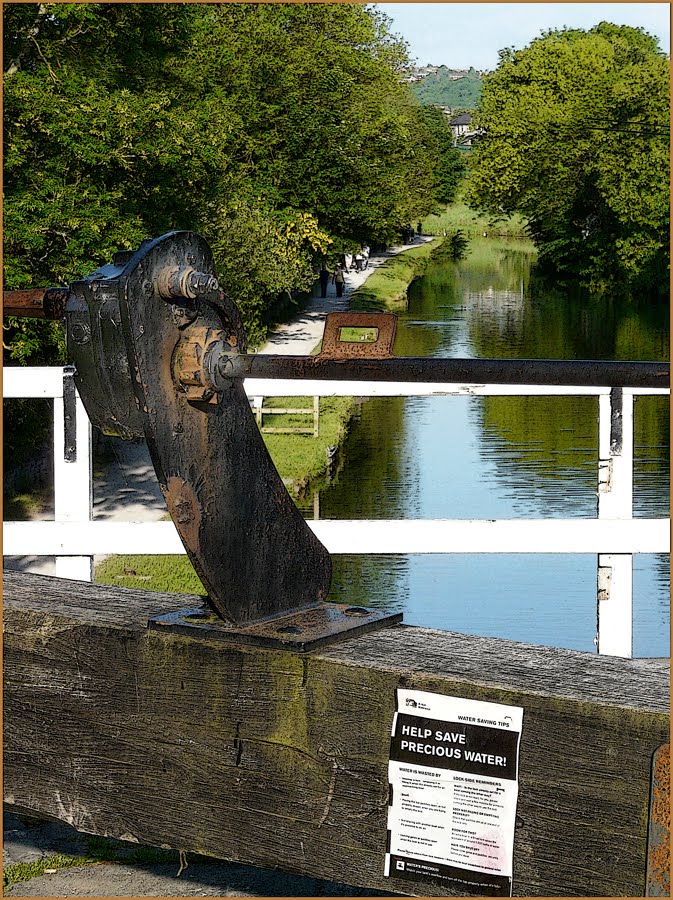
 There is something that fascinates me about locks and lock gates - the old weathered wood and the complex variety of metal plates, cogs and levers. I liked the pattern of the creeping rust on this plate and bolt at Hirst Lock.(This photo seemed to need 'something' so I have tried a different framing style on it - with thanks to Scott at his brilliant blog for the idea and explanation. I don't think I've done it as well as he does, but it makes a change and is all part of my rapid learning curve. I love it that bloggers are so ready to share their techniques so we can all learn and develop. Thanks Scott! - and all my other lovely blog friends, from whom I learn so much.)
 As I said in yesterday's post, there was at one time a lock keeper's cottage and a farm at Hirst Lock, just outside Saltaire. The buildings have disappeared but I have this old photo (courtesy of Dorothy Burrows) which shows the farm as it used to be. Apparently in the early part of the 20th century Hirst Farm was a popular weekend destination for families, offering horse rides, home-made ice cream and a café.
The River Aire and the Leeds-Liverpool Canal at this spot run alongside each other and there has been a mill here since the 1700s, using the river to turn its water wheel to power the machinery. The mill was originally a corn mill but later made paper. It was rebuilt in the 19th century and has now been converted into flats (see this link for a photo). There are other cottages and houses in the hamlet, built in the 1860s, which still stand, though they too have had various conversions and additions.
 There are eleven locks and an aqueduct on the Leeds-Liverpool Canal between Shipley and Skipton. The nearest to Saltaire is Hirst Lock - an uncomplicated single rise lock situated about half a mile out of Saltaire. It raises the canal 10 feet 2 inches (over 3 m) to a height of 216 feet (about 66 m) above sea level. It's a really pleasant walk along the towpath on a summer evening, and there's generally plenty to look at (and photograph).
Some of the more complicated 'stair' locks - the two-rise at Dowley Gap and the three and five-rise locks in Bingley - have lock keepers on duty in the summer months, to assist holiday-makers who have hired narrowboats and who may not be entirely familiar with the complex sequence of moves required to fill and empty the locks. But it seems that Hirst Lock is deemed easy enough, even for novice boaters. There is, however, a notice reminding people how not to waste water.
In times past, there was apparently a two-storey lock keeper's cottage here at Hirst Lock, alongside Hirst Farm, but both these buildings were demolished in the first half of the twentieth century.
 Saltaire's Boathouse Inn, shown yesterday, is sandwiched between the Leeds- Liverpool Canal and the River Aire. Its entrance is just alongside the entrance to Roberts Park, and sports this rather attractive sign.
You can see some wonderful photographs, taken throughout its history, on the Saltaire Village Website and in the Francis Frith Collection. The building did actually start life as a boathouse. In Victorian times, the river seems to have been quite a bit wider and deeper at this spot and it had a large pleasure boat (steam-powered!), as well as rowing boats for hire. (I think it would be nice if they brought the boats back, since Roberts Park has been renovated.) Remember that Sir Titus Salt strongly disapproved of the demon drink and would not allow licensed premises in the village. I'm not sure when the boathouse was converted into a bar, but it was quite a while ago. Some things have changed!
 (View large)This is where the locals seem to hang out on a sunny summer evening - The Boathouse Inn, Saltaire, down by the River Aire overlooking Roberts Park. The terrace nicely catches the evening sunshine and it's a soothing and pleasant place to relax, looking out over the water, at the end of a busy day. (You may even be able to watch a cricket match on the opposite bank too!) I had another picture of it on my blog last year (see December 7), when I reported that it has recently been totally rebuilt following a fire. That must, in the end, have been a blessing in disguise because the revamped bar-restaurant is clearly doing a good trade. For a foodie review, see another great Saltaire blog - them apples. I must mention (mainly for Alan's benefit... the writer of the Great Yorkshire Pubs blog has to be interested in the ale...) that it has on tap, among other things, the local Saltaire Brewery's Saltaire Blonde, which I'm told is excellent.
(Umm, I wonder if I should have cropped this and removed the sky? I wanted to show the church tower just peeping through - but that puts the roofline of the pub right in the midline of the picture...)
 "Ne'er cast a clout til May be out" is a well-known English proverb. There is some doubt about its meaning. The first bit about casting a clout is easy enough - it means don't take your (warm winter) clothes off. But the second bit, about May being out, could be taken to mean when the month of May is over or when the May (Hawthorn) blossom is out. Either way, at the beginning of June and with the hedgerows in full bloom, you'd think we'd be safe enough contemplating bare legs and sandals.I think the May blossom is quite late in flowering this year - not surprisingly, given how cold it's been. But, as you can see, there's plenty of it. The blossom is commonly white, but there is a wonderful tree full of palest pink blossom beside the canal and another darker pink further on. There is even a red one by the car park in the middle of Saltaire, but I think that is a garden variety. I think it's a very pretty blossom, forever linked in my mind with May Festivals. As a child that meant family fun at the May Fair at Wellow in Nottinghamshire, watching children dancing around the maypole, weaving intricate patterns with their ribbons and then, just as marvellously, unravelling them (see this link.) As a little girl, I thought it was magical.
 I spotted this door, adorned with a beautiful clematis, at a house on William Henry Street in Saltaire. I think they must use the back door to go in and out of the house!If you'd like to see what the street as a whole looks like, look back a year to this link - that picture is of George Street, which is the one next along from William Henry Street, in the oldest part of Saltaire. The houses are very similar, all built at the same time in 1854.I'm fascinated by doors - and am delighted to find a whole blog devoted to pictures of them. If you're addicted too, take a look at Cat's blog: The Door Hunter.
 Sad to say that this area is in the spotlight for the wrong reasons at the moment. A man has been arrested and charged with the murders of three women in Bradford, following the discovery of remains in a rucksack in the River Aire just outside Saltaire. In consequence, the whole area is teeming with police and parts of the river have been cordoned off whilst they conduct methodical underwater searches. There are police support officers stationed at every place where you can access the river bank - hence this police van parked on the Victoria Road bridge across the canal in Saltaire. (There is a path that links the canal towpath with the riverbank, just past the Mill.)
I got talking to the chap on duty by the canal gate. They have had officers there night and day for over a week... pity the poor guys who had to stand on the canal bank all night with nothing to do but watch the night. It's because the river is a 'crime scene'. The search shows little sign of abating - there was a large van labelled 'Specialist and Underwater Search Unit' in Saltaire last night.
On a lovely sunny day, it's hard to believe that evil can exist, just around the corner so to speak. But I am grateful for the meticulous way British police generally operate - I know they sometimes make mistakes under pressure, but on the whole they do a great job.
 So many delightful things to do in London.... We went to the V&A (Victoria & Albert) Museum to see the exhibition "Grace Kelly: Style Icon" (which is well worth a visit if you love clothes, Grace Kelly or fantasise about being a princess).
The V&A is situated in South Kensington, in the area known as "Albertopolis". The land was purchased with the proceeds of the Great Exhibition of 1851 (Prince Albert was the driving force behind the Great Exhibition) and is home to many museums and wonderful Victorian buildings, including the Royal Albert Hall and this astonishing memorial to Prince Albert. Commissioned by Queen Victoria in memory of her beloved husband, who died of typhoid in 1861, it was designed by Sir George Gilbert Scott (who also designed the wonderful St Pancras Station in London, now the Eurostar terminal). The memorial is 176 feet tall, took over ten years to complete, and cost £120,000.
Its decoration includes the Frieze of Parnassus (which shows 169 individual composers, architects, poets, painters, and sculptors) and allegorical sculptures depicting the four continents and Victorian industrial arts and sciences. The Memorial was extensively restored and regilded in the late 1990s.
 "The Royal Family in 1846" by Franz Winterhalter
Living in Saltaire, I am reminded every day of the vision, skill and confidence of our Victorian forebears. It was an unprecedented era in British history, watched over by a Queen who was only 18 when she was crowned and who ruled for over 60 years. Her reign saw enormous changes - in the way Britain is governed (by a constitutional monarchy), in the rate of industrialisation and in the growth of a huge empire world-wide (on which, it was said, 'the sun never set'). At the heart of it was Victoria and her family. She came to the throne in 1837 and in 1840 she married her first cousin, Prince Albert of Saxe-Coburg-Gotha, with whom she had nine children. Theirs was evidently a real love-match and when he died prematurely in 1861, Victoria withdrew from public view and remained in mourning for the rest of her life. She became unpopular because of this, but in the 1880s was persuaded to return to public life. Her Golden and Diamond Jubilees (in 1887 & 1897) were enthusiastically celebrated (in Saltaire as in the rest of the country.)I have just been to London to visit my daughter and son-in-law and whilst there took the opportunity to visit the exhibition currently in the Queen's Gallery at Buckingham Palace. 'Victoria & Albert: Art & Love' celebrates the relationship between Victoria and her beloved husband through the many gifts and works of art that they bought and commissioned for each other. From the kitsch (necklaces made of stag's teeth, a sofa made of stags' antlers and hooves) to the improbable (an exquisitely decorated indoor fountain made of precious metals, enamel and gems), the fascinating (watercolour paintings of key places and events, compiled into albums much as we do with family photos) and the stunningly beautiful, it is a dazzling show. I loved this amazing family portrait by Franz Winterhalter, carefully and subtley composed to show the Queen and her eldest son and heir, Edward, set slightly apart, as the royal line - but placing Prince Albert unmistakably at the centre as the head of the family.
 Another day, another cricket match
.
For the benefit of Malyss, Scott and others who don't really understand this wonderful game (and sparked off by Vicki's comment a few days ago) here is an explanation. It's not from Wisden, the cricket lover's 'Bible' nor even from an encyclopaedia. It is actually, famously, printed on a tea-towel for drying dishes - but it is nevertheless entirely accurate.
'You have two sides, one out in the field and one in. Each man that's in the side that's in goes out, and when he's out he comes in and the next man goes in until he's out. When they are all out, the side that's out comes in and the side that's been in goes out and tries to get those coming in, out. Sometimes you get men still in and not out.
When a man goes out to go in, the men who are out try to get him out, and when he is out he goes in and the next man in goes out and goes in. There are two men called umpires who stay out all the time and they decide when the men who are in are out. When both sides have been in and all the men have been out, and both sides have been out twice after all the men have been in, including those who are not out, that is the end of the game.'
So now you know! Or, if you don't, and want a lengthier explanation, try this. This view of the cricket ground in Roberts Park in Saltaire is taken from the riverside beside the scorebox, looking across to the Half Moon Café, which has Sir Titus Salt's statue on its upper level with the bandstand opposite.


 Local newspapers yesterday carried this slightly alarming headline. It seems strange... Reading blogs from various parts of the world, it seems that a lot of people are having the opposite problem, experiencing more rain than usual. But we in England have had an unusually dry start to the year. All that snow last winter didn't add up to much in terms of rainfall and the spring and summer have been markedly dry. The drought is especially affecting the north and west of the country, precisely where the reservoirs that top up the Leed-Liverpool Canal are situated. It's usually the wettest part of the country, but already the area has a hosepipe ban - and now this! The report says that a long stretch of the canal from Wigan in Lancashire to Gargrave (just beyond Skipton) could be closed by the beginning of August, unless there is significant rainfall between now and then.