Pages
Monday, 30 June 2014
Coming along nicely
Jack asked for an update on the community gardening scheme in the Caroline Street car park in Saltaire - see here for original post. Well, although I'm very much a non-gardener, to my untrained eye it all seems to be progressing nicely. I am not sure of the rules for harvesting the crops. I presume you have to have done some of the hard work to benefit, but it all looks quite healthy - herbs, salad leaves, courgette plants (I think), beans and peas growing up the sticks. It is an interesting use of a former shrubbery in the corner of the car park.
Sunday, 29 June 2014
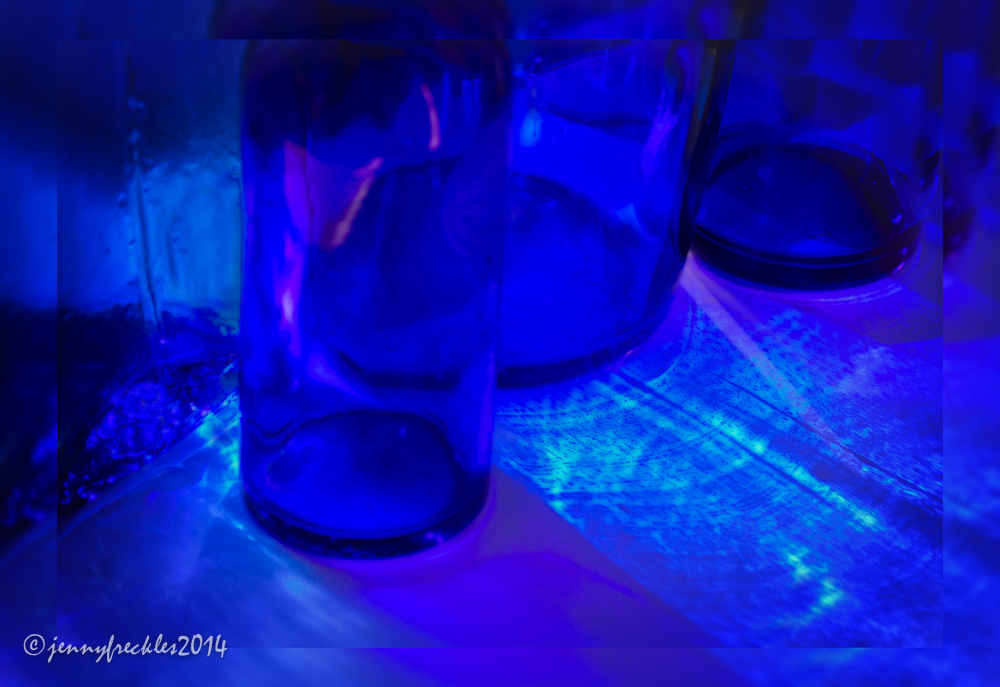
Blue like jazz
This month's theme for my online photography club is 'Blue'. I didn't think I'd find it hard - but most of the month went by without me noticing anything that might fit the theme with any panache. Perhaps if Saltaire was more Mediterranean.... but blue doesn't seem to be a colour used a great deal around here, apart from the odd front door or blue car.
I do, however, own a small collection of blue glass bottles and vases. I love the way the light shines through them so one sunny afternoon I decided to play around with them. I rarely take anything approaching a still life inside, so this was new for me. I gathered them on a piece of white paper in front of a sunny window, camera on a tripod. The hardest bit was arranging them and positioning the camera to avoid the glimpses of bright white light through the gaps. I have underexposed it a bit in post-processing to enhance the blue and put a gaussian blur layer behind.
For some reason it reminds me of a book title I once saw that has stayed in my mind: 'Blue like Jazz'. I never read it! but I thought it was a great title.
Saturday, 28 June 2014
A kind of nostalgia
In the indoor exhibition area of the National Coal Mining Museum there was this mock-up of the yard of a brick terraced house, with its coal shed (not the outside toilet!) and washing line. It reminded me very much of my grandad's house, though they also had a vegetable garden beyond the yard. Grandad lived in a tiny house by modern standards: compact little front room with a coal fire (miners got free coal), small and basic kitchen, a high-cisterned lavatory downstairs in a tiny closet just inside the back door. Upstairs there was a largish bedroom and a small one, and a little bathroom with a sink and bath - no toilet upstairs nor a shower. The small bedroom was where I occasionally stayed - and, oh bliss, the high bedstead actually had a feather mattress! I can remember sinking down into it and almost being buried in its softness. Happy memories, though I wouldn't want to go back to that sort of basic living. I can recall my great-aunt putting wet clothes through a hand-operated mangle to squeeze the water out. It was hard manual work. When I was a baby we lived with my grandad, until my parents could afford a home of their own when I was about three.
Friday, 27 June 2014
Scrubbing up
I have hazy memories of seeing the miners coming out of the mines blackened with coal dust. At one of our local collieries, the pit baths were across the main road from the pithead. All pit baths had a 'dirty side' and a 'clean side'. When you arrived for your shift, you left your home clothes in your locker on the clean side and walked through to put on your pit clothes, kept in a locker on the dirty side. At the end of a shift, the journey was reversed - dirty, wet clothes left in your locker on the dirty side (where warm air circulating would dry them overnight), into the communal showers to scrub yourself clean and then through to the clean side to collect your clothes to go home in. Even so, the environment was dirty and dusty so there was plenty of washing for the women at home to do. Each pit baths also had medical facilities. There were frequent accidents and even minor incidents like cuts and crushed hands could turn nasty and septic if not treated properly.
I can remember going to the local miners' gala, an annual event with a big parade. All the pits had their own colliery brass band and lots of banners. I can still vividly recall the sensation in my stomach caused by those huge drums being marched past, boom, boom. There were decorated floats (flatbed coal trucks) with all sorts of tableaux: people dressed up and waving at the crowds, some comic, some pretty, including of course that year's 'Coal Queen' in her finery and tiara, with her ladies around her. The parade seemed endless and hugely exciting to a little girl. It all finished up at a local park where there were lots of tents, exhibitions, food and various demonstrations in a large central arena. I recall there were always lots of things about health and safety, which by the 1960s was taken very seriously, with Mines Rescue Stations situated at strategic points in the area, within easy reach of all the local pits. Much of the working and machinery in the mines was controlled from the surface by then - but look how rudimentary the control room of the mid-1960s looks now!
Happy days to me then, but I didn't really appreciate the sacrifices all those men made and the guts it took to power our industries.
Thursday, 26 June 2014
Pit ponies
This is Eric (or was it Ernie?) He's a Welsh pony, one of a few that are kept at the National Museum of Coal Mining for England in order to educate visitors about their crucial role in the coal mines. Ponies were used in mining from the very earliest days, at first walking endlessly in circles powering the winding-engines (gins) that raised the coal up the pit shaft to the surface from below. By the mid-1700s they were being used underground too, pulling sledges and later wheeled tubs filled with coal. At the peak in 1913 there were 70,000 ponies working underground. The number diminished as mechanisation increased and the last pit pony retired in 1994. They were stabled underground and only saw daylight for a few weeks each year, but they were generally well-looked after; a good working horse needed to be well fed and well shod.
Wednesday, 25 June 2014
Winding gear
I grew up in the Nottinghamshire/Derbyshire coalfields. From the back garden of my childhood home, high on a hill, you could see several 'headstocks' with their huge, spoked wheels. They are the winding gear for the mine shafts that took the coal miners up and down into the deep seams in metal cages, and brought the coal up to the surface. I used to be fascinated to see them rotating, imagining the cages going up and down. They have nearly all disappeared now. In the first half of the 20th century there were over 1000 deep mines in the UK; now there are just three (Kellingley in Yorkshire, Thoresby in Nottinghamshire and Hatfield near Doncaster) and the closure of two of those is imminent. It is a combination of increasing difficulty in getting at the coal and economics, with cheap coal from abroad flooding the market. The closure of the pits over the years has devastated many local communities that were heavily reliant on the industry and economic recovery for those areas is a very long, slow process.
At the Mining Museum, you can actually don a hard hat and a miner's lamp and descend in the cage at Caphouse Colliery to walk along the tunnels and explore exhibits showing mining throughout the ages. The guides are all ex-miners - hard men with soft centres, I felt, and real characters too - humour and banter all the way. You get a feel for what it must have been like working in the pits.
In the early days, women and children worked down there too. Children could get into narrow spaces and were used to haul the tubs of coal along the tunnels. In 1842 women and children were banned from working underground, largely as a result of the deaths of 26 children from drowning in a mine accident in 1838, when water gushed into a tunnel.
When my forebears were miners, it was a terribly dangerous occupation. Coal was hewn by hand with picks in very confined spaces; miners often spent all day lying down in semi-darkness. There were frequent rockfalls, floods and explosions (miner's lamps often ignited gas in the mines.) In one year during the 1920s, 1297 miners were killed at work and 212,256 seriously injured. In the 1920s when grandad was a young man, there was a series of strikes and the mine owners used bullying tactics, forcing families out of their homes (which were usually owned by the company) and effectively starving the men back to work.
Tuesday, 24 June 2014
Paying homage
As yet I have done very little research on my family tree, though it is something I hope to progress one day - when I retire, probably! I do know that my maternal grandfather and both his father and my grandmother's father were miners in the Derbyshire coalfields. In homage to my forebears, I recently visited the National Coal Mining Museum for England at Caphouse Colliery near Wakefield, (about 20 miles from here) and it was very interesting.
From census information I know my great-grandfather was a coal miner when he was 16 in 1881, and perhaps even before that, and was still a miner, aged 46, at the last published census in 1911. (Census details are released after 100 years.) My grandad was a miner at age 24, in 1923, though I am not sure exactly when he started or when he stopped. It took a terrible toll on his health. I remember him as a seemingly very old man (though he died aged only 66) continually wheezing and struggling for breath. He used an inhaler and sometimes oxygen and was in and out of hospital with chronic bronchitis and emphysema - a result of years of breathing coal dust. It was such a common disease; there was a special TB isolation hospital and it was full of ex-miners with respiratory problems. They must have had such tough lives.
According to exhibitions in the Museum, mining in the 1920s was already in decline and miners were paid very little. Their wages almost halved in the space of seven years. It wasn't a nationalised industry until 1947 and the mining companies used to reduce the men's wages when prices went down. In the 1920s there was series of strikes, including the general strike of 1926 when most of the country's industries ground to a halt in support of the miners.
Monday, 23 June 2014
Field of gold
Another buttercup meadow, part of Northcliffe Park. The haze of gold is as pretty in its own way as the haze of blue that bluebells create, but buttercups don't seem to enjoy the same cachet.
Sunday, 22 June 2014
Saturday, 21 June 2014
Cruising
The tour boat 'Titus', cruising along the canal between Saltaire's mills, adds the finishing touch to this classic view.
Labels:
boat,
Leeds-Liverpool canal,
New Mill,
Saltaire,
World Heritage Site
Friday, 20 June 2014
Lacewater Vintage
I like the idea (and the look) of vintage but somehow it has never come together as a passion for me. I wish I had started collecting things at a much younger age. I do like the idea of having pretty mismatched china and I have kept one or two china teacups that my mum had. But I don't even use the extensive and perfectly matching Royal Doulton dinner service that I own. Since the 80s, when it was 'the done thing' to have OTT dinner parties in dining rooms with fancy curtains, swags and tails, things seem to have got a lot simpler!
Isn't it lovely to see one of the old 'corner shops' in Saltaire being used as a shop again? This one was once a grocery store, run in 1879 by James Parfitt and his son William Henry. It became a branch of Windhill Industrial Co-operative Society and was a shop until the mid-1960s. After that it had a spell as a launderette, and then a design consultancy. (Info from Roger Clarke's fascinating book: 'A Penny for Going'.)
Thursday, 19 June 2014
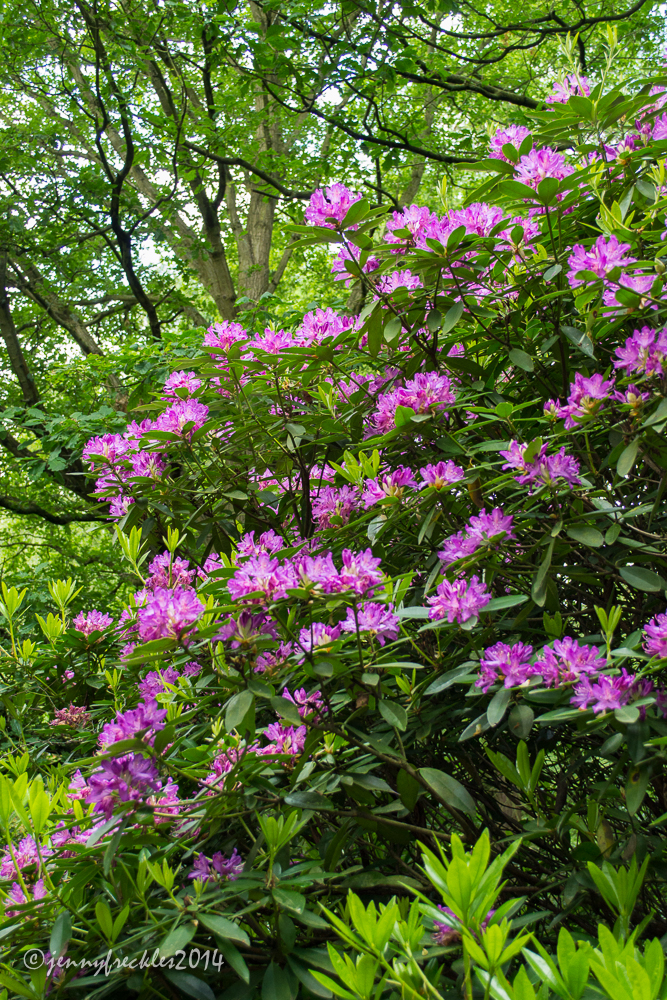
Beautiful but deadly
The showy, spring-flowering rhododendrons and azaleas in our parks have mostly passed their peak. There were only these purple ones (Rhododendron ponticum) still in bloom in Golden Acre Park. They are not native to Britain. They were introduced in the late 18th century, from Asia, Spain and Portugal. Prized for their exotic and colourful blooms, they were planted all over the country in Victorian parks and gardens. The trouble is that they are not only toxic to grazing animals but they spread quickly, via seed and roots. They rapidly crowd out our native plants, with consequent negative effects on animals, insects and birds. Notoriously difficult to control and eradicate, they are now considered to be an ecological disaster, especially in areas such as the west of Scotland, Wales and heathlands in the south of England. Efforts are being made in many areas to root out the pest.
Wednesday, 18 June 2014
Having a gander
I haven't noticed many ducklings along the canal this year, either because I'm unobservant or because there just aren't many. I think the geese have rather taken over and driven many of the ducks away. These aren't the Saltaire geese, which are mostly greylags. These are Canada geese at Golden Acre Park near Leeds. Mum and dad were keeping a careful watch over their large brood. From their alert pose and extended necks, you can see where the colloquial phrase 'having a gander ' (a good look) comes from!
Tuesday, 17 June 2014
Fun and games
I'd arranged to have coffee with a friend. We set off for a garden centre that has a very nice café, shop and gardens but on arrival found it was closed for a private celebration. Plan B (always have a Plan B!) saw us over on the outskirts of Leeds at Golden Acre Park. I'd never been before but it has some beautiful mature woodland and attractive planting. It's possible to take a circular walk around the lake though the woods, very pleasant. We arrived at the tea rooms for coffee and cake just as the sun came out so it was most enjoyable to sit on the outdoor terrace and chat.
On the way home we stopped at a huge shop called 'Hobbycraft' which sells arts and crafts supplies - all manner of exciting things: embroidery threads, patchwork pieces, artists materials, floristry supplies and decorations for cakes and parties. There's also a large section for children's toys and activities so I stocked up on felt, big buttons, pompoms and other fun stuff. Bliss, if you like that kind of thing! (Stationers and art shops come close to bookshop heaven for me). Now my granddaughter is almost three she's able to concentrate on simple games and activities, so I'm going to make a few things to mail that will occupy her. Her mum deserves a few minutes respite every now and again as she awaits the birth of her second daughter. I may live a long way away but I do my best to support!
Monday, 16 June 2014
Countdown to Le Grand Départ
You may recall me saying a couple of years ago that Yorkshire had been awarded the opening stages of the 2014 Tour de France cycle race... Well, Le Grand Départ is getting closer (5 & 6 July) and the whole county is becoming saturated with (media!) excitement. There are lots of cultural events associated with it too. There has been so much hype that I am already bored with it. Even my local garage has repainted its courtesy cars with Le Tour slogans.
This countdown clock, with its busy little cyclists through the ages (spot the penny-farthing bicycle?) is in the Trinity shopping centre in Leeds.
Given that they will close a lot of the roads, if you want to watch it you will have to get up at the crack of dawn just to secure a viewing spot - and given the speed with which the cyclists will flash past, I may just stay home and watch it on TV! I must be getting old....
Sunday, 15 June 2014
Do you like butter?
One of the flowers that I remember liking best as a child was the buttercup. Bright yellow and shiny, we used to hold them under our friends' chins and say 'Do you like butter?' If there was a patch of reflected yellow, the answer was deemed to be 'yes'!
They look so pretty against a blue and white sky. I am delighted that there are fields full of them locally, now that some of Northcliffe Park is managed as wild grassland and wildflower meadow. Delightful.
Saturday, 14 June 2014
Saltaire traffic lights
Saltaire roundabout has been Saltaire traffic lights for quite a few months now, though they are still adding the finishing touches to it. Saltaire Road was closed to vehicles last Sunday, causing some congestion at the bottom end of the village as people tried to find another route through. But it was novel and pleasant to walk up through the village and notice how quiet it is without traffic.
The new traffic lights do make it feel a huge amount safer and less stressful driving up and joining the main Bradford road. Previously it always felt like taking your life in your hands, trying to negotiate the very busy roundabout - and several people had tragically lost their lives at the junction before the will/money was found to do something about it. It has not solved the congestion problem and at rush times there is always a long traffic jam in all directions, but it is far safer, I think.
See here for what it used to look like, a view taken from more or less the same spot.
Friday, 13 June 2014
Saltaire, World Heritage Site
A recent addition to Saltaire's streetscape, this triangular stone proclaims the area's World Heritage status. About time too.... It has been added as part of the recent reorganisation of the road junction at what used to be Saltaire roundabout.
Saltaire, designated in 2001, is one of 28 places in the UK to be awarded World Heritage status by UNESCO. The list includes such varied and amazing places as Stonehenge, Edinburgh, Blenheim Palace, Westminster Abbey, the Giant's Causeway, Dorset's Jurassic coast and St Kilda. I'd like to visit all of them some day. I think that would be a good target to aim for! I have already seen 15 of them at some point during my life, though most of those I'd love to go back to. When I was younger, the significance of such sites hadn't really hit my consciousness but now I realise how important it is to appreciate, conserve and promote the beauty and history of our nation and other key sites across the globe.
Labels:
Saltaire,
statue/sculpture,
World Heritage Site
Thursday, 12 June 2014
Unexpected orchids
Climbing up the hill beyond Moorhead, I crossed a patch of undeveloped land, a sort of wide grass verge along the side of the road above a steeply wooded slope. I've driven by hundreds of times and walked across it many times too but perhaps never before at this time of year. So I had never noticed that it is full of wild flowers - among them purple clover, buttercups, and lots of beautiful purple and red grasses. The star of the show, however, has to be these orchids, which I think are Common Spotted Orchids (Dactylorhiza fuchsii). Not rare but still a thrill to see when I was least expecting them.Someone clearly manages the land, as it was mown with wide paths at intervals, the better to explore and see what was there. I don't know who, whether it is managed by a local community group or by the local council. But it made me realise how even a small area can be important for wildlife. There were lots of insects, some butterflies and some bumble bees busily pollinating a large area of brambles. Must remember that... there will be blackberries to gather in the autumn!
Wednesday, 11 June 2014
Game, set and match
Last Sunday was a day for getting out and getting up high; such a bright, clear day with a blue sky and lots of fluffy clouds. You could see for miles. I really wanted to get back in time to watch the French Open tennis final between Nadal and Dokovic so I didn't want to go too far. A brisk uphill walk through Moorhead took me to this vantage point overlooking the Aire valley beyond Saltaire, looking to Bingley and Eldwick and beyond. Then back through Northcliffe Park. Aren't I lucky that a stroll can take me through such lovely spots? And yes, the tennis was worth watching too!
Subscribe to:
Posts (Atom)