Pages
Sunday, 23 June 2019
Blue sky in the park
Sunny days and blue sky make for cheerful photos, if not technically good ones. One such day at the end of May, I took a stroll round Lister Park. I always think the back view of Cartwright Hall, Bradford's civic art gallery, is rather more attractive than its front. Lawns at the rear, sloping down to the lake, were covered in daisies. Though they're a common flower, it's not often you see them forming a complete white carpet like this.
The boating lake was an unlikely shade of bright turquoise. I've never observed it looking quite like that before. There were no boats in evidence though. Perhaps the boating season hadn't started, despite the bright weather.
Saturday, 22 June 2019
Clean Air Day
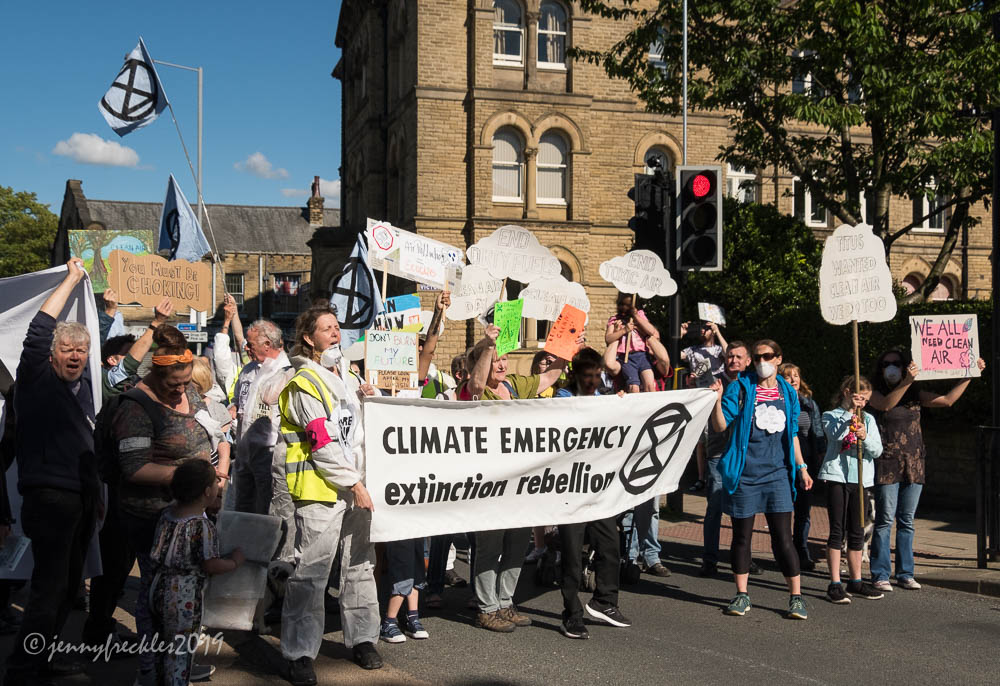
June 21st was (apparently) Clean Air Day and I did something I rarely do - joined in a street demonstration. A small group of people, led by the environmental group Extinction Rebellion Bradford, got together to demand the right for our children to grow up breathing clean air. It's ironic, when Saltaire was specifically built by Sir Titus Salt to remove his workforce from the pollution and city smog of the 1850s, that Saltaire Road is now one of the most congested roads in the country, outside London. Measurements of nitrogen dioxide (largely produced by emissions from road traffic) regularly exceed legal levels. The legal level is 40mg/m3. Monitoring last November at the Saltaire Road/Bingley Road junction showed levels of 55.08! That is shocking, I think, especially when you consider there are two primary schools on the road. The school nearest my house has windows that open right on to the road just a pavement's width away. (The noise levels must be horrendous too.) And yes, my house is not far from all this pollution as well. Saltaire Road is regularly completely congested in both directions with slow-moving traffic, including many huge lorries.
The demo was good-natured and orderly, marching up the pavements either side of the road from one primary school to the other. Where there are pedestrian crossings, we stopped and pressed the button a few times, standing in the road when the lights turned red and then moving off when they turned green again. No doubt that would have enraged a few motorists but many tooted their horns in solidarity.
It's hard, isn't it, not to feel hypocritical about this? We mostly enjoy the luxury of cars - albeit mine is a well-maintained hybrid (petrol/electric) vehicle. I do undertake most of my local journeys on foot too and use the trains/buses when it makes sense to do so. I even walk to the supermarket with a shopping trolley 90% of the time, rather than use my car. But even so, I am guilty of being part of the traffic jam on Saltaire Road at least some of the time.
In discussion with one of the more seasoned protestors on the march, she emphasised that individual action can only go part of the way to solving the problem. What is really needed - and needed quickly now, as we definitely are in the last-chance saloon globally on this - is action at government and big business level to tackle toxic air and climate change. There is lots that could be done: skewing taxation in favour of green alternatives, putting more money into research, an end to polluting fuels, a movement towards a cleaner, greener, affordable transport system and so on. It's not an impossible dream...
In the meantime we can all help, by choosing to minimise and protect against air pollution by our own actions: walk/cycle more, use public transport, choose an electric or hybrid vehicle when you next change your car, keep your car tyres properly inflated, minimise those polluting door to door deliveries (choose click and collect!), avoid burning polluting fuels, ensure heating and cooking appliances are serviced and well maintained, grow trees and have houseplants, avoid harmful chemicals in the products you use at home...
Air pollution causes as many as 29,000 deaths a year in this country and causes or worsens debilitating illnesses like heart disease and asthma. Young children, pregnant women and those already frail are especially vulnerable. A street demonstration can't change that in itself but if it makes one or two people stop and think, and if it adds to the growing pressure on our governments to take action, well, I think it must be worth raising our voices in protest.
Friday, 21 June 2019
Favourite flowers
Daisies are one of my favourite flowers.
I love the philadelphus or mock orange shrub too, with its pretty white blossom.
Blue iris were one of my mum's favourites. I have inherited from her several items decorated with iris, including a china mug and a biscuit tin.
Alchemilla mollis, or lady's mantle, look so pretty in the rain as, for some reason, the raindrops bead on the surface of the leaves.
I don't know what the flowers below are. They were prettily blushed in pink and reminded me, for some reason, of shrimps! Can anyone identify the plant?
Thursday, 20 June 2019
Garden glory
Keen gardeners in Shipley opened their gardens to raise money for charity one weekend in early June. Unfortunately it was damp and showery, not the best conditions for seeing them at their best. I had limited time too, but managed to get a few photos. Most of the plots are quite small and it's amazing what people manage to pack into them. Even the smallest garden can have a pond, providing a rich habitat for wildlife. Some gardens are a riot of colourful flowers and shrubs, whereas others make use of the huge variety of foliage to make a more subtle show of colour and texture.
These red and pink flowers are almost like weeds, they grow so prolifically, but they are very cheerful. I think they are called valerian.
Anything daisy-like is a hit with me. I liked the way these yellow blooms were complemented by the natural stones around the base.
Thanks for all the lovely messages yesterday, by the way. It means a lot to me and I'm thankful, so thankful, for all the friends I have through my blog.
Wednesday, 19 June 2019
Ten years of reasons to be glad (iolus)
This is another image I produced in Photoshop. I've used layers and some motion blur to give an impressionistic feel. It's a bed of gladioli, stately blooms with long colourful spikes of flowers, that were growing in the allotments in front of Salts Mill. They're kind of old-fashioned; I remember my grandma used to grow them in her garden. She used to call them 'gladdies'. Plenty of reasons to be glad... not least that it's my birthday today!
I also realise that I have now passed the ten year milestone for this blog. Ten years! How did that happen? When I started it in June 2009, my aim was simply to challenge myself: to take more photos, to take better photos, to take more notice of and learn more about my home village (Saltaire, which had recently been designated a World Heritage Site) and to learn how to compose a blog. I had not expected to fall in love so completely with the process and discipline of blogging. Nor did I foresee just how passionate I would become about photography or how that would open up the world to me, to learning and exploring. Nor did I realise that I'd make friends through blogging and through photography, some of whom have become really special to me. It's been (and still is) a genuine pleasure and a wonderful hobby. One day too, I guess, I'll be glad to look back on what is effectively my personal journal. It'll make me smile and remember all the good days. And if, as it seems, in the process I am making a few other folk smile sometimes, well, that's well worth it too, wouldn't you say?
Tuesday, 18 June 2019
The yellow house
Wales: Have you ever become obsessed by a single photographic subject? That's what happened to me when we were on holiday in Wales. This yellow painted house lies just across the Teifi estuary from the flat where we stayed. It caught the light differently at different times of the day. In the evening light it positively glowed. It was also visible from many viewpoints on the walks we took around the area. I found myself snapping it and snapping it.
Called Bryn-y-Mor, it's a listed Georgian house, built in about 1802 on the site of an older property (Pritchard Fach) for a master mariner, Captain Samuel Jones. It was restored in the late 1980s, but I can't find out much more about it, although on the internet there is a list of names of people who've lived here. It seems to have been a farm for some of the time. It's not very accessible as it is down a private road. Such a beautiful house though and in a lovely setting. I could imagine it being the subject or the backdrop of a mystery novel. Certainly it should feature on that TV programme 'A House through Time'. I'm sure it has many tales to tell.
Monday, 17 June 2019
Welsh Wildlife Centre, Cardigan
Wales: It was a good walk from our flat upstream along the River Teifi to the Welsh Wildlife Centre and Teifi Marshes Nature Reserve - a return trip for us, as we enjoyed a visit the last time we were in Wales. Run by the Welsh Wildlife Trust, it has hides looking out over the river and areas of marsh and reedbed. It's popular and you would no doubt see more if you went early or late in the day, when there'd be fewer disturbances. Nevertheless we were pleased to see a little egret fishing. We saw them occasionally on the estuary outside our flat but this one was much closer.
The hides are all named and in the Kingfisher Hide we saw... a magnificent grey heron:
and - would you believe it! - a kingfisher. That was a real thrill. We watched it for quite a while as it was sitting on a branch and then diving for fish. It was too far away for a good photo (my lens isn't long enough and this is heavily cropped) but it's the best image I've ever got of a kingfisher. I don't know why they are so exciting as they are not uncommon on our rivers. I guess it's their vibrant colour and the speed with which they move, so that you rarely get more than a glimpse of a flash of electric blue.
After that excitement, it was time for a coffee in the Visitor Centre, though I stopped to capture some pretty pink hawthorn, which is much rarer than the usual white blossom.
The Visitor Centre is an imaginative glass and wood structure, with a nice café on the upper level and a shop and educative displays lower down.
Sunday, 16 June 2019
The bleeding yew and other treasures
Wales: Like many of our old churchyards, Nevern Church has an avenue of ancient yew trees, some 700 years old, leading from the gate to the church door. One of these trees is famous as 'the bleeding yew', something I've never seen before. Where a limb has been sawn off, the tree 'bleeds' with a deep red sap, the colour and consistency of blood. It has been bleeding for as long as anyone can remember and no-one really knows why. Myths and legends abound, but perhaps the most obvious of them is that it is bleeding in sympathy with Jesus as he died on the cross.
and another stone, known as the Maglocunus Stone, dated to the 5th century. It is inscribed in Latin (which you can just about see along the wavy edge at the back) and in Ogham, a curious early medieval script consisting of marks and slashes, which you can see along the edge below.
Saturday, 15 June 2019
St Brynach's Church
Wales: St Brynach's Church in Nevern was founded in the Celtic period in 540AD. By the 10th century, it became an important stopping place for pilgrims en route to St David's in the south-west corner of Wales. You can still see an ancient pilgrim cross, hewn out of rock on the hillside above the village, and an indent in the rock worn away by the feet or knees of pilgrims stopping at the cross.
There is a very interesting history of the church on its website HERE. One of its treasures is the beautiful, carved Celtic cross standing in the churchyard (see below), which dates to the 10th century. There is also a standing stone known as the Vitalianus Stone, dating from around 500 AD and inscribed in Latin and an ancient script called Ogham.
I find old graveyards fascinating and was touched by the memorial stone below, beautifully inscribed. It says: Here lieth the body of Elinor Salmon, the daughter of John Salmon of this parish, who departed this life the 20th day of July 1781 aged 26 years. Afflictions fore long time I bore. Physicians were in vain. Til God did please Death should me seize to ease me of my pain. How sad...
Most of the interior of the church was remodelled by the Victorians in the 1860s, and there is a pretty, modern, stained glass memorial window inserted in 2005. The nave and chancel don't seem to line up and I learned from a post of John's (HERE) that is sometimes deliberate. The nave represents the body of Christ and the side transepts the arms of the cross, so the chancel (his head) may be tilted. In this case it seems to tilt slightly to the right. Or maybe the builders just had wonky plans...
Labels:
church,
graves,
holiday,
stained glass,
statue/sculpture,
Wales
Friday, 14 June 2019
Nevern
Wales: Nevern, a few miles from Cardigan and over the border into Pembrokeshire, is a pretty village nestled around the river of the same name. The area has been occupied at least since neolithic times, about 4000 years ago. We followed the footpath up the hill to where, in the 1100s, a Norman castle stood, one of the earliest stone castles in Wales. It was destroyed in 1195. The site has been extensively excavated and there is little to see (or photograph) there now except for the mound (motte) where the keep stood and the flat courtyard area that was the bailey. It was fascinating though, and a lovely walk through bluebell woods to get there.
There was plenty of interest to photograph around the church, where this old mounting block still stands, handily placed to allow you to dismount from your horse (or carriage perhaps) as you arrived at church.
Thursday, 13 June 2019
Pentre Ifan
Wales: Not far from the Iron Age village (see previous posts) lies Pentre Ifan, a huge dolmen structure dated to around 3500 BC. Weighing something like 16 tonnes, the massive capstone is balanced on the tips of three other stones, about 2.5m high. There are three other standing stones that may have formed a doorway to a huge burial chamber covered over with earth and stones or, an alternative theory suggests, the dolmen may have been designed just as it is seen today, as a kind of elaborate standing stone. No bones have been found during excavations at the site, so either it was not used for burial or the bones were later moved.
It stands on a hill with a wonderful view over the Nevern valley and across to the sea. Quite a magical place to visit...
Wednesday, 12 June 2019
Age old tasks
Wales: Archaeological excavations have uncovered numerous tools and artefacts that give an insight into how the Iron Age people at Castell Henllys actually lived from day to day. Our (personal!) tour guide showed us different methods of grinding grain to make flour. She had a concave rock that enabled her to rub hard at the grain with a stone, work clearly needing strong arms and a lot of stamina. She also had a simple corn mill: two flat stones with the upper one rotating around a wooden post. Grain was poured down the centre and distributes out through grooves. The action of the stones rubbing together grinds it down into flour.
They have not found any cloth still surviving but they have found stone weights that were used to hold the warp threads on a rudimentary wooden loom. Spun threads of wool and flax were used to weave cloth, dyed with herbal decoctions.
In the grounds of the fort, there was a simple wood-turning lathe, powered by a foot paddle.
Some of the roundhouses were decorated with painted designs: shields, knots and wild animals like this powerful wild boar. The warriors would have killed deer and boar for their meat and skins.
We had such a good time on our visit to Castell Henllys. It is a kind of living history and seeing, touching and smelling makes it all come alive. It must be a super place for children to learn. It's all in a lovely setting too, with a path by a stream tumbling through a wooded valley and leading up to the hill fort. There's a very good visitor centre with a shop, an excellent café and some interactive information boards and videos. Highly recommended if you're in the Cardigan/Pembrokeshire border area.
Labels:
Castell Henllys,
exhibition,
holiday,
museum,
Wales
Subscribe to:
Posts (Atom)