I HAVE CLOSED DOWN THIS BLOG. Please click the photo above to be REDIRECTED TO MY NEW (continuation) BLOG.

Tuesday, 8 May 2018

Old haunts


April was a capricious month, with all extremes of weather from snow to the hottest April day for over 70 years. Right at the end of the month, I walked my favourite local route and it's always interesting to see what has changed from last time I did it. Now spring has arrived, it is all happening fast: leaves unfurling, blossom out and even bluebells in the woods. These photos don't, however, convey how extremely cold it was. I can't recall having to wear my winter lined walking trousers so late in the year before.

The allotments in front of Salts Mill are greening up and starting to look lush. The little boat that offers short canal trips has reappeared and the ice cream boat is back in business, though possibly more hot drinks were being sold than ice creams that day. There were some baby geese on the lawns by the church, too far away to get a photo though.


The local heron was trying his luck fishing by Hirst Lock.


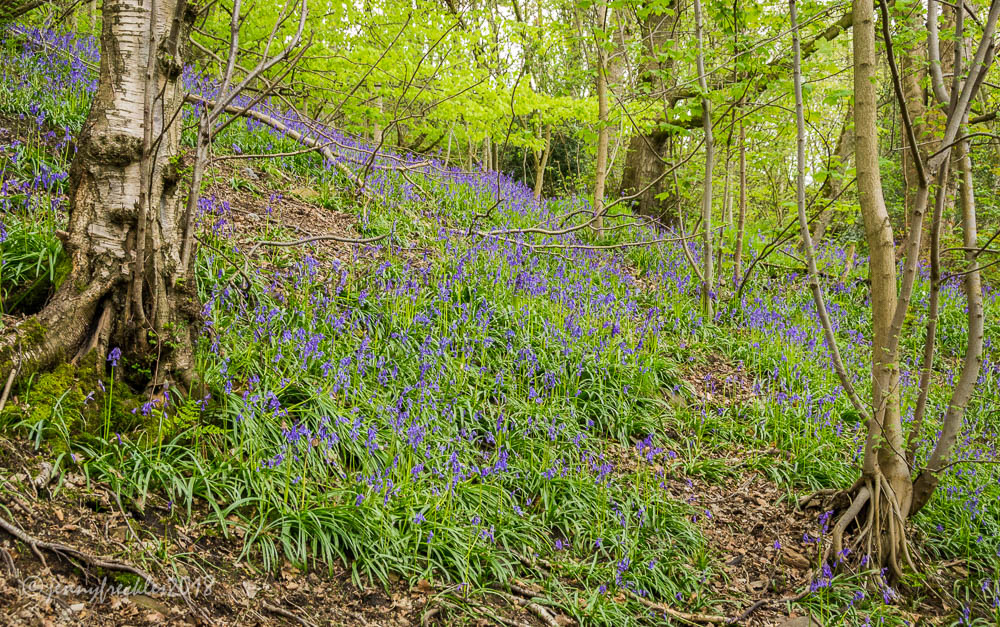
There were bluebells in flower on the south-facing slopes beside the River Aire, but those in Hirst Woods were not so advanced. I'll have to go back this week to see them. We've just had a very hot and sunny early May Bank Holiday weekend, so I'm sure that will have brought them out. I've been out and about at the Saltaire Arts Trail over the weekend, but photos of that will have to wait until I've had time to sort and process them...

Monday, 7 May 2018

Tiptoe through the tulips


Tulips are one of my favourite flowers. There were some tumbling out of a container in that blousy, loose kind of way they have as they mature. Even the shadows they threw looked attractive. Truly a case of tiptoeing through them! 

Sunday, 6 May 2018

Yellow peril


This is an 'American skunk cabbage'. (Not the most flattering name!) There were lots of them growing in the boggy ground beside the stream that runs through Harlow Carr gardens. They were an evil, neon yellow and, whilst sculpturally arresting, they had something of a malevolent look, I thought. Apparently they are very invasive and cannot now be bought or planted. The plants at Harlow Carr are carefully controlled to prevent their spread. 

The other yellow bog plant below - a marsh marigold - is altogether more benign looking, and good for attracting bees and butterflies.


Saturday, 5 May 2018

Spring at Harlow Carr


The RHS gardens at Harlow Carr near Harrogate look beautiful and immaculate at all times of year. There is something special, though, about the first flushes of Spring - the delicate hues of spring bulbs, early cherry blossom and our native primroses. You could almost hear nature awakening, stretching, breathing in the sun. It called to me to awaken, stretch and breathe too. 


Friday, 4 May 2018

May Day in Otley part 2


For dancing, you need music and the Otley May Day maypole dancers (see yesterday's post) were accompanied by the musicians that play for the Buttercross Belles and the Wharfedale Wayzgoose morris side.

The Wayzgoose are a border morris side and have very ornate and traditional costumes, with lots of bells, ribbons and feathers.

The Otley Bellman (Terry Ford) also had a hand in the proceedings. He is Otley's Town Crier, an ancient role that involves delivering messages and proclamations to the townspeople.

Thursday, 3 May 2018

May Day madness


When I was a child, my parents used to take me every year to the May Festival in Wellow, Nottinghamshire, near where we lived. I used to adore it, watching children dancing around the maypole, the procession and crowning of the May Queen and all the sideshows and stalls associated with the fair. I always remember it being sunny and warm too! (I'm sure it wasn't always.)

It was with some delight therefore that I discovered that the market town of Otley, some ten miles from Saltaire, was having maypole dancing on May 1st.  It has been a tradition in this country for many hundreds of years to celebrate the pagan festival of Beltane, a farewell to winter and a celebration of things coming to life again in spring. Many towns and villages used to have maypoles and some remain, whilst others are reviving the tradition. The Otley celebration was organised by the Buttercross Belles, a ladies North-West Morris Dancing side based in Otley.

It was all very good-natured, with children encouraged to join in. The end result of ribbons wrapped round the pole was not very precise! My childhood memories are of costumed and highly trained dancers making very neat patterns with the ribbons, the patterns varying depending on the steps of the dance. But who cared about neatness? It was fun.


Towards the end, the professionals did have a go and the result was a rather neater pattern, as you can see below. Of course, once the ribbons are plaited round the pole, the dancers have to do the same dance in reverse to unplait them again. That is even more difficult.


I found the occasion surprisingly moving; lots of memories came flooding back. The only thing that wasn't quite fitting was the weather. Although thankfully dry, it was absolutely freezing cold, with the temperature more akin to November than May Day!

Wednesday, 2 May 2018

Spring in Saltaire


Saltaire's iconic buildings (Salts Mill, Saltaire United Reformed Church and the New Mill) look especially good in the early Spring sunshine, among the daffodils and the first sprays of apple blossom. At this time of year, things change so fast. These photos were taken on the 21st April and everything has greened up quickly since then.  

Incidentally, the early May Bank Holiday weekend, 5-7 May, sees the return of Saltaire's Arts Trail, when village houses become art galleries and there is lots to enjoy. If you're local, do think about coming. For details, please click the link. 


Tuesday, 1 May 2018

Sky


For all the grandeur and scale of Saltaire's Victorian architecture, it is completely overshadowed and overawed by the sheer beauty of a spring sky. I was walking through Roberts Park and the scene quite took my breath away.

i thank You, God, for this most amazing 
day: for the leaping greenly spirits of trees
and a blue true dream of sky; and for everything
which is natural which is infinite which is yes

e e cummings


Monday, 30 April 2018

A visit to Beningbrough Hall


Just before the weather warmed up, in mid-April, I went with friends to visit Beningbrough Hall, near York. It's another National Trust property (rocking that membership!), a Georgian mansion in the Italian Baroque style. Completed in 1716, it has a chequered history, including acting as a billet for British and Canadian airmen during WWII. It was acquired by the Treasury in lieu of death duties, and was offered to the National Trust in 1958, though devoid of contents. It seems that for many years the Trust wasn't sure what to do with it, and at first it was not open to the public. In recent years, a collaboration with the National Portrait Gallery has led to its use as a gallery for portraiture. There are many 18th century portraits displayed and some special exhibitions. When I was there, we saw contemporary portraits of women who have made a significant contribution to the Arts. They have also imported some furniture and there's a display about WWII and the airmen. It's all quite interesting, though it lacks the personality of some of the Trust's other properties that have been closely associated with one family or one special person. 


Beningbrough is set in some attractive gardens but it was all still winter-dormant, with very little colour apart from the daffodils. We enjoyed a breezy, chilly but pleasant walk around the estate's perimeter, following the course of the River Nidd, which joins the River Ouse at this point. There were newborn lambs leaping in the fields and some shy spring flowers under the trees. Tiny wild violets are mostly mauve but you occasionally see yellow or white ones, as pictured. The village in the distance (above) is Newton on Ouse, which we drove through on the way. It is very pretty. 


Sunday, 29 April 2018

Aldwark Toll Bridge


On an outing with friends to yet another National Trust property near York (more of which tomorrow) we had to cross the River Ure on a 240+ year old toll bridge! It avoids a detour of about 25 miles and for the payment of a toll of 40p, that seems well worth the saving in time and money. Private toll bridges and roads are uncommon in Britain nowadays, though at one time most roads were toll roads and you can sometimes spot the little buildings that used to be toll houses. The first bridge at Aldwark was built by John Thomson. He used to operate a rowing boat ferry across the river but it proved dangerous so he rode to London to obtain an Act of Parliament in 1772 that enabled him to build the bridge and collect tolls. The original bridge was damaged - by an iceberg! - in the 19th century so the existing bridge was built, of iron with a hardwood deck. It makes an amazing rumble as you drive over! I didn't know about the bridge in advance and just hopped out of the car quickly to snap a photo. (It was very narrow so not really suitable to stop.) The treasures in this lovely country of ours never fail to amaze me!


This photo of the bridge itself © shirokazan (cc-by-sa/2.0) used under Creative Commons Licence

Saturday, 28 April 2018

Park circle


I rather liked this random and colourful arrangement of people enjoying the sunshine in Saltaire's Roberts Park. The balustrade on the roof of the Half Moon Café provides a good vantage point for candid shots of what's going on in the lower field - and there is nearly always someone sitting on the alpaca statue. If I'd have zoomed my lens a bit wider, I could have included people sitting at tables outside the café. A bit wider still and you'd have seen lots of people having picnics and playing games on the grass. Even wider and I could have taken in the game of cricket getting underway on the adjacent pitch. There was something, though, about this circle that pleased me; it seemed adequate to convey the  mood: sunshine, friendship, relaxation... aaahh...

Friday, 27 April 2018

Steam punk


There were a few steam punk enthusiasts among the crowds in Roberts Park on World Heritage Day.  This is Jackie and Dennis, both splendidly attired for the occasion. 

Thursday, 26 April 2018

WWI military camp


2018 marks 100 years since the end of WWI, the so-called Great War. (Sadly, it was not 'the war to end all wars'.) As part of the World Heritage Day event, there was a WWI military camp in Roberts Park and displays related to Saltaire's WWI history, which attracted lots of interest from visitors. 


The re-enactors take their history very seriously and are at pains to make things authentic and accurate. The unit was named as '6 Platoon B Company 1/8 Manchester Regiment' but I'm afraid I can't find any more information about the re-enactors. There is, however, a diary online detailing the horrors of the war in France and Belgium for the actual battalion (HERE).

The medic (right) was offering 'chloroform' to anyone willing to try it!


The older I've got, the more pacifist I've become. Nevertheless, I find these historical re-enactments (which usually centre around one or another of our wars, whether it's the English Civil Wars or the two World Wars) very fascinating. I think it's important that people should have the chance to learn about the past, and those involved are pretty knowledgeable and try hard to make it all interesting. They don't convey the horror of the war though. My own eyes were opened to that when I visited the battlefields and museum in Ypres, Belgium in July 2015. (HERE)


Boys and their guns though... (rolls eyes!)


Wednesday, 25 April 2018

The return of the cannons


The World Heritage Day celebrations had a particular focus this year: cannons. In 1871, Sir Titus Salt, bought two Napoleonic War naval cannons as features for the newly opened Saltaire Park (now known as Roberts Park). It was said that one of them had been fired during the Battle of Trafalgar. As can be seen in old photos in Saltaire's archives, those cannons stood either side of the original bandstand, until they were removed and melted down to make more armaments during WWII.

Two 68 pounder cannons have now been reintroduced to the park, on permanent loan from Bradford's Industrial Museum. They have their own interesting history. They were made locally at Bradford's Low Moor Ironworks in 1846, and used as a display at the foundry. It is said they could fire cannonballs over a range of two miles in 15 seconds! After the foundry closed, the cannons, which each weigh four and a half tonnes, eventually ended up at the Industrial Museum, where they have been displayed at the gates. The iron work was deteriorating, so they have been professionally restored, painted and mounted on new military gun carriages, which replicate those originally in Saltaire's park.


It has been a real labour of love. I spoke to the conservator, Ian Barrand (photo below), who has spent over 18 months researching and restoring the cannons, work which has been possible thanks to lottery funding. He was clearly very moved to see the project concluded and the cannons in their intended positions. There is a very interesting video and feature HERE, worth clicking for more information. It shows some footage of the original cannons too.


I can see that the cannons will rival the Roberts Park alpacas as climbing frames for children. I was rather amused by the three little boys in my middle photo, who hunkered down underneath the barrel and found that their baseball caps just neatly fitted on the cannonballs piled up below.

Tuesday, 24 April 2018

World Heritage Day 2018


It was a beautiful, warm, sunny, Spring day. There were masses of people enjoying Saltaire's Roberts Park. Check out, too, the four gorgeous magnolia trees on the Promenade, blooming late this year but happily (so far) unblemished by frost. Even someone official with a chain was there... though I'm not sure who he was! (I thought it would be the Lord Mayor of Bradford but it isn't.) (PS: Might be Baildon's mayor?)


In the bandstand, Hall Royd Brass Band were playing. I always love listening to a brass band in the bandstand. It is really the only music that can be heard without amplification. It just sounds so right and fitting.

The occasion was, of course, a celebration of Saltaire's UNESCO World Heritage Site status, to mark World Heritage Day 2018.


Monday, 23 April 2018

Farnley Hall


I was fortunate to be able to go on a privately arranged tour of Farnley Hall, near Otley. It is a Grade I listed mansion, built in the late 1700s by John Carr, who (along with Robert Adam) also designed nearby Harewood House. Farnley Hall was built as a Georgian extension to an existing hall (just visible behind in my photo) that dates back to the early 1600s and is now called Farnley Old Hall. (I haven't shown a full photo of the Old Hall as it is nowadays a separate, private dwelling.) 

The Old Hall was owned and occupied in the 1780s by Francis Fawkes. When he died in 1786, without children, the house was inherited by Walter Hawkesworth, who adopted the name Fawkes as a condition of the will. It was Walter who commissioned John Carr to build the huge new wing now known as Farnley Hall. Walter sadly died in 1792, and his son Walter Ramsden Fawkes finished the house and furnished it.

The house has a special connection with the artist JMW Turner, who was a close friend of the family and often stayed with them. Turner's watercolours, including some of the house and the local area, give a fascinating glimpse into how it all looked, both inside and out, in the early 1800s.

We were welcomed by the present owner, Guy Horton-Fawkes, and the tour was led by two ladies with a long connection to the house, who were both extremely knowledgeable. It is beautiful inside, with the wonderfully symmetrical and well-proportioned rooms so typical of Georgian architecture. The interior has stunning plasterwork on the ceilings and walls; delicate white mouldings against a pale blue or duck-egg background are reminiscent of Wedgwood pottery.

The windows frame the sweeping view over the valley to Otley and The Chevin.


The Hall sits in extensive grounds, with some lovely trees, one of which is a 200 year old weeping beech - which I must admit I'd never heard of before. The pendulous branches touch the ground and form new roots, so the tree spreads out like a tent. The garden entrance has this rather imposing archway that, according to one of Turner's sketches, was once sited at the front of the Old Hall as its main door. The datestone is 1604. 


It was a privilege to be shown round such an exceptional mansion, to hear its history and to see its interesting and beautiful contents. We were made most welcome, even being treated to tea and cakes around the kitchen Aga. I can't say that I envy those who have the responsibility of preserving such places, especially when they are still family homes, though I'm really grateful when they do such a good job of it. I had a fascinating afternoon.

Sunday, 22 April 2018

Human tide


And so to Oxford Circus, a heaving and cosmopolitan mass of people. It was actually a little scary trying to get down the stairs into the underground station, swept along by a tide of humanity and almost as powerless against the current as one would be in the raging sea. I love visiting London for a day or two but I'm also enormously glad not to have to live there. It's so noisy and exhausting. Glad to be home!

Saturday, 21 April 2018

Swinging London?


When I'm in London these days, I seem to spend most of my time on the South Bank, exploring the galleries and tourist magnets like Borough Market. Although the gallery@oxo (where the exhibition was) is close to the Tate Modern and the Hayward Gallery, I decided this time to forgo their delights and venture north and west, across the river, up through Covent Garden (above), Leicester Square and Piccadilly Circus and then up Regent Street to Oxford Circus. There was plenty to enjoy - and lots of people everywhere.


I'm old enough to remember the 1960s, when Carnaby Street (above) was the place to be, at the heart of 'Swinging London'. It is still full of quirky shops and independent traders, and interesting to wander down. It's now pedestrianised too, so at least you don't have to worry about stepping out into the path of a London taxi!  The days when I could wear shoes like these are also long past, but I thought they were fun and so colourful.

Friday, 20 April 2018

Flat white


It turned out to be a 'flat white' kind of a day in London, fuelled by several cups of my favoured coffee... and determined to get a few photos, despite the unpromising dull, flat light and blank, grey skies. In some ways a diffused light is easier for architecture and suits the pale Portland stone buildings, like Somerset House (above) - yet you do really need a bit of sparkle to enliven a photo... and there was none. 

I like the little 'wedding cake' churches scattered through the city, like St Mary-le-Strand below, now marooned in the middle of the busy thoroughfare that is the modern-day Strand, with St Clement Danes, equally marooned, a little distance beyond. They are known as 'island churches', for obvious reasons. Built in the early 1700s, I guess its location would have looked very different when it was first used but it is still a functioning church, and acts as the home church for the Women's Royal Naval Service. 


On such a day, it was better, perhaps, to focus on close-ups. The magnolia trees in front of the church were in blossom, their colour and chaos forming an interesting foil to the church's Baroque ornamentation. 


Thursday, 19 April 2018

Fog on the Thames


I had a day trip to London to see a photographic exhibition, Vision 9 (see HERE), at the 'gallery@oxo' on the South Bank. It was a most enjoyable treat and a wonderful exhibition to see. I'd seen it advertised and realised that, of the nine photographers exhibiting, five are people I already follow on Facebook, finding their work very inspiring. So, even before I'd really thought about it, I'd booked a train ticket to go! All the artists are landscape photographers but they are producing some exquisite and unusual work, far removed from a straight landscape shot. Some use multiple exposures and ICM (intentional camera movement) or long exposures to produce work that sings with light and has an impressionistic feel.

I took my own camera, hoping for some city shots, but it was a poor day, dull and foggy and very cold. The view along the Thames looked almost monochrome, with the dome of St Paul's Cathedral and the skyscrapers in the City looming out of the mist in the distance.