I HAVE CLOSED DOWN THIS BLOG. Please click the photo above to be REDIRECTED TO MY NEW (continuation) BLOG.

Thursday, 16 January 2020

Summer Sunday stroll 2


Hirst Lock to Dowley Gap Lock
[Continuing my walk from Saltaire to Bingley along the towpath of the Leeds-Liverpool Canal] 

Beyond Hirst Lock, the path passes through Hirst Wood itself, a shady and rather mysterious stretch of the canal with trees lining both sides. Views open out when you reach the aqueduct (above) that carries the canal over the River Aire. It is such a broad bridge that you don't really feel as though you're on a bridge (unlike, say, the Pontcysyllte Aqueduct in the Welsh Borders, which is rather hair-raising to cross). 

My brisk walking pace was almost keeping up with the cabin cruisers that had set off just before me when I passed Hirst Lock. 

There is an old mill on the left here, now converted into dwellings. It would be such a nice place to live... were it not for the sewage works just over the fence, with its distinctive aroma! The foliage along the canalside now more or less obscures the view of the changeline bridge, where the towpath passes from one side of the canal to the other. It's a pity as it's quite an attractive bridge. I suppose, sooner or later, someone will come along and trim the bushes back as part of the waterway maintenance. 


It's from this spot that you can see my two favourite trees, up the hillside. Some trees were beginning to look a little autumnal at this stage of the summer, but not these two. 


Here, I did catch up with the two cabin cruisers, as they had to stop to get clearance to negotiate the locks at Dowley Gap. The scene from the bridge looks much more interesting when there are boats moored.
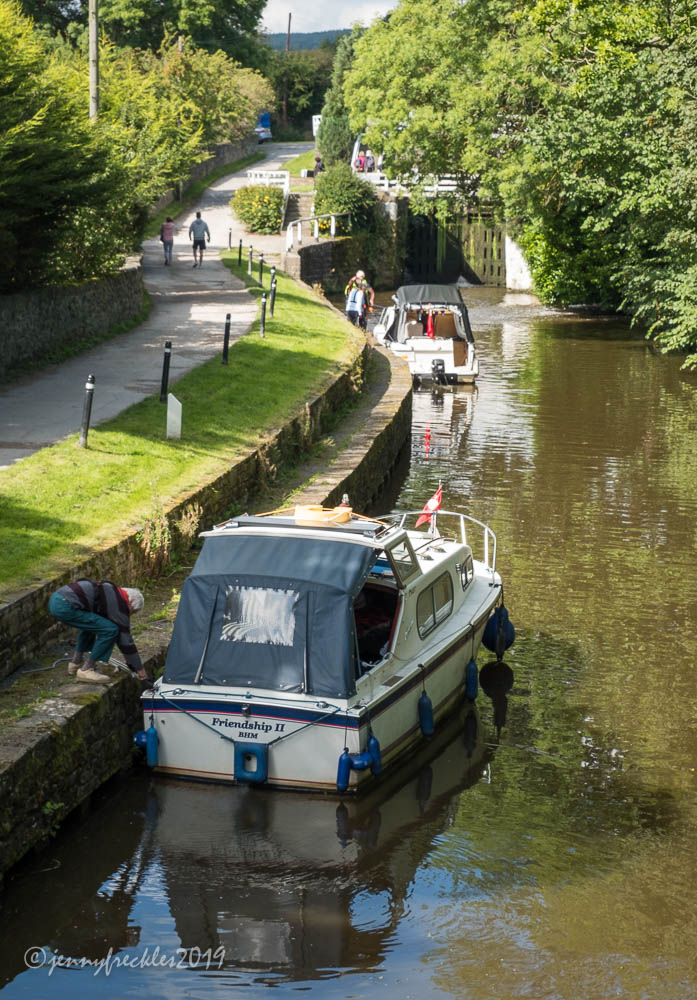

There were a lot of other people about, enjoying the beautiful late summer weather. I have to be careful as I never hear cyclists coming up behind me, and some of them ride rather too fast.


As I reached the top of the locks, a narrowboat had just finished its journey up the 20 foot (6 m) rise. The cabin cruisers lower down faced a bit of a wait, until the water levels in the two lock chambers were regulated to allow them to enter the bottom lock. It's a fascinatingly complicated enterprise. You have to know what you're doing, so you don't waste a lot of water. Some of the locks have lock-keepers to operate them and there is a lock house at Dowley Gap, but I'm not sure if these locks are manned or not. This particular boat looked to be doing a good job of negotiating the locks. Narrowboats can often fit through if just one gate is opened, but the advice is to open both gates to avoid damage to the gates. (Not everyone heeds the advice!)


Wednesday, 15 January 2020

Summer Sunday stroll 1


(Continuing my series from last summer, whilst my eye settles down after the surgery)

Saltaire to Hirst Lock
It was such a lovely, late summer's morning that I decided to walk from Saltaire to Bingley's Five Rise Locks and back, a good six miles round trip. It's a very familiar walk and I've shown photos of the area before on this blog. I thought it'd be fun to string some together in order this time, to illustrate the whole route.

Once out of Saltaire, through the short stretch of shady trees (see yesterday) the view opens out across the area of playing fields that belongs to Salts Sports Club. Sunday morning meant football matches were underway, the juniors at one end and a senior game at the other.


There were fishermen on the canal bank, having a real Sunday morning treat - able to watch their rods, watch football and cook a fry-up of bacon and eggs on a camp stove, all at the same time. (Breakfast smelled delicious!)   
I did take a photo... but I don't think you'd want to see the bum-crack the cook was displaying as he leaned over - ha!


Perhaps it was because the season was drawing to a close, or perhaps just the weekend effect, but there seemed to be more boats on the canal than I've ever seen. Some were moored, like the narrowboats I passed, still having a lie-in, perhaps? The towpath passes the lock at Hirst Wood. Just beyond the lock there were two cabin cruisers, a type of boat we rarely see on this canal. (They made so much more noise than a narrowboat!)


Tuesday, 14 January 2020

We're going on a Saltaire hunt (4)


Continuing down to the bottom of Victoria Road in Saltaire, we arrive at the bridge over the Leeds-Liverpool Canal and this iconic view along the waterway between Salts Mill and the New Mill. The mills are still connected by the remaining one of three original walkways over the canal.

Looking from the bridge in the opposite direction, we see one of the most popular spots in the village, where people can access the canal towpath or walk down to the right and over the River Aire into Roberts Park. It's a good place for people to stop for a breather, perhaps indulge in an ice-cream from the ice-cream boat, feed the ducks and generally watch the world go by. Most weekends, there is a volunteer from the Canal and River Trust, the charitable body that looks after the UK's waterways. They seek to educate and encourage people to enjoy all that our waterways have to offer, as well as to recruit volunteers to do some of the many tasks needed to maintain the network.


Looking back up the slope that leads down to the canal level, you get a beautiful view of the amazing Italianate chimney of the New Mill, a copy of a Venetian church tower.


Then down on to the canal towpath - and immediately we are transported into a cool, green, peaceful world that seems far away from the bustle of the village and its industrial heritage. Deceptive though... as it was partly because of the canal that the mills were built here, with a crucial transportation route for goods and materials to the docks in Liverpool, 100 or so miles away to the west.  At one time, it would have been busy with boats and horses - and even these days you have to keep a watch in front and behind for cyclists, as the towpath is a cycleway too.


Monday, 13 January 2020

We're going on a Saltaire hunt (3)


Arriving at the railway bridge on Victoria Road in Saltaire, we get our first glimpse of the church tower, behind the old Dining Hall where meals used to be provided for the workforce at Salts Mill. The Dining Hall is now part of Shipley College. If we shift our view a little to the right (below), down Victoria Road, we can see Salts Mill on the right and the trees of Shipley Glen in front of us, leading up to Hope Hill on the horizon.


A few steps down the road from the Dining Hall building, we arrive in front of Saltaire's grade 1 listed Victorian church, with its distinctive round tower and cupola:


From the same spot as the photo above, looking in the opposite direction, we can see a matching stone post at the entrance to Salts Mill. This area retains the original stone setts that used to surface most of the streets in the village when it was built in the 1850s. (I'm rather alarmed to see that the metal railing has come loose from the post. I hope that gets repaired before it becomes impossible to deal with. These small features are such a distinctive part of the village's design.)


Sunday, 12 January 2020

We're going on a Saltaire hunt (2)


At the cross roads in the centre of Saltaire (see yesterday), if you turn up the hill along Victoria Road you quickly arrive at the imposing bulk of Victoria Hall, opened in 1871 as the Saltaire Club and Institute. It was provided by Sir Titus Salt as a place of recreation and education for his mill workers. It housed a reading room, a library, laboratory, chess and draughts rooms, a smoking room, a billiard hall, a lecture hall seating 800, classrooms, a gym and a rifle drill-room. Even today, it functions as a social hub for the village with space for events and exhibitions, concerts, meetings and weddings. Since the large trees on Victoria Road were felled, you can appreciate the building as Salt intended, as a centrepiece of his model village. It has a small garden in front and the square made by the Hall and the Schools opposite is guarded by our four famous stone lions. You can see 'Peace' silhouetted in my photo. 

If you turn down the hill from the cross roads, along Victoria Road towards the railway station, you pass the shops shown yesterday. Opposite them, there is a view of the south elevation of Salts Mill, its chimney prominent beyond the allotments that border the railway line. As the trees grow bigger, it gets harder to see the mill. 


Saturday, 11 January 2020

We're going on a Saltaire hunt (1)


(Whilst I recover from eye surgery, with the consequent 'clipping of my wings' - no driving, nothing too strenuous - I'm going to post some local photos I took in the late summer last year (2019). It is nice in winter to look back at brighter days. It does no harm either, on a blog like mine, to do a recap of some of the local sights. They're so familiar to me that I almost take them for granted but it's a while since I showcased the local icons.)

So... We're going on a Saltaire hunt... (no, not a bear hunt - though you can't go under it, you can't go over it... you've got to go through it!). It was a beautiful day (and I wasn't scared) so I decided I'd take a local walk for a change. I'd been out and about so much over the summer, I really hadn't done much around home. Mind you, over the years I've taken so many photos in Saltaire that it begins to be difficult to find a fresh view. Here are the classics, again:

Our first view of Salts Mill (above), from Caroline Street, with the Shipley College horticultural department allotments displaying a few bright red dahlias in the foreground.

We arrive at the main crossroads in the village centre, where Caroline Street and Victoria Road intersect. Looking southwest, a few of the Victoria Road shops lead up to the square where the Victoria Hall sits (out of view on the left) opposite the old school buildings, now part of Shipley College, behind the trees.


Looking northwest from the same spot, the Victoria Road shops continue down to the railway bridge:

Friday, 10 January 2020

Selfie


Me in a blue mood... The theme for my online group for December was 'Selfie'. I think perhaps it was envisaged that we might dress up in the style of Cindy Sherman, whose work consists exclusively of photographic self-portraits where she imagines herself as different characters. Or we might even copy the Japanese grandmother's hilarious self-portraits HERE. That's just not 'me' however. I've always hated dressing up and I haven't that kind of sense of humour at all.  So my submission was a rather more muted affair, reflected in a blue-toned modern artwork in a gallery.

2019 was a rather blue year in some ways. We hope for better things nationally and globally in 2020. Speaking personally, my world will be a little bluer and a little less yellow in a positive way after today, as I am due to have my second cataract operation. With two plastic lenses, the world will be bright! I am not nearly as apprehensive as I was the first time, now I know what to expect. Yes, there's always a slight risk something could go wrong but que sera sera. I won't be driving or doing anything very vigorous for a week or two afterwards, until it settles down. I've some local pictures that I took in the summer and haven't yet posted, so I think I will take you on a sunny walk to remind us of what we're missing.

Thursday, 9 January 2020

A night at the ballet


I was lucky enough to be treated by a friend to a night at the ballet, just after the New Year. We went to see Northern Ballet's 'Cinderella' at the Grand Theatre in Leeds - and it was wonderful. All the city's Christmas lights were still lit, so it was lovely walking through the city centre from the rail station to the theatre.

The theatre itself is full of history, built in 1878 in an elaborate mix of styles: gothic, Romanesque and Scottish baronial. The traditional Victorian interior has tiers - the Stalls, Dress Circle, Upper Circle, Balcony (Gallery) and Upper Balcony, carefully organised to maintain the separation of rank for the class-conscious Victorians. There are still some boxes at the sides too. (One of my abiding childhood memories is the thrill of our family having a box at a performance in a theatre in Nottingham. I can't even recall what we saw, but I remember the box, vividly!) The Grand has, of course, been upgraded many times during its life and is now a comfortable venue with enough elegance to make you feel rather special.

We had excellent seats near the front in the Stalls, close enough to the stage to be able to see the expressions on the faces of the dancers, and with a glimpse down into the orchestra pit in front of and below the stage. Such anticipation waiting for that red curtain to draw back and reveal the performance...


These are all snaps taken on my phone, and I had to wait until the end when the theatre had emptied a bit. They do, however, give a glimpse of the theatre's breath-taking decoration. That's a massive chandelier at the centre of the ceiling rose, though my phone couldn't really deal with its brightness.


I couldn't of course, take any pictures during the ballet, so you'll have to believe me when I say it was absolutely gorgeous. I love that Northern Ballet performs with a live orchestra, the Sinfonia, and the costumes and staging were phenomenal. There are some photos on their website HERE. The company has existed since 1969, building from a small dance troupe of just 11 dancers to become one of the world's greatest ballet companies. In particular it benefitted hugely from the leadership, as Artistic Director, of the renowned Christopher Gable, from 1987 until his death in 1998.  The company now operates from a huge, brand new purpose-built studio and theatre space in Leeds, now under the direction of David Nixon.


Wednesday, 8 January 2020

Luck and promise


Even on a dull day, spots of colour, shape and texture attract my eye. I snapped all of these in a small area by the entrance to Linton churchyard. Some of the dying geranium (I think) leaves had turned to vivid orange and red. The winter jasmine was in full bloom, a little early perhaps as it's been quite mild. It's such a cheerful shrub, happily promising spring from the depths of winter. As for the horseshoe, it's a lucky symbol (and we could do with some of that in the current mire!) Hung with the end upwards, they say, it catches the luck; others maintain it should hang with the ends down to pour luck on those who pass beneath it. If you're of that persuasion, you'll have to turn your laptop upside down!

Tuesday, 7 January 2020

Linton Falls


Just upstream from where it curls around Linton churchyard, the River Wharfe thunders over Linton falls. I've posted photos from here before. It is a popular spot, a short and pleasant walk from Grassington village centre. In winter it can be a fairly bleak, dark, colourless scene but the roar of the water adds drama, so that it is worth visiting in any season.

There are two weirs. You can just see the upper weir in the background of the photo above. The weirs built up a head of water to power Linton Mill, originally a medieval corn mill and, from 1788, a worsted and cotton mill, which was sited alongside the lower weir. The mill went out of business in the 1950s and was demolished in the 1980s, after which housing was built on the site (see third photo).

The upper weir is harnessed for hydro-electricity. The original hydro plant opened in 1909 to power the nearby village of Grassington. In 1948, when the National Grid took over, it became redundant and closed. The plant was reopened in 2012, using the original building and fitted with two screw turbines.

Below the weirs, the river is constricted by limestone outcrops and, particularly after rain, it sweeps down in a dramatic cascade. The bridge across the river is known as the Tin Bridge and was originally constructed so that mill workers could get to work from the village. The current wooden footbridge was built in 1989.


Monday, 6 January 2020

New Year's Eve excursion


I went out with some friends on New Year's Eve, for a gentle ramble around Grassington. We stopped at the church of St Michael and All Angels in Linton, a long name for quite a compact church! It nestles very attractively in the Wharfe valley, where a bend in the river cradles the church and its graveyard in a kind of a hug. The church has Norman origins, as the two rounded arches (above on the left) inside suggest, but was rebuilt in Victorian times (1861).


It's not very fancy inside, but has a few interesting features including some attractive stained glass windows:


It also holds this royal coat of arms from George III's reign. After the reformation, Henry VIII wanted to assert his authority over the Church and royal coats of arms began to be displayed, to remind congregations of the link between church and state. When King Charles II was restored to the English throne in 1660, ending Oliver Cromwell's 'Commonwealth' period, it became accepted practice for churches to display them. This ceased in Victorian times and this particular board was, I gather hidden away in the back of a cupboard until it was rediscovered.


The roof of the church has some interesting carved bosses, two of which are of 'green men' with foliage spewing from their mouths. Originally a pagan image, green men are found in many of our churches and cathedrals. 


Some of the furniture has more recent symbolism: a characteristic mouse carving, that shows it was made by 'the Mouseman of Kilburn', Robert Thompson - a renowned ecclesiastical furniture maker from North Yorkshire, who 'signed' all of his pieces in this way.

Sunday, 5 January 2020

On top of the world


I usually feel driven to get out for some brisk walks at this time of year, not so much because I've overindulged at Christmas (I don't tend to) but rather as an antidote to all the sitting around and the sense that I no longer know what day it is. Add in a lovely blue sky and the need to get out is overwhelming. If I really want exercise, climbing the hills either side of the Aire valley is just the ticket.

I took these photos from the high point in Northcliffe Park. (You can go higher still if you want to, but after this point you have to follow the road so it's not such a nice walk.) The photo above is looking north, across Saltaire to Baildon and Hope Hill. The chimney sticking up at the bottom right is the top of Salts Mill's big stack, which is near the start point of my walk. You can see how deep it sits in the valley. From there it's a steady but inexorable climb uphill that took me about 40 minutes. Never mind, it's downhill all the way going back!

A slight turn to the left at this viewpoint affords a vista up the Aire valley. That's the town of Bingley in the valley bottom (below). There is one block of 'the three flats of Bingley' still standing (see my post of yesterday), about one third in from the right, looking like a white box as the sun catches its side. The dark hill on the left is the Bingley St Ives estate, where I often walk too.


I tried a pano shot with my phone. It does slightly weird things to the perspective, elongating the foreground, but it does show the sweep of the view from Northcliffe's top meadow - and my own shadow! 

Saturday, 4 January 2020

Going, going, gone


Walking to Bingley on the canal towpath, I noticed demolition of the Crosley Wood flats is underway. The tower blocks, Peel House, Brunswick House and Adelaide House, have been a local landmark for about 50 years, though not a very attractive one. When she was a little girl, my daughter used to call them 'the three flats of Bingley'. She could see them from her bedroom window when we lived in Bingley and she said they always made her feel she was 'home' .

They were owned by the local social housing provider, Incommunities, who took the decision to demolish them after the Grenfell Tower fire disaster. They apparently had a piped gas supply which was considered unsafe and, being increasingly run down, they were not popular to live in. They have rehoused the remaining residents and the tower blocks are being demolished mechanically rather than by a controlled explosion, probably because of the location on the hillside above the canal. Ugly as they were, I might miss them a little.

Friday, 3 January 2020

Zen and the art of walking


Despite fairly constant light drizzle, I decided I'd have a walk on Christmas Eve. I chose one of my usual routes along the canal, from Saltaire to the Five Rise Locks in Bingley. Everywhere is so muddy at the moment and at least the towpath is a little firmer most of the way. There is, anyway, a simple pleasure in taking the paths much travelled and really noticing the sights, at once familiar and at the same time always new and fresh. I didn't take my 'big camera'. There is a freedom in walking untrammelled and I had my phone with me. 

The first thing I stopped to photograph in my zen mode was a slender twig (below), still hanging on to green leaves. Lovely in its simplicity, I thought. I liked the delicate leaves against the rough bark of the big tree trunk beside it. 

A little further on, I stopped to appreciate my two favourite trees and - oh joy! - suddenly there was a rainbow. How perfect! I felt very blessed, I have to say. 


Even sweeter, as I crossed over the canal bridge at Dowley Gap, a lady approached me and thanked me for stopping to photograph the trees. 'It was because of you', she said, 'that I noticed the rainbow.'  I must say I can't think of a nicer ambition, in this New Year, than to be the means by which other people notice the rainbow.

Thursday, 2 January 2020

In other news...


On a chilly day just before Christmas, I had a brisk walk that took me through Roberts Park and along the river bank. I was surprised to see that a huge tree had come down into the river, just beyond the boathouse. It must have made a huge crash! I don't think it had been especially windy the night before but often the flow of the river starts to undercut the banks so that trees right on the edge are vulnerable. It is always sad to see such big old trees lose their lives. That's a considerable task for the River Trust people to remove the debris too. I would hope someone will plant a replacement. There is, I think, a plan to try and establish more trees locally. This shows we need it. We will gradually lose the ones we have as they get older and less viable. Unless there is an ongoing planting programme, our tree cover will diminish and it's even more important these days to soak up water and pollution and lock in carbon. Trees are so attractive and uplifting too. Plant a tree in 2020, if you can!

Wednesday, 1 January 2020

Another year gone


Saltaire Living Advent Calendar 2019

So Christmas is over, another year gone... and, in the words (approximately) of the song, what have we done? I won't attempt to answer that!

I do, however, wish everyone a very Happy New Year, hoping 2020 brings good health and much joy to your lives. Wishing too that this will be the year when we move globally in a more positive direction, towards peace, stability and an end to the trashing of our natural world, people's lives and livelihoods, and the balance of our earth. No more swanning about - let's make some real progress.