I HAVE CLOSED DOWN THIS BLOG. Please click the photo above to be REDIRECTED TO MY NEW (continuation) BLOG.

Saturday, 16 March 2019

Rhubarb rhubarb


I finally achieved a small tick off my 'bucket list' by visiting the Rhubarb Triangle. It's a small (9 sq mile) area between Leeds and Wakefield that is celebrated for growing the tender, sweet, bright pink forced rhubarb. It is grown in long, low, dark, heated sheds and harvested, between January and March, only by candlelight to prevent the stems going green and hard due to photosynthesis. All the work is still done by hand, a back-breaking and labour-intensive process (which explains why it is relatively expensive to buy).

Many gardens and allotments still grow rhubarb. It's technically a vegetable, but used as a fruit. My dad grew it and the stems were thick and green, needing gentle stewing and lots of sugar, but I grew up rather liking the flavour (and the peculiar way the oxalic acid 'coats' your teeth!). The Yorkshire Forced Rhubarb (now an EU protected designation of origin - PDO - like Parma Ham or Champagne) is sought after by top restaurants and stores in the UK and abroad. It's very different from the outdoor kind, having thin stems with a delightful colour, very tender and flavourful.


We visited E Oldroyd and Sons farm. Their website (HERE) has lots of fascinating information about the history, cultivation and uses of rhubarb, a plant native to Siberia (which is why it likes Yorkshire's climate!) We were given a talk and then taken into the rhubarb sheds to look. We had my granddaughters with us, and I have to say they got rather bored as the talk went on for over an hour and was not aimed at children. They were very well-behaved, however, and it is good to give them new experiences.  We bought some stems and I'm going to try gently cooking it in orange juice, as recommended. Yum.


Friday, 15 March 2019

Gentle adventuring


There was some beautiful morning light on this scene, as I watched a boat negotiate Hirst Lock and then pass through the swing bridge on its way to Bingley, with the promise of Dowley Gap Lock and then the Three and Five Rise locks to come. It's an energetic stretch of the Leeds-Liverpool Canal for the person who has to keep leaping off the boat! I often think a life afloat would be idyllic. It's only the realisation that it isn't a one person job that stops me daydreaming of a gentle adventure.

Incidentally, I noticed someone has applied for planning permission to build three large detached houses on the site just to the right of this picture. It's where the derelict garden centre is currently decaying (see HERE). I guess a few more houses (there are a few old cottages opposite) may not, in the end, cause as much traffic as a revamped garden centre would. It all puts a strain on the swing bridge though.

Thursday, 14 March 2019

Freeze dried


I don't really know what this plant is but I liked the look of it, even though it was dried up and frosted. I was practising with my new camera, with a wide aperture to get a shallow depth of field. It's not easy (for me!) getting the point of focus in the right place. There's a joystick thingy that you can move around to shift the focus point but I'm not very dextrous with it yet. I quite like the effect that the lens gives to the background blur. It has a different appearance from that produced by my previous camera.

Wednesday, 13 March 2019

Burnsall


The village of Burnsall sits a few miles up the Wharfe valley from Barden Bridge (see yesterday). It's a very popular place and can get packed with visitors in summer. You hardly ever see it without cars parked along the road, even though there is a fair-sized car park nearby. It too has a distinctive old bridge and the river here is shallow, making a popular spot for families to picnic and bathe. It is also a centre for walking, with the Dales Way long-distance path passing through the village.


It has a good pub, The Red Lion, which dates back to the 16th century and reputedly has a ghost in the cellar who likes to turn off the beer taps!


It also has a chapel, a church, cafés and an ice cream shop - not bad for a village with only about 100 inhabitants. I had a lovely cup of tea from one of the cafés, sitting outside enjoying the warm sunshine. There were families picnicking on the river bank! (In February!) In fact it was so summery that I bought myself a tub of ice cream too.


Many of the local place names (Thorpe, Cracoe, Skyreholme) are derived from Norse and that, plus the discovery of carved stones now kept in the church, tells us that the area was settled by the Vikings over a thousand years ago. St Wilfrid's parish church itself dates back in parts to Norman times though much of it is built in the Perpendicular style (c1380-1520).


Another notable building in Burnsall is the school (below), still used as a primary school. It was founded in 1602 by William Craven, of nearby Appletreewick, who went on to become a Lord Mayor of London. 


Tuesday, 12 March 2019

Barden Tower and the Priest's House


On the valley side just above Barden Bridge sits Barden Tower. It was a hunting lodge and administrative centre, when hunting deer and wild boar was a sport popular with noblemen and vast tracts of hunting forest were owned by local lords. It was rebuilt as a residence in the 15th century, by Henry Clifford, who preferred it to his family seat at Skipton Castle. The adjacent Priest House was built in 1515.

The tower was restored by Lady Anne Clifford in the late 1600s, but after her death it was no longer used. Decay accelerated in the 18th century when lead and timber from the roof disappeared. For a full account of its interesting history, see HERE. Nowadays, the crumbling walls are all that remain, and you cannot go inside as it's unsafe. You can, however, see the remains of fireplaces and the various floor levels inside. It is now in the care of the Dukes of Devonshire, who own the Bolton Abbey Estate.

The Priest's House (bottom photo) has recently been fully restored as a romantic venue for weddings and events. See HERE.


Monday, 11 March 2019

Enjoying 'the summer' at Barden


We had a few days of really beautiful summery weather at the end of February, with record temperatures around 18-20 C, which is at least 10 degrees above our usual February high. It was lovely, if rather worrying. A late burst of summer is known as an Indian summer, so I wonder what an early burst should be?

I tried to make the most of it. One day I enjoyed a lovely stroll along the River Wharfe beyond Bolton Abbey, from Barden Bridge to The Strid gorge and back again. Such blue skies! I took several photos and am really undecided which to post... so you can have them all!


Barden Bridge itself is interesting and very old, built in the late 1600s. It is only about 10 feet wide, and is steeply humped in the middle, so modern cars have to be careful crossing it. The triangular cutwaters are intended to strengthen it against floodwaters (though it has been damaged several times). They provide useful pedestrian refuges as it is quite a long, narrow bridge to be stranded on when a vehicle comes along.


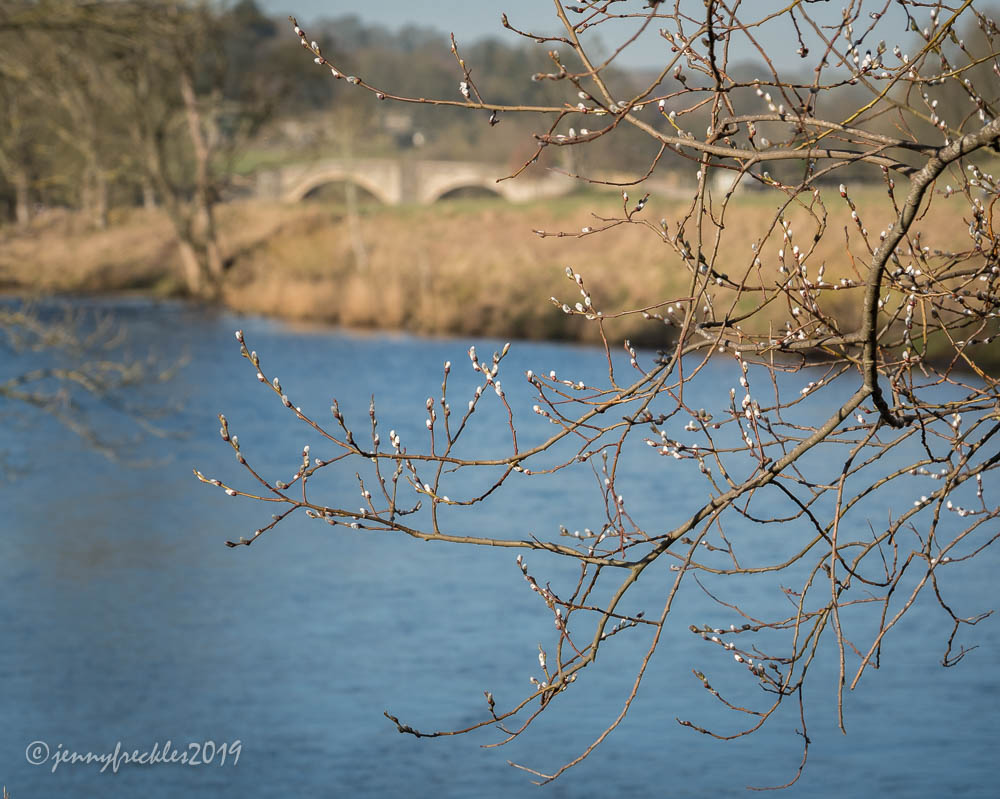
The warm weather was certainly bringing on the buds. The pussy willow looked very pretty against the blue water. I watched a red kite soaring on the thermals too.


Sunday, 10 March 2019

In the glasshouse


A Bird of Paradise plant, Strelitzia reginae. You can see how they got their name! 


The extensive glasshouses at Cliffe Castle were rebuilt as part of the recent renovations, and follow a similar plan to the original Victorian ones. It was fashionable for well-to-do Victorian gentry to have glasshouses on their estates for growing exotic plants and fruit, and the Butterfields' were more vast and ostentatious than most. The planting now is lush and exotic and there is a whole shed full of cacti and succulents, which look extremely well cared for. I'm not a huge fan of them but, looking at those on display, I was actually fascinated by the many different shapes, sizes and intricate structures. I began to understand their appeal to collectors.


Saturday, 9 March 2019

William Morris & Co


One of my favourite exhibits in Cliffe Castle Museum is the display of William Morris & Co stained glass rescued from various local mansions and churches. It's exquisitely detailed and wonderfully rich in colouration. I particularly love the pre-Raphaelite style faces.

William Morris and his fellow Arts and Crafts designer Edward Burne-Jones set up a company to undertake stained glass commissions, in the latter part of the 19th century. After their deaths just before the turn of the century, work was continued by John Henry Dearle, who had worked for the company for many years. The company ceased soon after the outbreak of WWII, after Dearle's death.

The panel above, dated 1921, showing angels with harps, came from a war memorial in Temple Street Methodist Chapel. (My apologies for the unavoidable reflections bottom left.) The panel below, part of a larger window showing the crucifixion of Christ, depicts Jesus welcoming and blessing children. It's by Burne-Jones, dated 1871, and came from St James Church, Brighouse, which was demolished in 1971.


Friday, 8 March 2019

The poor Passenger Pigeon


Our rape and pillage of the natural world is by no means a 21st century scourge, though it is clearly reaching critical levels. I was fascinated, in Cliffe Castle museum, to read about this bird and see two stuffed specimens. It's a Passenger Pigeon, Ectopistes migratorious, once the most numerous bird species in North America. Between 1840 and 1860, there were an estimated 3 to 5 thousand million of them, migrating in flocks that turned the sky black. In 1866, one flock in Ohio was described as 1 mile wide by 300 miles long and took 14 hours to pass overhead!
Deforestation and disturbance of their breeding grounds, together with widespread hunting, led to their extinction. The last verified sighting of a wild bird was in 1902. The last captive bird died in 1914. How very sad.

Thursday, 7 March 2019

Random treasures of Cliffe Castle


Cliffe Castle Musuem in Keighley has to be my all-time favourite museum. It is crammed full of all sorts of quirky treasures, so many that it would take a lifetime to really see them all. Some of the rooms are furnished as they would have been when the house was a Victorian mansion, home to the Butterfield family. Then there is huge gallery full of stuffed birds, reptiles and animals, a relic of Victorian times that could and would not be replicated nowadays but that I find, nonetheless, absolutely fascinating. You can, for instance, get a close view of the exquisite markings of a barn owl's feathers, realise how large our naturalised brown hare is and see the delicate skeleton of a snake.

Then there are wonderful geology specimens: rocks and crystals with subtly gorgeous colours and intricate structures. Then still more human handiwork: paintings, ceramics, textiles, clothes, stained glass, tools... so much to marvel at. The displays range from the traditional glass cases to much more interactive, colourful and user-friendly exhibits, with many geared to young people. It's a real treasure-trove.


This colourful exhibit is a timeline, exquisitely embroidered as a collage/tapestry, with a rainbow display of related exhibits in the glass domes.


Nearby is this glassy-eyed creature. I forgot to note exactly what it is but I think it may be a coleocanth. Yikes!


Wednesday, 6 March 2019

Cliffe Castle park


A friend of mine, Ann Davies, has just had an exhibition of her paintings at Cliffe Castle, Keighley. (Click the link to see them.) She's made detailed studies in pen and watercolour of the glasshouses there, which have recently been rebuilt. I went along to see the exhibition just before it closed and also had a lovely stroll round the newly renovated grounds.

The carpets of pale mauve crocuses looked very pretty and were proving an attraction both for little girls and dogs to run through! They will soon look a bit squashed at that rate.

The museum used to be a grand mansion belonging to the Butterfield family (see HERE for more about that) and some of the features in the grounds have recently been restored as they were in Victorian times. There are elaborate lamp-posts and a rediscovered fountain and fishpond that had at one time been filled in.

The park has some beautiful mature trees and good views from the perimeter across the Aire valley.


Tuesday, 5 March 2019

Apocalypse now


So there I was, on Sunday at about 1pm, catching up on a bit of ironing, with the tumble dryer rumbling away in the background, when suddenly... everything stopped. At first I though the dryer had blown a fuse but, on checking, I realised it was a power cut. A couple of houses opposite experienced the same, which was somewhat reassuring (though, oddly, none of my neighbours on my side of the street were affected).

I checked the Northern Powergrid website on my 'phone (oh, the wonders of technology) and it wasn't reported so I duly reported it and, shortly after, got a text to say engineers would be on to it pronto. At first they said the repair would be achieved by 4.30pm so I settled down to wait it out. It was, unfortunately, raining hard and blowing a hoolie, so there was no question of escaping for a good walk, which I would have done. 4.30pm came and went and eventually I got a message saying it would be 9.30pm before a repair was done! (At least they kept me updated.)

What do you do? Everything I thought of needed electricity - boiling a kettle, making toast, using the microwave or oven, getting on with some housework. No vacuum cleaner, no iron, no hot water or heating. No TV, no computer, no broadband - so no iPad. I had a book from the library - hurray for reading! Thankfully I also have a gas fire and hob so I was able to keep one room warm and boil water for a cuppa. (They're talking about banning new houses from having gas supplies altogether and many flats, like where my mother lived, are all-electric. What do people do then?)

It started to get dark and my phone ran out of battery. :-(  I made something to eat, worried about opening the fridge as it was rapidly warming up. Daren't open the freezer either, though luckily it's small and was well-stocked so I gather they can last a good few hours without power. I went to church (as planned) and managed to charge up my phone there during the service. When I got home there was a mini-digger out at the back hacking up the pavement, under floodlights, and several chaps with cable tracers, and another message on my phone saying they expected the repair to be achieved by 1am!

So I sat in the dark with a few candles burning and the street light outside shining in and tried to read by the light of a torch, which was hard work after a while. I began to wish I could knit or crochet... But it was strangely peaceful and I was happy enough. Friends and family had kindly offered aid, but it was hardly a life and death situation. When I went to bed, I realised I couldn't remember which light switches I'd tried... and, sure enough, at 12.23 am I was woken in a sudden blaze of light! Then - oh no! - it all went dark again. I got up for a drink and the lights came back on and stayed on. Phew! Eleven and a half hours without power. (If it had been twelve, I would have been able to claim compensation, ha!)

It was not, by a long way, the worst experience of my life but I was surprised by how much of an impact it had. We take so much for granted and yet 'civilisation' is such a fragile thing, resting so much on infrastructure working and people broadly agreeing to move together in the same general direction for the common good. As I've got older, I think I have taken fewer things 'for granted' and I'm grateful every week when the bin-men turn up for the rubbish, the train arrives more or less on time, the light goes on when I press the switch and things mostly behave how I expect them to. Not to mention my brain and body slipping into gear every morning when I wake up (even if the process isn't quite as smooth as it once was!)

But it is increasingly clear that not everyone is working towards the same future (yes, including whoever thought it a good idea to drop takeaway cartons into the newly-dug trench!) It is a little worrying, don't you think, that we now rely so much on electricity, plastic, computer-guided programmes and so on, and have largely lost the ability to get back to basics even if we wanted to? At the very simplest, the toasting fork my grandma used to use in front of the open fire, on occasion (and only for fun even then), would be no use here! It makes me quite fearful for my granddaughters' future, as I suspect change (for the worse) may come rather more suddenly than the gradual advance of 'progress' that I've seen during my lifetime.

A power cut is hardly the apocalypse, but it certainly left me pondering...


Monday, 4 March 2019

Inspired by...


There are two huge old barns in the grounds of East Riddlesden Hall, dating back 400 years to when it was a thriving farm estate. The Airedale Barn has been cleaned up and weatherproofed and is used for weddings and exhibitions. When I visited, there was a display of work by Barbara Greene, National Trust artist in residence. She has been inspired by fragments of china, glass, bone, fabric and nails found during the renovation of her 17th century farmhouse up the valley in Cononley. She has created small sculptures, artist books, boxes and textiles, displayed as a 'cabinet of curiosities' and tracing the connection between the objects and the lives of people who have lived and worked in the Aire valley. The exhibit shown was called 'Fibonacci sunflower' and I thought it was rather pleasing. 

The other barn, the Great Barn, remains in its rough state: dark and somewhat mysterious, despite the four sets of huge barn doors. I love just standing inside, allowing my eyes to accustom to the dark and then noticing the stone flags of the threshing floor, the old farm carts and the implements stored inside. Above it all, my gaze is always drawn to the massive oak beams, with their matching marks used when it was being put together (like a 400 year old 'flat pack'). The barn would have been used to thresh and store grain, as well as sheltering animals. It always feels very peaceful to me. I think it resonates with my links to the farmers and labourers that abound in the paternal line of my family tree. 


Sunday, 3 March 2019

NT East Riddlesden


Although it's quite expensive, I've decided to renew my National Trust membership for another year. It's often costly to get into NT properties anyway, so if I visit a few (like I did last year) I will get the most out of it. I've decided I like the feeling of 'ownership' that you get from being a member and contributor. It's good to be helping to care for the lovely places. It also means I can pop along to my nearest NT property, East Riddlesden Hall, anytime I like. It's quite a small property, a 17th century manor house - but 'perfectly formed', as they say. (Click the label at the bottom of this post to see more info and photos taken on other visits I've made here).

Despite the warm weather, the gardens are looking a bit bare as yet, though there were snowdrops and crocuses in the woodland garden.


The house sits on a ridge above the flood plain of the River Aire (which runs through the trees on the right) and there's a good view of the valley from the side garden. The property's estate includes the field lower down and there's a nature trail to explore beside the river.


Saturday, 2 March 2019

An early spring


I can't remember a year where we've had such a mild and sunny February. It has brought out the spring flowers very early, producing unusual combinations instead of the usual sequencing of snowdrops, followed by crocus, followed by daffodils. My little narcissus have already popped up in the tubs outside the front door. On a street nearby, admittedly in quite a sheltered spot, there is a camellia in full bloom, with snowdrops at its base. All rather pretty... but if we get sharp frosts in March (as we surely will) then all the magnolia buds and the camellias will get scorched and ruined. I passed a magnolia tree whose buds had already burst their sheaths. I felt like shouting at it: 'Stop! Go back, go back!'

I've been out and about a lot, making the most of the lovely weather. Usually I'm struggling to find enough photos to keep my blog going at this time of year. This year, I've more pictures than I can find time and space to show.


Friday, 1 March 2019

Tracks in the woods


It is beautiful in the woods on a misty morning. When I took these photos the sun was barely filtering through but, as I walked, the mist gradually burned off. The haze adds a sense of depth to the scene. I'm always fascinated by the young beech shoots that seem to hang on to their leaves right through until spring. There must be a reason for it, when the woodland floor is carpeted with the discarded leaves from the mature trees. Maybe the young ones are sappier or something. There were plenty of other people about, mostly walking their dogs. I like that. It feels safer, though, as far as I know, my local woods are as safe as anywhere for a lone woman (with camera) out walking.


Thursday, 28 February 2019

Time for breakfast


When I woke up and opened the curtains last Sunday morning, I noticed the sun was trying to burn through the fog and I could see the conditions were great for photography. So, unusually for me, I decided to forego my cuppa and my usual leisurely breakfast, dressed quickly and set off for a walk. It was wonderfully atmospheric and beautiful alongside the canal and in the woods. As I went down onto the towpath, a boat was mooring up and the smoke from its stove added to the misty effect. When I was heading home after an hour or so, the same boat was passing through Hirst Lock, so I guess they'd just stopped for breakfast before getting on their way again. 

I was ready for mine by the time I got home!