I HAVE CLOSED DOWN THIS BLOG. Please click the photo above to be REDIRECTED TO MY NEW (continuation) BLOG.

Tuesday, 11 June 2019

Building Castell Henllys


Wales: The first roundhouse was reconstructed on the Castell Henllys site in the 1990s. The original buildings are beginning to deteriorate and are now being renewed, which gave us a good insight into the building methods.

A company that builds using timber frames has started to put in place the wooden structure of a new hut. Then the walls will be constructed using hazel rods woven through timber posts (the wattle) - see example above left. Once the reed-thatched roof has been added, the walls will be finished with dried mud (the daub). The guide told us that the circular structure is built around a central post. Once the structure is balanced  and self-supporting, roped and jointed together, the central post is sawn off up in the roof, to provide an open living area.


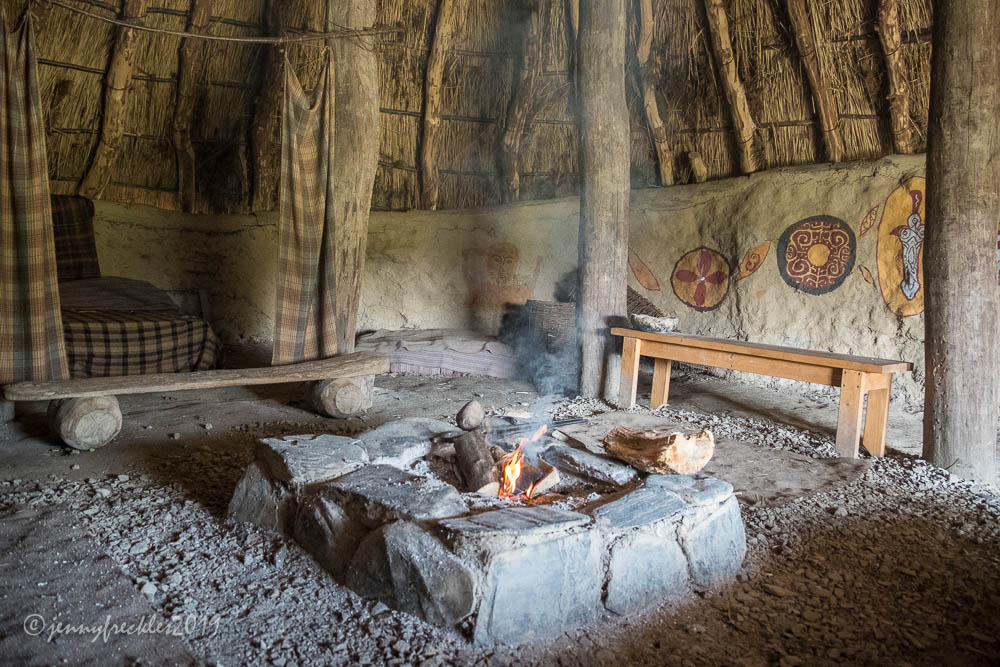
There's a great beauty in the roof structure, being at once organic and ingeniously engineered. The photo below is looking more or less directly up to the apex in the middle.


This is a more detailed view of the thatch overhang at the entrance, showing the timber and ropes.


Monday, 10 June 2019

Iron Age village


Wales: Whilst in Wales, we had a most interesting tour of an Iron Age village, at Castell Henllys, which has been excavated and studied for the past twenty years by archaeologists from York University. They have reconstructed several roundhouses on the actual foundations of a hill fort, belonging to the Demetae tribe, dated to between 500 and 100 BC. Their work has enabled a greater understanding of the Iron Age period, as well as providing training for archaeology students and a wonderful visitor attraction. Luckily, we visited when it was very quiet and had a personally guided tour, which was really fascinating.

The roundhouses are built of wattle and daub on a wooden framework, with reed thatched roofs. The granary (the smaller hut in the photo above), where food was stored, is built on stilts off the ground to mitigate against damp and vermin. The settlement was protected by a complex of earthworks and ditches, including a 'cheveaux de frise' - a stony ditch (right) designed to protect against horses and chariots.

Heat, light and cooking were provided from a central fire within the roundhouse, whose smoke was drawn out through the thatch.


The roundhouses were home to extended families and some have private sleeping quarters separated by woollen curtains. It's estimated that the village could have housed over 100 people, led by a wealthy and influential chieftain. The people were very resourceful and skilled: coppicing woodland, growing crops and keeping livestock;  spinning, dyeing and weaving cloth; turning wood; weaving baskets; grinding grain to make bread and generally living a healthy and sustainable lifestyle. Some would have been warriors and hunters, protecting the settlement from wild animals and human enemies.

The hill fort seems to have been abandoned during the 1st century BC, possibly due to the Roman invasion.


Sunday, 9 June 2019

St Dogmael's market


Wales: St Dogmael's has a local producers' market every Tuesday, with all the produce grown, reared or produced within a 30 mile radius of the village. Situated beside the ruined abbey and next to the Coach House Visitor Centre, the market is a colourful sight and packed with high quality goods, both food and crafts. We enjoyed browsing the stalls, buying cheese, pickles and other things.


I was tempted by the dressed crab. (I love fresh crab but it's hard to get at home, being so far from the coast.) However, as we were on our way out for the day, I decided it might not keep so well in a hot car!

The display of hand-knitted socks was colourful, though I wonder if they might be a bit itchy...


Music was provided by a skilled accordionist - and very good coffee is available in the visitor centre adjacent to the market place. We stopped there several times for refreshment during the week. It has a café, shop and gallery and holds some interesting information and objects related to St Dogmael's Abbey.


I fell in love with a small earthenware bowl by the ceramicist David Small, decorated with a pretty turquoise glaze. It was very reasonably priced so I treated myself to it. I've brought it home and then suddenly decided to 'refresh' my whole sitting room around the colour. The decor is mainly neutral cream and I add colour with accessories. I then proceeded to spend four times as much again (!) on new turquoise cushions to match, swapped around some pictures and feel delighted with the new look! 


Saturday, 8 June 2019

The Miller's Daughter's tour


Wales: We booked a tour of Y Felin, The Mill, in St. Dogmael's and we were really glad we had. We were the only three in the group so it was, in effect, a private tour and extremely interesting. Our guide was Emma, the miller's daughter. She first showed us how the waterwheel kicks in when the sluice gate is opened. The initial gush of water is quite spectacular and then the wheel gradually assumes its steady. smooth turning.


Inside the mill, in the basement, the water wheel's shaft drives a series of cog wheels with wooden teeth, which operate all the machinery.


On the top floor, a rope and pulley system, driven by the water wheel's power, is simply operated - by sitting on the lever!


Sacks of grain can thus be winched up through a hatch in the floorboards.


The grain is then poured through a fabric chute into a hopper below.


The hopper steadily feeds it into the machinery, where the huge grinding stones get to work. The water-driven power makes the top stone rotate and the grain is fed along channels and is crushed.


Depending on what is being made, the flour pours down through chutes to the ground floor


or can be diverted into a flour grading machine with a series of different gauge meshes, that rotates and sifts the flour,


eventually delivering it through tubes into bags on the floor below.


The finished produce: wholemeal flour, spelt flour, unbleached white flour, rolled oats and a number of other products, can be purchased directly from the mill and from farmers' markets and local outlets. Emma explained that the benefits of the traditional method mean that all the nutrients are retained, whereas with mass produced flour, the wheatgerm and bran are removed and then added back later, and flours from different sources are often blended. (See HERE if you're interested.) 


I bought some rolled oats, which I've yet to try. Sadly, I can't eat wheat flour but my friends bought some bread for their sandwiches. It was rich and crumbly, a bit tricky to cut evenly with the blunt bread knife in our holiday flat (!) but delicious nonetheless. We really enjoyed the tour. Another thing that I'd highly recommend if you're ever in mid Wales.

Friday, 7 June 2019

Y Felin (The Mill)


Back to my holiday journal: 
Wales: Nestled in the centre of St Dogmael's, beside its mill pond, is Y Felin, one of the last working water mills in Wales producing traditional stoneground flour. Probably originally built in the 12th century by monks from the nearby abbey, its history is documented from the 1640s. It was a working mill until the 1920s, when the miller, Evan Gwynne, died. After that it lay closed up and unused, until it was bought in 1977 by Michael and Jane Hall, who set about restoring it, including the laborious work of digging out the mill pond and sluice. Inside, it still has the machinery that was installed in 1820, restored by Mr Hall and now in full working order again.


The pond is fed by a stream coming down off the hill behind. Water then runs through a sluice gate to power the water wheel that, by a series of interconnected cog wheels and shafts, drives the mill machinery.


Even the door is ancient, marked with signs that have been authenticated to the 15th century.


The mill not only sells bread and flour but second-hand books too! 


Come back tomorrow and I'll show you round... We had a tour.

Thursday, 6 June 2019

Throwing a pot


Saltaire Arts Trail 2019 - It's always interesting to watch artists demonstrating their skills. In the Maker's Fair, ceramicist Sylvia Glover was showing how to throw a pot on a potter's wheel. She made it look so easy, not a wobbly line in sight! From a lump of clay to a beautiful, even-sided little bowl, ready to be dried, took her less than ten minutes. 

Wednesday, 5 June 2019

Mawdsley Williams furniture design


Saltaire Arts Trail 2019 - David Mawdsley, of Addingham-based Mawdsley Williams Ltd, designs and crafts the most beautiful, unique furniture from a variety of different woods, chosen for their natural characteristics and grain patterns. His pieces, both the larger items of furniture and the exquisitely crafted smaller boxes and chopping boards, make decorative use of the grain pattern and the effects achieved by inlaying different types of wood.

I've seen his work exhibited at various events like the Arts Trail and Skipton's Art in the Pen. If I had money to spare and somewhere to display it, I'd treat myself to one of his console tables or maybe a bar stool. There's something wonderfully tactile about good wood, as well as the joy of the craftsmanship that goes into each piece.

Here, he was shaping a leg for a stool. I'd love to try working with wood, though since I have difficulty even filing my nails, I'm not sure I'd be much good at it! See David's website HERE for more examples of his lovely work.


Tuesday, 4 June 2019

Eye-catching moments


Saltaire Arts Trail 2019 - Here are some more exhibits that caught my eye this year, as I browsed the Arts Trail Maker's Fair and Open Houses:

Rather superior hand-made peg dolls by Peggie Belle - superior, that is, to the various attempts I've made at peg dolls during my career as mother and grandmother! They each had a lot of personality. 

Gorgeous, tactile, vibrant leather bags and accessories by Gosia Weber.


Colourful baskets and mats, made from recycled T-shirts by Saltaire resident Lola Moreno of Aupalola Crafts.


A frog water feature by Martin Norman, made of bronze and iron resin. Quite a cheeky looking chap, don't you think? I'd quite fancy installing this in my little back garden, though I expect it would soon hop off into some passing shyster's white van, so I won't! 


Monday, 3 June 2019

Made by Today


Saltaire Arts Trail 2019 - The Open Houses showcase work by local people, as well as celebrated artists from further afield. Séarlait McCrea is a Northern Irish girl living in Saltaire, making understated jewellery in her home and, when on the move, in her trusty campervan. With a love of simplicity and a loathing for excess, she creates minimalist, timeless pieces produced as ethically as possible. Her vision is set out in her 'Made by Today' website HERE, where you can see (and buy) some of her subtle and classy designs. She also runs jewellery making workshops in Saltaire and Leeds.

In my photo, she was carefully shaping tiny crescents from the thin sheet of metal, using a very fine hacksaw blade. She made it seem easy but I'm sure it's harder than it looked. One slip and your finger would be cut or the piece ruined!


Sunday, 2 June 2019

Mandy Long - Ceramic Sculpture


Saltaire Arts Trail 2019 - It's interesting to notice what catches your eye as you wander round the Arts Trail... For me, it's not always the most obvious things, and often it is just one piece that stops me in my tracks.

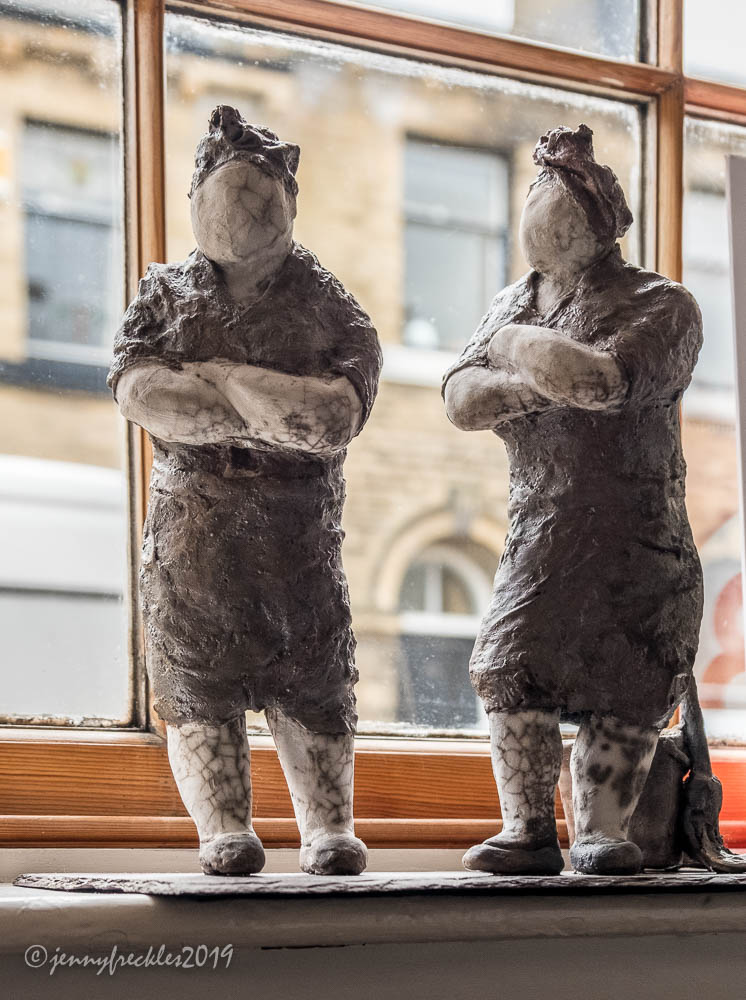
The ceramic sculpture above was in the window of a house on Titus Street. It's called 'Landladies' and is the work of Leeds-based artist Mandy Long, pictured right. I loved the way she has caught the pose of these women. Even without faces, they are still hugely expressive and the piece really tells a story, I think.

Other exhibits displayed were also powerfully expressive, like the one below - the Hurdler. Seemingly suspended mid-leap, the athlete's muscles are straining to clear the hurdle. Much of Mandy's work depicts the physicality of sport in its various forms, allowing her to fuse grace and power very eloquently in her sculptures. The pieces are raku-fired, causing random crackling and blackening of the glaze.

I loved it - and I loved that I dared ask Mandy if I could take her photo and she said 'yes'! I'm getting braver. Look at her website for the full range of her beautiful work - HERE.


Saturday, 1 June 2019

Saltaire Arts Trail 2019


There's always something happening in Saltaire... The film company left and the shops and cafés have all been returned to their usual look, with little remaining of their exciting BAFTA-seeking performance (see here), save traces of dusty gravel on the road.

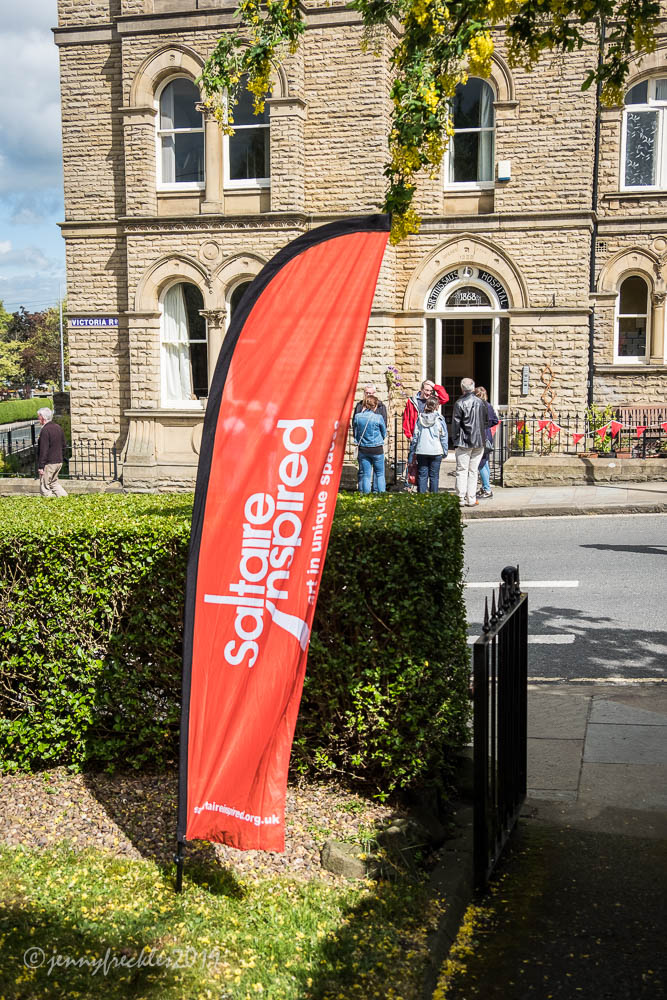
Then it was the annual Saltaire Arts Trail over the bank holiday weekend. Residents in the village houses open their homes as mini art galleries, there's a huge Maker's Fair in the Victoria Hall and the art cognoscenti, both local and from wider afield, descend on Saltaire to enjoy some of the best art and craft imaginable, in one of the most interesting settings you could find.

The café in my top picture has had a number of re-imaginings in the recent past (not least as a pub during the recent filming). It is now Nordish, a café dedicated to good Scandi fika and smorrebrod. It operated as a 'pop-up' initially, with limited opening times. Recently it's been closed for an extensive refurbishment and now plans to build up to a more regular opening schedule and a wider menu. It was open for the Arts Trail, with artwork on show by Liz Tolan and Salma Patel.


'J Chadwick and Sons, Fruit and Potato Sales' has been turned back into Massarella's Café Bar and Gallery, where (even on an ordinary weekend) you can enjoy a coffee and a light snack whilst browsing their range of pictures and photographic prints.

Up in the residential zone of the village, various houses and some gardens were colourfully marked out with bunting, with a wide range of attractive and sometimes quirky artwork on display. This house had a selection of 'Sac pots' for sale, knitted plant pots that I featured on my blog last year - see here.


When the sun came out, so did the children, busily engaged in sculpting a willow lion with the guidance of Todmorden-based willow sculptor Joevanka Gregory.