I HAVE CLOSED DOWN THIS BLOG. Please click the photo above to be REDIRECTED TO MY NEW (continuation) BLOG.

Monday, 25 November 2019

More gold


Autumn seemed to start a little early but slowly this year. Then, as the nights got colder, we did see some wonderful colour develop. One of the best places locally to enjoy the varied hues is along the stretch of canal that goes through Hirst Wood. It's a pleasant circular walk of a mere three miles to go out from Saltaire along the canal towpath and return through the ancient woodland itself. Again, these are just phone snaps, but I think they still show how lovely it all looked. With the benefit of cataract surgery (and really appreciating the privilege of having it done on the NHS, so skilfully and with so little fuss) I am looking around me with a renewed sense of awe and gratitude for the glorious world we live in.


Sunday, 24 November 2019

All is pure gold


So... I hope you enjoyed my holiday photos - and here I am back again, posting 'live' and with photos I've taken over the past couple of weeks. Much of November has been spent taking care of my eye after the cataract surgery. Endless amounts of eye drops to apply! It was all extremely easy and painless though. I was amazed that the surgery itself only took about 15 minutes and was quite fascinating, watching a kaleidoscope of lights and colours as my old lens was swapped out for a new one. Once the anaesthetic wore off and my pupil returned to a normal size, I found I could see perfectly well with my existing glasses. There are various warnings against driving and a plethora of other things: no dusting or hoovering (yay!); no lifting; no swimming; no makeup or creams on face; careful hair washing; no rubbing your eyes; try to avoid coughing and sneezing! Everything does look sharper and brighter, especially if I close the other eye (which in comparison now makes everything look rather yellowed). The best bit is that lights at night, which were very glaring, now look much more bearable, so that will make driving after dark a great deal safer. In January, I've to go through the whole procedure again with my other eye so it will be weeks yet before it all settles down enough to get my eyes tested to see if I really need glasses, and if so whether I need a new prescription.

Shortly after the op, I gave in to a head cold that has been nudging at me for ages. I didn't want to sneeze in the middle of the delicate surgery (!) and I'd managed to keep it at bay beforehand with a mix of vitamins, echinacea and antiseptic gargles. It never got fully scared off, so I decided to let it overtake me and snuggled up with a few good books and the TV for a few days, sniffling and dozing. Every now and again, I think, one just needs to stop and rest so that's what I've been doing. I feel much better now.

I left my camera behind on the short walks I've done, just using my phone to take photos. One day I wandered in the grounds of Saltaire's URC church, alongside the canal. There are some wonderful, mature beech trees there so the ground was literally a carpet of gold. Adjacent to the churchyard, the buildings that make up the old stable block (see above), which are just cottages really, look from this angle rather like a grand mansion. Sir Titus Salt certainly had a bold vision for his village, and we still reap the benefit more than a century and a half later.


Saturday, 23 November 2019

The Callanish Stones


Harris, day five

The Callanish Stones are perhaps the most famous visitor attraction on Lewis. It's a complicated site, consisting of three separate stone circles and some avenues of stones, believed to date back to between 2900 and 2600 BC, making them about the same age as Stonehenge. They are of a simpler construction, consisting of standing stones without any lintels.

It is believed to have been used as a Bronze Age ritual site and a little later a burial chamber was added, which was used for many centuries. The whole site fell out of use around 1000 BC and was then used for agriculture, being completely abandoned in around 800 BC and eventually buried under peat. It was cleared of peat in the late 1800s and taken into protective care.

The Gneiss markings make each stone very attractive and the whole site is quite awesome.

We were privileged to enjoy the sunset at the main stone circle, a powerful and beautiful experience, despite a little drizzle. Our final sunset of a memorable trip - most poignant...


Friday, 22 November 2019

Gneiss beaches


Harris, day five
We spent the afternoon in Lewis on a couple of (very Gneiss) beaches, one stony and one sandy. The local rock is Lewisian Gneiss, a metamorphic rock that, at 3 billion years old, is reckoned to be the oldest rock in Britain and one of the oldest in the world, two thirds the age of the earth. See HERE for a more detailed explanation. It is very attractive, with multi-coloured layers and patterns. I love pebbles, there's something so tactile about water-smoothed stone and I was tempted to put a couple in my pocket. (I know you shouldn't!) It was mainly the thought of my luggage allowance on the flight back that stopped me!

Wherever, there are stones, someone will have balanced a few...


I was fascinated by the patterns in the peaty water of a small stream running across the beach to the sea.


Thursday, 21 November 2019

The preserved village


Harris, day five
On our trip to Lewis, we also paid a short visit to Geàrrannan blackhouse village. These traditional blackhouses were abandoned in 1974, when the residents were moved to more modern social housing nearby. They are only about 150 years old, but built in a very traditional croft style that was once common in the Scottish Highlands, Hebrides and Ireland. Since these at Geàrrannan were the last blackhouses in Lewis to be vacated and they sit in such an attractive setting overlooking a stony beach, the decision was taken to make this a conservation area. In 1991 a programme of restoration was undertaken. Now, there is a museum and some holiday accommodation within the carefully restored village, where modern amenities have been discreetly integrated.

The buildings have double-skinned drystone walls with earth packed between them, and roofs made of straw thatch and turf, anchored with ropes and stones to withstand the harsh Atlantic gales. Fires would have burned peat and originally the smoke was left to find its way out through the thatch. The houses are long and would have accommodated families at one end and animals at the other, separated by a thin partition.


Wednesday, 20 November 2019

The ruined croft


Harris, day five

On our last full day, we drove north to the adjoining island of Lewis. Both Harris and Lewis are dotted with abandoned crofts, left either as a result of depopulation or perhaps simply because the original residents moved into newer accommodation. Many of them are too dangerous and dilapidated to venture too close, but we did find one at Arivruaich that you could walk down to.

A once substantial dwelling, it was set in a small hamlet with a few other houses and a postbox. One wonders if the inhabitants mind the view of a decaying cottage?


For photographers, it was, of course, a dream location, with a sea loch behind and lots of details: sagging outhouses with rusty corrugated iron roofs...


... rotten window frames with sad fragments of lace curtains that must once have been chosen with pride...

... the decaying remains of a bathroom, the bath and sanitary ware still in situ, although the ceiling was caving in, the walls were bare and the floor was dangerously rotten...


... and of course, when man leaves, nature rushes in so that wild plants were recolonising the boggy ground.


Tuesday, 19 November 2019

Pastel tones


Harris, day four
We spent late afternoon on day four on Scarista beach, a long crescent of pale sand in the shadow of Ceapabhal. The beach faces north and the sunset unfolded gradually in a series of pastel hues. I was busy again with my ND filter to smooth the water. The top photo is without it and the one below is using it to give a 1.5 sec exposure. Sometimes I prefer one and sometimes the other!


As the light faded the hills of Taransay across the Sound were tinted pink:


The clouds, lit by the setting sun, were a gentle fire of blues, greys, corals and pinks:


Monday, 18 November 2019

The harbour


Harris, day four
A little further beyond the church is the village of Rodel, once the historic capital of Harris, situated around a harbour that used to host the Skye ferry. Those accolades now fall to Tarbert and Rodel is much more tranquil.


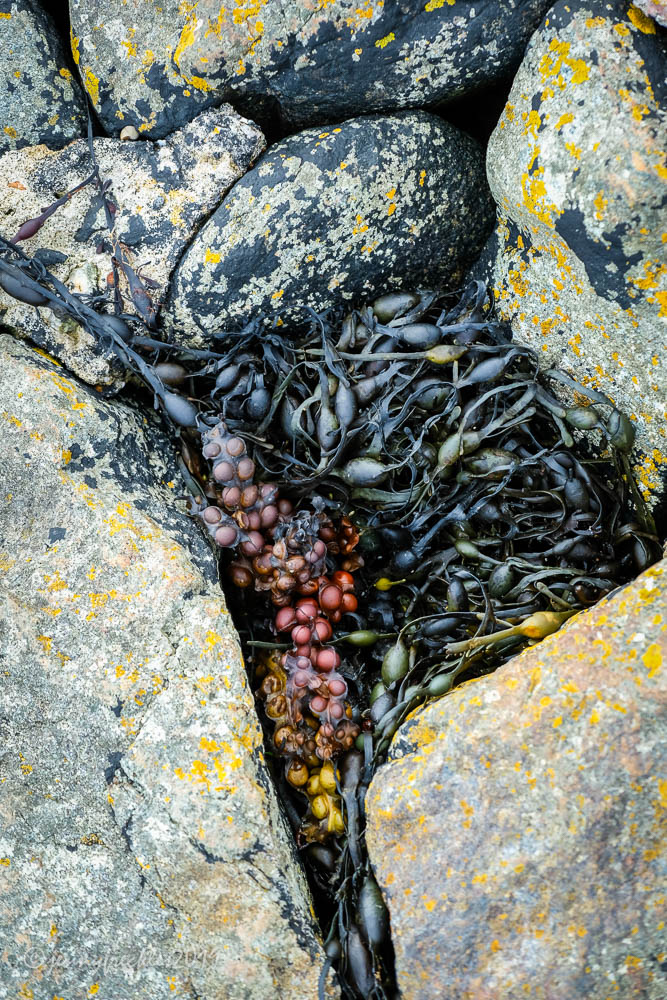
I really enjoyed taking a few 'mini-landscape' shots here. There was much to inspire me: old boats, rusty chains, knotted ropes, seaweed and lichen. Some lovely colours too...


For some reason I can't quite define, this shot of seaweed caught in a gap in the decaying harbour jetty is probably one of my favourite images of the whole trip. The shapes and colours just seem very pleasing to me. I think it's an archetypal feminine image in some senses - a bit Georgia O'Keefe, albeit not a delicate flower. 


Sunday, 17 November 2019

St Clement's Church, Rodel


Harris, day four
By day four, I was ready for a variation in the Harris diet of sea, sky and rock so I was interested to explore the little church of St Clement in Rodel. It was built around 1520 as the burial place of the chieftains of the Clan MacLeod of Harris. The church was disused after the reformation in 1560, but continued to be used as a burial site. It has since had a number of restorations.

There is an elaborate tomb on one wall for the 8th Chief, Alasdair Crotach MacLeod, crowned with an arch and featuring carvings of the Trinity, other biblical scenes, a sailing galley, a hunting scene and the Chieftain himself in a knight's armour. There are other significant MacLeod tombs within the church and a series of tombstones from the 1500s and 1600s, decorated with ornate carvings of swords denoting high status, power and strength.


On the outside walls of the church there are more intriguing carved stones, including a figure in a kilt (left). The figure of the man (right) is known as 'The Lewd Man'.


There is also a 'Sheela-na-gig' - a female effigy (see below). There is a similar carving on a wall in Iona, which may indicate links between the two. It may depict the goddess of fertility, life and death, perhaps as a reminder to those entering the church that they are entering a sacred space, the womb of the goddess, or perhaps simply to ward off evil. (Pagan and Christian symbols are often interwoven in our medieval churches.)


The drystone boundary wall of the churchyard had symbols too: hearts and flowers - though much more recent, no doubt. They don't do that in Yorkshire! Adjacent to the churchyard was a small public toilet for visitors, apparently installed and cared for by the local community. It was really neat. It even had flowers and a visitors book! I loved Rodel. 

Saturday, 16 November 2019

Luskentyre patterns


Harris, day four
One of the motivations that had me longing to visit Harris was seeing, some years ago, a series of photos taken at Luskentyre that had been printed on pearlised paper so that they shimmered. They were wonderful. Our best opportunity to see the incredible patterns of tide and sand was on the morning of day four of our trip, from the high viewpoint on the Seilebost side of the estuary. The tide was partly in (though I could never work out if it was on its way in or out!), giving shades of turquoise, grey and duck egg blue against the very light sand. Strands of seaweed made darker counterpoints, as did the flocks of birds feasting at the water's edge. Without binoculars, they were a little hard to identify but some were oystercatchers, some lapwing and some geese, though there were a few much smaller waders scurrying about as well. Hopefully these photos give at least some idea of how beautiful it was.


Friday, 15 November 2019

Early morning on the rocks


Harris, day four
I managed to drag myself out of bed on the fourth day to participate in the dawn shoot. (I'll never be a real landscape photographer!) We scrambled about on the rocks at Rubha Romagraich, not far from where we'd been the evening before. I like the photo below, even though it's an annoying composition and I want to move the hill.


The sun came up behind us, throwing a soft light on to the outline of Ceapabhal.


I also liked the effect and the colours in this ICM image: