I HAVE CLOSED DOWN THIS BLOG. Please click the photo above to be REDIRECTED TO MY NEW (continuation) BLOG.

Wednesday, 16 March 2011

Gotcha!


Parking in Saltaire is a perennial problem. The big main car park, which visitors are supposed to use, is sited behind Salts Mill and thus a fair walk from the village itself.  Those in the know make for one of the two small car parks near the centre of the village, or attempt to park on the streets.  The problem with that is that nearly all the streets in the village are resident-only permit parking.  You might think that, for a short stay, you might risk it... but as my photo shows, there are several 'Parking Services' officers (traffic wardens) who patrol the village - even on a Sunday.  One of these cars, or maybe both, is going to get a ticket. (Perhaps not such a smart car after all!)

Tuesday, 15 March 2011

Who are you looking at?


Like most villages, Saltaire has not only a community of people but also a community of cats.  I am sure they each have their preferred territory.  I've been lurking around corners trying to snap a few of them.  This handsome ginger was sitting watching trains by the station - at least until I started messing about with my camera.  He didn't look too amused at that and soon stalked off.  The sides of the railway line have a lot of vegetation and are probably fertile hunting ground, though I have many times been alarmed to watch cats nonchalantly strolling across the lines when a train is due.  I imagine they can feel the vibrations along the rails - hope so anyway!


The black one above was also near the railway - a very friendly cat.  I was framing up a photo and he twined himself through my legs, purring!  But then I found one sitting as still as the Sphinx on a windowsill, almost hidden by the shrubs.  And he just stared and stared... not the most handsome of cats, it was rather eerie!

Monday, 14 March 2011

Salts Mill from Albert Terrace


Late winter sunshine illuminates one of the most famous views in the World Heritage Site of Saltaire, often seen in magazines and tourist information.  It is also the first view you get if you arrive by train, as the railway station is in a cutting just to the left.  Looking up the cobbled roadway of Albert Terrace, towards Victoria Road, you can see Salts Mill on the left and its large chimney straight ahead.

See here and here for more pictures taken in the same area.

Oh dear, sorry - I failed to remind those with access to BBC TV that the Antiques Roadshow, filmed in Saltaire last year, was shown last night. It is on iPlayer if you want to catch it (the first three minutes of the film are about Saltaire in general and are worth watching - click the arrow on Fiona Bruce's picture!) - and there is a second episode next Sunday evening too.

Sunday, 13 March 2011

Pause....


A pause to remember all those throughout the world... Japan, Australia, Libya and countless more places... whose lives have been touched by tragedy and violence in the last few days and weeks, and those, like my own dear mum, facing battles of their own.  May you know the peace of the Lord, which passes all understanding.

Saturday, 12 March 2011

The Monkey Puzzle tree


This large Monkey-Puzzle tree (Araucaria araucana) is an exotic addition to a small Saltaire garden.  Native to the south-central Andes in South America, the trees nevertheless grow well in northern Europe's temperate climate.  The genus can be traced back 250 million years to the Mesozoic era and its spikey leaves probably developed to fend off grazing dinosaurs. (It seems to have worked well in Saltaire.  I haven't noticed any dinosaurs lately.)

The tree was first brought to Britain in 1795 and was grown as an ornamental specimen tree in botanical gardens, becoming popular with the Victorians.  It is believed to have come by its name when a visitor to a garden in Cornwall remarked that "it would puzzle a monkey to climb that".  This tree in Saltaire, the only one in the village as far as I know, must be quite old and was probably planted quite early in Saltaire's history, in the late 1850s.  It must have had a great deal of novelty value at the time; the trees are still quite a rarity in domestic gardens.  It looks a beautifully healthy specimen.  If the Health and Safety people don't have it felled (as the needles are believed to be 'as sharp as syringes' and therefore a danger to children) then it might last a good few years yet.  Some of the native trees are thought to be 1200 years old!

Friday, 11 March 2011

Riverside walk


There is a pleasant riverside walk along the bank of the River Aire through Bingley.  It's quite a while since I passed this way and I was pleased to see that they have tidied it all up considerably.  The river runs parallel to the town's main street.  Behind the shops and down to the river there is a warren of old houses and commercial premises, which at one time were a bit run down.   Some have recently been converted into apartments and some new apartments built too, all with an attractive aspect onto the river.  Far from spoiling it, it seems to have done a lot to improve the area.  There is still a lovely pathway to walk too, right from the church down in the oldest part of the town up to Myrtle Park, a large open park where the annual Bingley Show is held.

It's a while since I entered James' Weekend Reflections - I think this photo will fit the bill nicely, don't you?  For more interpretations of the popular Reflections theme, please click here.

Thursday, 10 March 2011

Purple patch


The next town along the Aire Valley from Saltaire is Bingley - quite an attractive little market town, much improved a few years ago by the building of a by-pass that diverted some of the traffic from the town centre.  I had a wander along the riverbank and through the town square and passed this bank of crocusses, such a cheering sight and a reminder that spring is on the way.  No doubt certain of my readers would have preferred to see more of the pub in the background - The Ferrands Arms, named after one of the local gentry families. (See this post for another mention of the name).  The pub serves 'real ale' and appeals largely to a late-night crowd of youngsters - or so I gather, since I don't frequent the centre of Bingley late at night, as a rule!

Wednesday, 9 March 2011

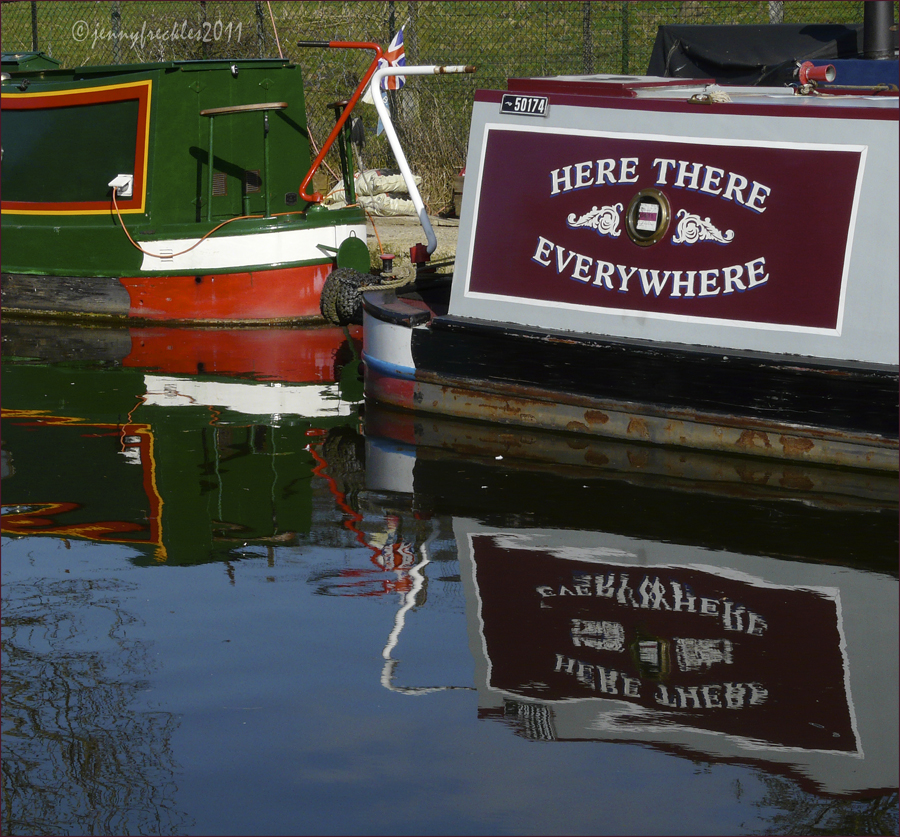
Here, there, everywhere...


I passed these narrowboats when I was walking by the Leeds-Liverpool Canal at the weekend enjoying the sunshine.  It's still pretty cold here but there was a promise of spring in the air.   It brought out walkers, joggers, people exercising their dogs - and of course photographers like me.  There is a small marina and boat repair yard a few miles along the canal from Saltaire, and lots of boats moor there for the winter.  On a sunny Sunday, it seemed like quite a few boat-owners had decided it was time to do a bit of preparation for the summer season: cleaning, painting and generally tidying up.

How could I resist taking this picture?  It provides a wonderful introduction to another of my favourite blogs: cieldequimper's Here, There and Everywhere - random pictures.  She's another skilful photographer with a good eye for composition.  Her blog features photos from all over the world, and she also has two more: Versailles Daily Photo and a new one called Artsy Versailles.  You've got to admire someone who can keep three great photo blogs going!

Tuesday, 8 March 2011

iPhone art

Images © David Hockney (these were originally available for free download )

David Hockney's latest exhibition in Salt's Mill in Saltaire is called 'Fresh Flowers'.  It shows paintings he has made using his iPhone and iPad.  A series of images - mostly paintings of flowers - are dramatically projected onto three large screens in a darkened gallery, so that the colours are vibrant and you can see the 'brushstrokes' ... made using his thumb and an iPhone app called 'Brushes'.

“After all, this is a medium of pure light, not ink or pigment, if anything more akin to a stained glass window than an illustration on paper.”

They do look very soft-focus, as in this photo, no doubt on account of being enlarged so much from the original iPhone size.  But the colours are wonderful, the paintings deceptively simple and - as with much modern art - you kind of feel that you might be able to create something similar, at the same time realising that really you couldn't!  (I did, however, create a very satisfying impressionistic photo made up of three of the images - only fear of litigation prevents me posting it here!!  The two above are by no means my favourites but they were available to download whereas the others are all copyrighted.)

There's an interesting article by Lawrence Wechsler from The New York Review of Books that explains this new development in Hockney's work.  One of the things I most like about David Hockney is his willingness to experiment and to embrace new technology, and I am always fascinated to hear him talk about his thought processes:

"It [ie: the iPhone] is always there in my pocket, there’s no thrashing about, scrambling for the right color. One can set to work immediately, there’s this wonderful impromptu quality, this freshness, to the activity; and when it’s over, best of all, there’s no mess, no clean-up. You just turn off the machine. Or, even better, you hit Send, and your little cohort of friends around the world gets to experience a similar immediacy. There’s something, finally, very intimate about the whole process."

(The artist David Hockney was born in Bradford, studied at Bradford College of Art and currently lives on the Yorkshire coast at Bridlington.  Salt's Mill in Saltaire holds a large collection of his work.)

Monday, 7 March 2011

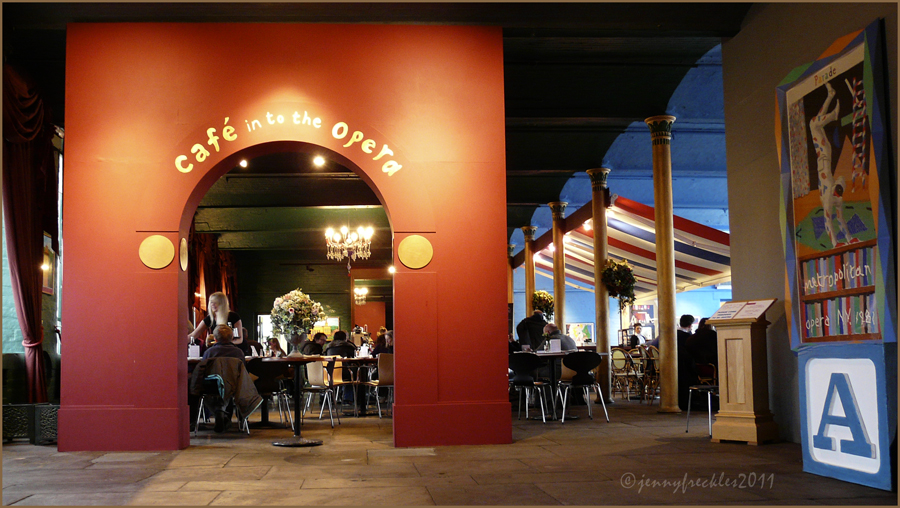
Café into the Opera


I wrote recently about Salt's Diner, the main restaurant in Saltaire's Salts Mill, but there is a second rather less well-known restaurant on the third floor,  known as 'Café in to the Opera' (I think because at one time you had to pass through it to get to the exhibition of David Hockney's Opera Sets, which has recently been dismantled).  Its décor is rather theatrical, with a striped awning and bright archway.  It gives it a cosy ambience, which is almost surprising in the vast space of the Mill.  It's also much quieter than Salt's Diner.

Meals are mainly fish-based dishes, but they also do snacks and drinks.  For a review see here.  It is closed on Mondays and Tuesdays and open from 10am until 4 or 5pm on other days (see the Mill's website for up to date info and menus.)  It sits beside a little florist's shop, which seems equally surprising in the context of the Mill.

Sunday, 6 March 2011

Retail therapy


Any visitor to Salts Mill in Saltaire risks leaving a few pounds (£s) lighter of wallet and with a few pounds (lbs) more to carry. (Ask me... even though I visit a few times a month, I rarely leave without a new kitchen gadget, a book or at the very least a couple of greetings cards).  They will give you a paper carrier bag or a plastic one, but now they are selling these durable, reusable calico (unbleached cotton) bags. (And - oh joy! - the handles are long enough to put over your shoulder but not so long that, hand-held, the bag hits on the ground.)

They are made in India by re-wrap, a not-for-profit manufacturing enterprise concerned with social and environmental change, which supports several fair-trade co-operatives.  The company was founded in 2002 by Jangri Triveldi after an earthquake in 2001 devastated the region of Kutch (Gujerat) and left its people struggling.  Re-wrap aims to join the traditional skills of craftspeople with modern designs to make attractive, affordable, ethical products.  Its website is really interesting, and has a couple of touching stories about the people they provide work for.

The bag has an image of Salts Mill screen-printed on both sides, designed by Yorkshire artist Simon Palmer.  Simon's work is quite distinctive, marrying what at first glance look like traditional landscapes with wonderfully surreal imaginative touches.  His pictures always tell a story.  The Mill itself is depicted fairly true to life, with a suggestion of chimneys and village houses in the background and there are lots of birds and people animating the scene.

I don't think Salts Mill sell online, so you would have to visit to buy a bag - but what a great idea. A useful, foldable bag that promotes two very worthwhile enterprises in Yorkshire and in India.  What's not to like? ... as they say!

Saturday, 5 March 2011

Cheese & Chutney


'Cheese & Chutney' is a great little delicatessen on Gordon Terrace in Saltaire.  I popped in to buy some blue cheese.  Spoilt for choice, I ended up with some Jervaulx Blue, made in Wensleydale (one of the Yorkshire Dales) to a recipe perfected by French monks who settled in the valley and founded Jervaulx Abbey in the 1100s.  Very delicious it is too - creamy, smooth and mellow.

'Cheese & Chutney', founded by Matthew Coxon about three years ago, was originally called 'Coxon's Kitchen'.  A trademark clash with a TV chef with the same name forced the shop to change its title last year.  The resulting publicity was, I think, no bad thing in the end.  The delicatessen seems to have gone from strength to strength and they seem to have benefited from focusing on cheese and chutney as their two main selling points.  They even supply wedding cakes made of cheese!

It's one of those shops you can happily browse in. You can select from over 40 UK and continental cheeses and 50+ chutneys and also buy artisan breads, cakes (try the wonderful chocolate brownies), olives, antipasti, cured meats, interesting store-cupboard ingredients and cookware.  They make up beautiful gift hampers too.  Matt has recently started supplying gluten-free products to order, sourced from a supplier in Leyburn in Wensleydale.  If you're in the area, I highly recommend you visit the shop, drool (though not over the produce!) and take a bag full of yummy things home with you.

I just happened in when Matt was rewriting his signboard and he happily smiled for the photographer.  I'm counting this as number two in my 'be brave and get people you don't know to pose for a photo' challenge! (The first being the KWVR train-driver last month).  Thanks Matthew!

Friday, 4 March 2011

Perfection revisited


Some of you may remember that a long time ago I posted a picture of what I always think of as "the perfect tree".   It's a type of rowan and has white blossom, followed by red berries and then the leaves turn an attractive red before falling.  But more amazing is that it retains a neat 'storybook tree' shape, without being trimmed or pruned.  I love it, and I like its location with Saltaire's Salts Mill in the background.  Being stripped bare of leaves, winter reveals its inner secrets - not just one bird's nest but three, hidden deep in the branches.

Thursday, 3 March 2011

Saltaire Rouge


I like the juxtaposition of the red letter box and the red door here.   Situated at the corner of Albert Road and Caroline Street in Saltaire, this post box is marked EIIR (for Queen Elizabeth).  It's obviously a late addition to the village as these houses were completed in Queen Victoria's reign.  At a meeting of the Saltaire History Club, an elderly gentleman, who has lived in the village for much of his life, told me a tale of how someone once inadvertently left a briefcase beside this postbox.  The police and then the bomb squad were summoned but the briefcase, when investigated, proved to be just a ... briefcase!  Whether true or not, it was a funny story and I can just imagine the excitement.

------
Another favourite blog - the one that gives rise to my title 'Saltaire Rouge' - is Virginia's blog: 'Paris Through my Lens'.  V shows, daily, wonderful pictures of Paris, its well-known bits and hidden secrets too.  She has a regular slot within it called Paris Rouge. V is a skilled, versatile, consistent photographer and I would rate her photos as some of the best around.  She has a breadth of subject matter, including some great portraits, and her blog keeps my attention, week in, week out.

Wednesday, 2 March 2011

Sunrise


This was the lovely sight when I opened the bedroom curtains yesterday morning (at just after 6.30 am - yawn!)  I'm fortunate that my house overlooks a school playground rather than other houses.  There is a veritable tangle of tree branches and a distant view of Shipley, looking almost due east.  The sunrise was quite fiery for a few moments.  That's not usually a good sign ('red sky in the morning' and all that...) but in fact the day turned out to be most pleasant: warm, bright and springlike.  (Pity I was in the office for most of it.)

-----------
I was prompted to post this picture as a link to another of my favourite blogs: Vicki Lane Mysteries.  Vicki hails from the Appalachian mountains in western North Carolina in the States.  Her writing (as befits a novelist) is wonderful: thought-provoking, beautifully descriptive, funny, interesting and educational.  She writes about the countryside around her and the farm on which she lives, as well as astute observations on the business of writing itself.  Her photos are lovely and she regularly features the view from her home looking east.  It's a rather more open aspect than mine and she catches some amazing skies - click the label 'Sunrise' and marvel.

I've recently got hold of one of Vicki's novels - 'The Day of Small Things' - and thoroughly enjoyed that too - 'a lyrical, evocative and haunting portrait of life in the Appalachians' as the book jacket puts it.  It was a good mystery, full of suspense and masterful characterisation - one of those books I was reluctant to put down.  In fact I found myself thinking about its characters long after I'd finished the book - always a good sign!

Tuesday, 1 March 2011

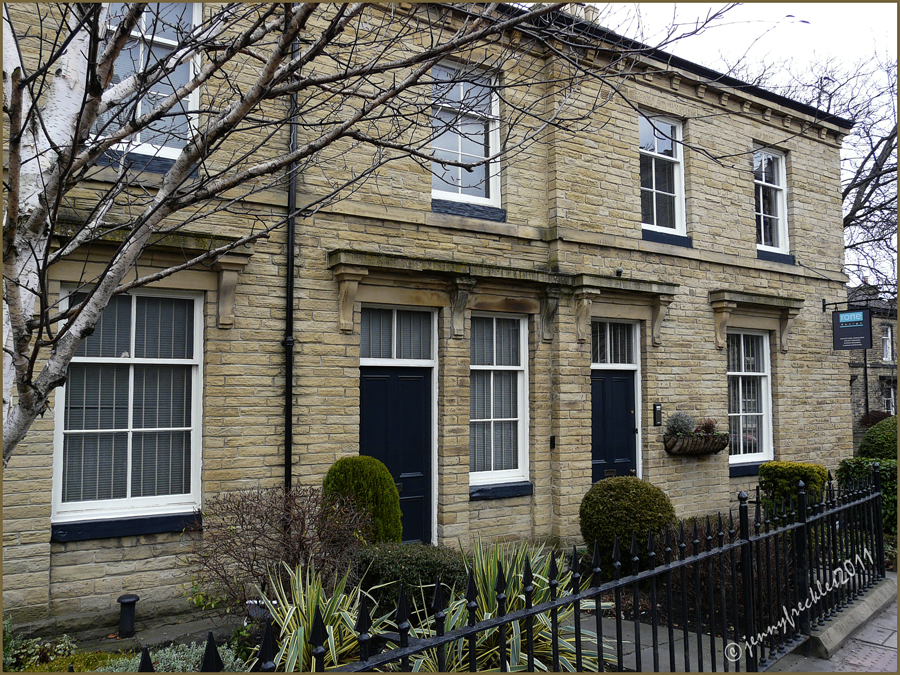
Rone Design


This is the attractive building in Saltaire that yesterday's lighted window came from.  The building, once a house (or two) and now an office, is situated at the junction of Victoria Road and Saltaire Road, opposite the Salts Hospital building.  It is beautifully cared for, kept very smart and the tiny garden is nicely designed too.  It gives a me a little lift of pleasure everytime I pass by - day or night.

I suppose if you are an architectural consultant and interior designer, then you would want your home-base to do justice to your brand. The company, Rone Design, has occupied these premises since 1989.  I don't honestly know much about them but they obviously work in partnership with architects and other professionals on new building projects and renovations, acting as project managers, quantity surveyors and consultants.  Read about them on their website.  It's vital that Saltaire continues to attract and keep businesses, as well as being a residential area.  An architectural consultancy seems to fit neatly within the ethos of Saltaire as a creative, arts-based community.

------
Thanks to Stacy at 'Microcosm' for your kind words and link to my blog.  I think it's time listed a few more of my favourite blogs, so where better to start than 'Microcosm' -  'a blog that explores the beauty that can exist in restricted circumstances'.  Given that I tend to focus much of the time on a very small patch of the globe here in Saltaire, Stacy and I - for different reasons - share something in common, looking at the detail close round us rather than at the bigger picture.

Monday, 28 February 2011

Picture window


I regularly pass by this house in Saltaire.  It is now an office and they leave the lights on in just one room at night.  The room has a beautiful turquoise wall and the whole window glows a beautiful blue at night.  (The wall used to be an orangey-coral and that gave a lovely warm glow, but I do rather like the blue.)  I've faffed about with this photo a bit in Photoshop, just to make it a bit more arty.  I can't now remember every step I took but it included getting rid of some tree branches that overlapped the window and spoiled the symmetry, tweaking the hue and saturation a bit and adding a soupçon of poster edges.

One thing that T Becque and I seem to have in common is that we're drawn to windows and doors and generally to shapes in buildings.  She makes some wonderful images in her part of the world, Tucson, Arizona, including some great pictures with a Holga camera.  If you don't know her blog Thoughts in Images, go there now!!

Sunday, 27 February 2011

Tombs with a view


(Click on photo to enlarge it)
Undercliffe Cemetery  is perched on top of a hill in Bradford.  The city itself (to the left of this picture) sits in a bowl, nestled among the surrounding hills.  In Victorian times, most of the growing population was crammed into a small central area, in terribly crowded and insanitary conditions.  So land was bought, well away from the population centre, to provide much need burial space.

The well-to-do folks (Titus Salt and his young wife among them) started to build large houses out to the north-west, into the areas known as Manningham and Heaton.  In those days the city didn't extend anything like as far as it does now.  In the early 19th century, much of what you can see here would have been green fields and moorland with a few hamlets dotted around.  Salt chose a greenfield site to build his new mill and village of Saltaire.

This photo is taken from the edge of Undercliffe Cemetery, looking north-west.  You can just see Saltaire in the middle distance - the tall chimney on the right is Salts Mill, sitting right down in the bottom of the Aire river valley. The church a little in front and to the left is St Paul's Church, Shipley.  Even further left, towards the middle of the photo, is the tower of Shipley's Roman Catholic Church, St Walburga's.  The patch of green on the far left middle is part of Northcliffe Park in Shipley.  Undercliffe Cemetery and Saltaire are almost exactly contemporary - Salts Mill was opened in 1853 and the first burial in the cemetery was in 1854.

(see also earlier posts - click the Cemetery label below)

Saturday, 26 February 2011

Graves

I wandered around Undercliffe Cemetery for a couple of hours
just reading the gravestones and enjoying the peace of the place.  Inevitably there are some poignant reminders of how tough life was in the 19th century.

This ivy-covered stone (right) records the children of Ann and James Hall(am?) (a Bradford ironfounder): William died aged 3 years 6 months in 1861, Arthur, died aged 3 years 4 months in 1864 and three other children - Mary Ann died in 1843 aged 16 months, John died 1847 aged 13 months and James died 1853 aged 13 months.  How tragic. I wonder if they had any children that survived?  
(click the pictures to make them bigger)


Walter Calver (1830-1866), Proprietor of the Original Marionettes, had a puppet theatre that travelled through northern England visiting towns and country fairs.  The theatre seated 1000 spectators!  His puppet theatre performed for Queen Victoria, who presented Walter with a snuff box.  After Walter's death, his son took the show to China and Australia.                                                                                                                                                                                                                                                                                                   
The Smith monument, a 30' high obelisk in a prime position overlooking the city of Bradford, is the resting place of Joseph Smith (1801-1858), land agent. He was the man who sold the cemetery plots and one of the 'perks' of the job, written into his contract, was the privilege of occupying the cemetery's most prominent location! 
 

There are also more recent graves in the cemetery, including that of Bob Cryer MP (1934 -1994). He was Labour Member of Parliament (MP) for Keighley from 1974 -1983, a Member of the European Parliament and then MP for Bradford South from 1987 until his life was tragically cut short by a road accident.  After British Rail closed the Keighley and Worth Valley Railway, Bob Cryer was one of a group of local people who formed the KWVR Preservation Society, which bought the line from British Rail and reopened it (see my posts from 14 February).  His memorial stone describes him as 'Socialist parliamentarian, iconoclast and life-long rebel'.

Stafford Heginbotham is also buried in Undercliffe Cemetery.  He was Chairman of Bradford City Football Club at the time of the tragic fire at the ground in 1985, started by a discarded cigarette which set fire to rubbish under the stand. It killed 56 supporters and shocked the nation. (In the aftermath, he is reputed to have said: "Hindsight is a wonderful thing, but it invariably comes too late.")

Friday, 25 February 2011

William Mawson


There are some notable people buried in Undercliffe Cemetery in Bradford (see yesterday also).  One of them is William Mawson, one of the architects of Saltaire.

William Mawson (1828-1899) was born in Leeds, the son of William Mawson, a paper manufacturer.  Aged just 21, he became a partner in an architectural practice with Henry Francis Lockwood, who at 38 was older and more experienced.  They opened an office in Bradford, after winning a competition in 1849 to design St George's Hall (a concert hall).  It was to this recently formed partnership that the visionary mill-owner Titus Salt turned in 1850, entrusting them with the task of planning and designing a large new mill to which he could transfer production from his five existing mills.  Salt rejected the architects' original proposals, asking them to submit a revised plan for a mill twice the size - demonstrating from the start the scale of his ambition.  His faith in the young architects was rewarded.  Lockwood and Mawson became one of the leading architectural practices of the time and went on to oversee the design and planning of the whole village of Saltaire, and some of the most notable buildings in Bradford, including the Wool Exchange and City Hall - both magnificent buildings.

Thursday, 24 February 2011

Undercliffe Cemetery


I love old cemeteries (perhaps on account of the fact that my childhood home was right next to one and it was a wonderful place for imaginative adventures and nature walks).  Undercliffe Cemetery in Bradford is quite famous, but in all these years I had never visited it, so one bright, frosty day I decided to remedy that.  I hadn't realised that it wouldn't be very good for photos as the low sun made such strong shadows, so I will have to go back on a more overcast day to get some better photos -  it is a very photogenic and atmospheric place.

The population explosion in Bradford in the early 19th century Industrial Revolution meant that more burial space became a necessity. A large mansion and grounds were bought in 1851 and the Bradford Cemetery Company was formed.  The first burials took place in 1854 and continue to this day.  The cemetery now contains over 23000 graves and 124000 burials.  It is arranged according to the strict hierarchies of Victorian England - half of it unconsecrated (for non-conformists like Methodists and Baptists - 'chapel' people) and half of it consecrated for members of the Church of England.  Furthermore, there was a social hierarchy too, with the gentry buried on the elite upper terraces and ordinary mortals on the lower terraces.

Graves are crowded upon one another and there are all manner of elaborate memorials, lavishly decorated with Victorian funerary art - obelisks, draped urns and even a scaled-down version of the Scott Monument in Edinburgh!

Burials declined, and the company went bust in 1977.  The whole site became neglected and vandalised and, when it was bought by a property developer in 1980, a campaign was started to rescue it.  Bradford Council compulsorily purchased it and some restoration took place and it is now properly managed by a new company, as a working cemetery, historic site and environmental conservation area. It's a fascinating place.

Wednesday, 23 February 2011

Grey days


We have had plenty of grey, mizzly days of late; typical February weather in these parts.  Though I am always glad we do have a variety of weather;  I don't really know if I'd like being able to predict what the day is going to be like, even before I've looked out.

I was walking down Victoria Road in Saltaire, past the Mill towards the river and noticed how attractive the tonal gradations looked on the misty hillside.  When converted to monochrome it is even more noticeable.  It's one of the aspects I appreciate about living in Saltaire, that you can see beyond the built-up area and up to the woods and moors of Shipley Glen.  There are three bands of trees - those in Roberts Park, those on the Glen hillside (Walker Wood from this viewpoint) and then the fields and trees up on top - what's known as Hope Hill.

I always think Hope Hill is very aptly named.  "I lift my eyes to the hills - where does my help come from? My help comes from the Lord, the Maker of heaven and earth." (Psalm 121)  My thoughts often turn to this verse when I glimpse Hope Hill.   I can imagine that, in the same way, looking up to the tranquil hill and remembering the psalm must have uplifted and comforted generations of Salt's mill-workers as they came to and from work... and perhaps even Sir Titus himself when he was having a bad day!

Tuesday, 22 February 2011

Saves coal every wash-day


A selection of colourful metal advertising signs, collected together from various points around the Keighley and Worth Valley Railway.  I have often thought it would be nice if there were a few old signs scattered around Saltaire, but there aren't.

It's interesting to read the selling points: I suppose a great little cigarette is better than a great big one! Saves Rubbing... I should think that would be a good thing if you were a housewife doing the family wash in a tub.  But if you could just soak in Rinso and Save Coal Every Wash-day wouldn't that be even better?  And what was the £1000 reward Sunlight Soap were offering?  I'm glad that royalty enjoyed their Fry's Celebrated Chocolate - and as for Cadbury's being Wholesome, well, I'm going out to buy some now.  But eat too much chocolate and not enough meat and green veg and you'll need the Virol, girl!  (Virol was a thick brown syrup, a kind of malted vitamin tonic.  Tasted weird - I used to be given it when I was a child.)

As for Camp coffee.... As John commented a couple of days ago, it had little to do with coffee, being mainly made from chicory essence, I seem to remember.  It must have been a war-time coffee substitute.  My parents always had a bottle in the pantry.  It's a real nostalgia thing; the labels on the bottles were very collectible too, though the picture was changed a few years ago after allegations of racism. (It originally showed a Sikh serving coffee to a kilted soldier.  Now they sit side by side drinking coffee together.)  I doubt anyone would give Camp that name these days though!  It even has its own fan site. Also see here for a blog post that's a bit of fun.

Monday, 21 February 2011

Arches


Ironwork arches and wooden panelling at the entrance to Keighley railway station (painted, I think, in the livery colours of the Midland Railway - dark red and cream.)

Sunday, 20 February 2011

It's all in the detail...


Another photo from my visit to the Winter Steam Gala Weekend of the Keighley and Worth Valley Railway [KWVR].

You can tell how much the railway volunteers enjoy their roles and how much effort and thought they put into it, from the little things - the attention to detail.  Around the various stations on the line there are some really attractive 'set-pieces', like this pile of old luggage waiting for a porter.  It's these details that add colour and atmosphere to the visitors' experience - and of course they provide great photo opportunities for when you've had enough of chasing the trains.

By the way, for those with access to BBC1 TV, the three-part drama series 'South Riding' starts today (Sunday) at 9pm.  It was partly filmed in Saltaire, as you may remember from my blog last September.

Saturday, 19 February 2011

The Railway Children


The Keighley and Worth Valley Railway and surrounding area has been used many times as a location for films, TV programmes and adverts. (For the complete list see here.)  One of the most famous was 'The Railway Children', an adaptation of the book by Edith Nesbit, which was filmed there in 1970 and starred Jenny Agutter, Sally Thomsett and Bernard Cribbins.  Some of the action takes place here on Oakworth Station, including the scene of the homecoming of the children's father.  It remains a delightful and atmospheric little station, much as it has always been, with coal fires warming the Ticket Office and the Waiting Room and bits of railway ephemera including some lovely old metal advertising signs.  I bought a little booklet outlining a 'Railway Children Walk', taking in some of the main locations where the film was made, which I will explore sometime when the weather improves (and bring you pictures of, of course!)

I took so many photos at the Steam Gala Weekend that I have put some more on my other blog.

Friday, 18 February 2011

Wheel


Isn't there something really satisfying and beautiful about this?  It is, of course, a wheel on one of the steam locomotives on the Keighley and Worth Valley Railway.

Thursday, 17 February 2011

Train driver


Rarely seen on SDP - a portrait of a person!  It's not so scary photographing people at events like the Keighley and Worth Valley Railway's Steam Gala Weekend - the volunteers seem to welcome it. There are probably many photos of this train driver on the Web!  There were hundreds of photographers around and he affably leaned out of his cab to chat to a passer-by.  Handsome man, don't you think?  It's a cliché that all little boys want to be train drivers - well, some of them manage it!  And as a visitor you get a real sense of the love that all the volunteers have for their work on the railway.  They all play their parts with relish: the ticket-sellers, the train drivers, the station masters and all those who run around doing the less visible jobs that together make the venture such a success.  Someone told me that KWVR have a hostel and people come to stay on working holidays to help with the restoration of the engines and rolling stock.  I salute them all.

Wednesday, 16 February 2011

Whistle


Here's a classic steam train shot.  Locomotive BR Standard 4MT No. 80002 arriving at Oxenhope station, as part of the Keighley and Worth Valley Railway's Steam Gala Weekend. (Although this train is 'resident' on the line and is often used to haul the normal service.)

Even though I'm not a rail enthusiast in the accepted sense of the word, I still find steam trains exciting and romantic.  And this line is very scenic, passing through some lovely Yorkshire countryside and some attractive and interesting villages.

The Worth Valley line was opened in 1867, built by local mill owners but franchised to the Midland Railway. It eventually became part of British Rail in 1948 and was closed in 1962 as part of swingeing cuts across the British rail network.  Locals fought to keep it open, creating a preservation society to buy the line and lease access into Keighley station, where it joins the main rail network.  The line was reopened in 1968 and has run a regular service ever since, staffed entirely by volunteers.

Tuesday, 15 February 2011

Train coming


The interesting and historical village of Haworth is about half-way up the Keighley and Worth Valley Railway line.  There is a footbridge over the railway line beside the station that provides a good vantage point, though you do get wreathed in smoke and steam when a train arrives!  On Gala Weekends like this one, the combination of steam trains and real-ale (served all day in the trains' buffet cars) guarantees a large and predominantly male audience.  Keen photographers can get line-side permits and it was amusing to see little groups gathered at all the best spots - orange high-vis vests, tripods and DSLRs with massive lenses seemed to be de rigeur.  There must have been many thousands of pounds worth of gear walking about the Worth Valley that day!

(Don't ask me why, but some of the locomotives seem to be hitched to the carriages backwards, as I think this one was.  I think they go up the line forwards and down it backwards, no doubt due to the lack of a turning circle at the top terminus.  I was worried that the driver wouldn't see where he was going... but then I remembered they can't anyway in a steam loco!)

Monday, 14 February 2011

Letting off steam


It promised to be a sunny day on Saturday - and did eventually deliver!  So I decided to make the most of it and have a day out, hoping to get some photos.  I made up my mind to visit the Keighley and Worth Valley Railway (KWVR), which is a privately-owned, volunteer-run railway that connects the town of Keighley (about 7 miles up the Aire valley from Saltaire) with the villages of the Worth Valley including Haworth and Oxenhope.  Even on wintry days there is lots of photographic interest along the line.

Imagine my delight to discover that this wasn't just any old weekend but a Steam Gala Weekend on the KWVR. (That explains why there was a steam train passing through Saltaire the other day, obviously one of the 'guest' locomotives.)  The KWVR is a thriving line that operates a number of steam-hauled trains, and regularly holds special events.  Even though I'm not a real train buff, there is something really lovely about the whole thing and I always enjoy visiting and riding the trains.

The low winter sun and backlighting make this photo into a story, I think.  I'll leave you to imagine that wonderful hissing sound as the engine lets off some steam pressure.

Sunday, 13 February 2011

Deep blue twilight


Here in the north of the northern hemisphere - and even though spring still feels a long way off - the days are imperceptibly lengthening.  My walk home from work mostly takes place in the twilight (isn't that a lovely word?) when the lights are on and the sky takes on a marvellous deep blue.  I actually took this photo a week or two ago when the moon was full and placed just beautifully over Salts Mill.  I never tire of this view, day or night.  I like how the lights within the mill have different 'warmths' - some showing white or yellow and some a warmer peach and apricot.  So much more visually interesting than if they were all uniform.

Incidentally, a steam train went up the railway line as I walked home the other night.  I could smell the smoke before I saw or heard the train and I was idly wondering if someone had a bonfire, when, whoosh... (or, rather, chugga chugga!)  Sadly, I didn't have my camera out and primed up, so the moment was lost as a photographic opportunity - must do better!  But, in the spirit of enjoying the here and now, I loved it.  (and PS: If you want to find out why the train came, visit again tomorrow!)

Saturday, 12 February 2011

Lions and photographers


This is the lion called Peace, one of four outside the Victoria Hall in Saltaire. (For more info about the lions and pictures of all four, click here.)  The photo would be improved by using a camera that would blur the background a bit, but mine (not a DSLR) doesn't, apart from in very specific lighting conditions.  However, I'm using it to illustrate an interesting little story....

I was coming home from work last Tuesday evening, and the daylight was beginning to fade.  As I walked up Victoria Road, I kept seeing flashes of light, and as I got nearer I realised it was a photographer taking pictures of one of the stone lions.  Not just any old photographer... you could tell this one was a Pro, kitted out with a stepladder and two assistants, one holding aloft an umbrella reflector.  I was mildly interested - but, living in a World Heritage Site, you do get used to seeing folks with big cameras.  Frankly, I was tired and in a grumpy mood as well (!) so, although I vaguely considered going and having a closer look and maybe even chatting to and photographing the photographer, I decided that - all things considered - I couldn't be bothered.

I was interested to see, the very next day, via Google Alerts for Saltaire, a whole new set of 31 photos of Saltaire on the Web (including, of course, the lion - War).  The photographer was Christopher Furlong, Senior Staff Photographer, Getty Images Europe.  It is always interesting to me to see other photographers' interpretations of Saltaire: what catches their eye, how they view the scene, how they tell the story of the village.  There are some evocative photos within this set.  Have a look and tell me what you think....

Friday, 11 February 2011

Punchinello


The 1853 Gallery is only one of several galleries in Salts Mill, Saltaire.  There are gallery spaces on both the third and fourth floors.  Unlike the 1853 Gallery, which has a permanent exhibition, the other spaces have visiting exhibitions, by David Hockney and by other artists and craftspeople too.  In order, I suppose, to protect artworks that would be damaged by too much light, the galleries are shaded with blinds. The third floor has this lively red and white fabric, called 'Punchinello' (if I remember rightly) and designed by David Hockney.

[For those readers who have come to my blog more recently, the artist David Hockney was born in Bradford and studied at Bradford College of Art.  After many years of living in California, he now lives for much of the time on the Yorkshire coast. He was a personal friend of the late Jonathan Silver, the man who bought and redeveloped Salts Mill in the 1980s when it fell derelict after the textile business closed down.  The 1853 Gallery - the largest single collection of Hockney's work anywhere in the world - was the first part of the Mill to be reopened. There's more info if you click the David Hockney label below. ]

Thursday, 10 February 2011

School desk


In common with the rest of Salts Mill, Saltaire, the Bookshop is filled not only with books but also with unusual treasures.  I am deeply fond of this old child's desk.  It reminds me of the desks we used at Primary School, though our chairs were separate, not linked as this one is.  But we had wooden desks with lids that lifted for storage inside - and they still had holes for inkwells, though we didn't use them (fountain pens had moved on to ink cartridges by then!)  I remember that at the end of every term half-an-hour was dedicated to polishing our own desk lid - with real beeswax polish.  You can imagine the fun we had!  I have often wondered if this particular desk has found its way into the Mill from the Victorian Factory Schools that Titus Salt introduced into Saltaire.  Haven't we come a long way?  I haven't been into a Primary School for a while but I would not be surprised to see suites of computers these days.

Wednesday, 9 February 2011

Diner dog


Driven back inside by the weather, we might need a snack and a drink!  The main restaurant in Salts Mill is on the third floor, through the Bookshop, and is called Salts Diner.  It has this rather appealing dachshund as its logo, found on everything from the menus to the paper napkins and the T-shirts of the waitresses.  Sketched by David Hockney (who else?!) it depicts Stanley...or maybe Boodgie... one of his two pet dogs.

Salts Diner is a large, bright space and does some imaginative food (see here for a review) - but at weekends it gets very busy so the service suffers a little, and it's very noisy.  That's the only trouble with the high ceilings and hard floors in the mill - everything clatters. Imagine what the noise must have been like with all the spinning machines working.  I was talking to a friend the other day who used to be a local doctor in Shipley.  He said he visited the mill once when it was still working and was warned to be careful what he said as he walked round, as all the workers were excellent lip-readers!

Tuesday, 8 February 2011

Playground mosaics


You may remember that last year I showed how the children's playground in Saltaire had been revamped.  It was a beneficiary of money that was earmarked for community projects, from the sale of Leeds-Bradford Airport to a private operator.  The new playground seems to have been welcomed by the local kids.  It is especially popular with mums of very young children, as there is a part specially for the little ones, and the mums can sit on the seats and chat while the kids play.  There is a winding path through the centre from one side to the other and at intervals there are squares of colourful ceramic mosiacs, which on close inspection are rather attractive.  Oldies like me are not supposed to enter the playgound (unless accompanied by a child under 14) and, since I don't yet have a tame grandchild, I had to sneak in when no-one (appeared to be) looking, to get these photos.  The top one is a mosaic of several of the designs and the lower picture is a close up of just one of them.


Study them closely...the more you look, the more you'll see.... animals and plants, Salts Mill, the New Mill (or maybe it's the Victoria Hall tower?), the Church, houses.....  They'd make a good project for a 'brass rubbing' technique, I would think.

Monday, 7 February 2011

Dreich


dreich
(dre·ech) Dialect, chiefly Scot -adj.
1. (intr.) drab.
2. (tr.) dreary (referring to weather or a sermon).
3. often leads to a state of being drookit; grey.

I think this picture just about sums up the weather here at the moment - grey, rainy, very windy - generally dreich, as they would say in Scotland.  ( I am amused that the same word might refer to a sermon as well as the weather!)  The grass is sodden and muddy, there are puddles of standing water everywhere and the river is gently overflowing its banks in Roberts Park.  Nevertheless, there were some brave souls out for a brisk walk, perhaps unaware that what is normally a pleasant riverside path has temporarily become less riverside and more river!  They'll end up drookit (soaked through).

PS: I'm entering this one in the most boring blog picture of the week contest! (If there isn't a theme day for that, there ought to be!)

Sunday, 6 February 2011

In spate


Well, nothing like Cyclone Yasi or the snow in the States here (thank goodness) but the start of February has seen gale force winds  and heavy rain across Scotland and the North of England.  I met a friend for lunch and we decided to go to the Half Moon Café in Roberts Park, which gamely remains open during the winter and therefore seems worthy of support.  It was quite a hard walk down to the park in the strong wind.  The River Aire is flooding its banks and thundering over the weir by the New Mill.  I thought it worthy of a picture even though the light was poor.  I battled to keep a reasonably steady hand on my camera, as the wind was buffeting me around.

Saturday, 5 February 2011

Gryphon jardiniere


As I'm sure I've observed before, one of the joys of visiting Salts Mill in Saltaire is that there seems to be something new to see each time.  I've lost count of the number of times I have wandered around the 1853 Gallery, getting my fill of David Hockney's art, the colourful stationery and artists' supplies, art and photography books and bright ceramics - all wrapped up in the heady scent from the vases of lilies they always have around the gallery.  But it was only this last time that I saw this unusual jardiniere - another Burmantofts design.  It has almost certainly been there for ages but I've never noticed it before.  I think it depicts a gryphon, a mythical creature with the body of a lion and the head and wings of an eagle. Thought to be an especially powerful and majestic creature, they are known for guarding treasure and priceless possessions - surely a good reason for this one to be sitting in the 1853 Gallery amongst the valuable Hockney artworks and Burmantofts ceramics.

Friday, 4 February 2011

Burmantofts planters


More of the colourful Burmantofts pottery in Salts Mill, Saltaire, part of the Silver family's extensive collection. These jardiniere bowls, some on pedestals, were decorative and no doubt made a fine display stand for that ubiquitous houseplant, the aspidistra.  Known as the 'cast-iron plant', these tropical plants survive neglect and shady corners and were popular indoor plants from Victorian times through to the Second World War.

They were immortalised in a song sung by Gracie Fields, 'The Biggest Aspidistra in the World':

'For years we had an aspidistra in a flower pot
On the whatnot, near the 'atstand in the 'all
It didn't seem to grow 'til one day our brother Joe
Had a notion that he'd make it strong and tall
So he's crossed it with an acorn from an oak tree
And he's planted it against the garden wall
It shot up like a rocket, 'til it's nearly reached the sky
It's the biggest aspidistra in the world.'


Thursday, 3 February 2011

Burmantofts pottery


Anybody know what this is? I haven't a clue, though it is another piece of Burmantofts pottery, with its colourful turquoise glaze and unusual pierced design. It looks lovely against the stone floor of the 1853 Gallery in Salts Mill - though I think many visitors pass it by without even noticing it.

The history of the Burmantofts pottery is interesting. It began as a small coal-mining and brick-making business in 1842 in the Burmantofts area of Leeds, run by two young men: William Wilcock and John Lassey. They discovered fireclay in their mine and began using it to make sanitary pipes and chimney pots. John Lassey died young and his share of the business was eventually sold to John Holroyd and then to his son Ernest. When William Wilcock also died, Ernest's brother James Holroyd became the general manager. He gradually developed the business, starting to produce decorative tiles and pottery including eventually high-temperature faience (glazed terracotta) architectural pottery and the 'Art Pottery' for which Burmantofts became nationally renowned. Trade prospered until 1904 when fashions suddenly changed and manufacture of terracotta pottery ceased. The business continued with other products until 1957.

Some of the Burmantofts ware is intricately decorated like the vase I showed yesterday. Other pieces are in a single bright (lead) colour and glaze, with intricate moulding and raised lines. Still others have stylised Art Nouveau and Arts & Crafts designs: curvy stems and flowers, leaves, peacocks and fish. It's highly collectable these days, with even small pieces fe
tching hundreds of pounds at auction.

As I said yesterday, the Silver family have an enviable collection displayed in Salts Mill. The Leeds museums (including the Abbey House Museum at Kirkstall) also have collections, and some buildings in Leeds, such as the University, have Burmantofts ceramic decoration incorporated into their architecture.

Wednesday, 2 February 2011

Faience vase


You may have noticed this beautiful vase on some of my other photos of the 1853 Gallery in Salts Mill, Saltaire. It was made in Leeds, around 1885, at the Burmantofts pottery. It's huge - 44"/112cm high. Designed by Leonard King, it is hand-painted in wonderful turquoises and greens in the Isnik style (which I understand is a style of pottery made in Ottoman Turkey, in its turn styled on Chinese porcelain).

Jonathan Silver (who bought Salts Mill in 1987) was a passionate collector of the 'Arabian Nights' vases made by Burmantofts between 1885 and 1904. He began collecting whilst still a student and amassed a collection of over 100 pieces, many of which are now displayed in Salts Mill. There is a nice twist in the story of this particular vase, because it was originally exhibited in Saltaire's Victoria Hall in 1887, in an exhibition of Anglo-Persian Bermantofts pieces as part of the Royal Yorkshire Jubilee Exhibition. These brightly coloured art pottery pieces were much sought after in Victorian England. In 1994, Jonathan discovered the vase by chance
in a gallery in Bond Street in London, bought it and brought it back to Saltaire.

(It constantly amazes me that all these priceless works of art, by Hockney and others, and the very valuable ceramics are just - almost casually - scattered around in what is often at weekends a very bustling, lively place. It's what gives Salts Mill its charm and ambience... it's absolutely unique - but must give the insurers a real headache!)

Tuesday, 1 February 2011

Yorkshire humour


I guess even the most enthusiastic bloggers must sometimes have to raid the archives for inspiration and I'm no exception.  (We could call it 'blogger's block'!)  I came across this photo that I took a few months ago, of an old cemetery near Heptonstall, up on the hills above Hebden Bridge.   My dad would have called it the dead centre of Yorkshire - and there isn't much more to say about it.  (Although it is near the comically-named hamlet of Slack Bottom, whose name I have always enjoyed!)  And it does give me an excuse to tell you one of my favourite Yorkshire dialect jokes:
 An elderly Yorkshireman was distraught when his devoted - and devout - wife died.  His only comfort was knowing she had gone to be with the Lord.  He gave much thought to what to put on her memorial stone and eventually decided Lord, she was Thine would be appropriate. When he went to view the stone, however, he was dismayed to find it had been inscribed Lord, she was thin.  He immediately contacted the stonemason, telling him: "You've missed off the 'E' ".  The mason replied that he was sorry but it was no problem and he would correct it.  When the widower went again to see the stone, he found it now said: Ee Lord, she was thin.