I HAVE CLOSED DOWN THIS BLOG. Please click the photo above to be REDIRECTED TO MY NEW (continuation) BLOG.

Monday, 10 February 2020

Industrial colour


There was plenty of wonderful colour in the threads on the weaving looms. This particular model was a moquette loom. Moquette is a thick, woven, velvety, short pile, hard wearing fabric with distinctive patterns, used traditionally for upholstery, in particular the seats on public transport: our trains, buses and London Underground trains. Holdsworth Fabrics in Halifax still make it, one of the very few manufacturers left. Wherever you are in the world, if you get on a coach, you're likely to be sitting on Holdsworth of Halifax moquette.


Sunday, 9 February 2020

Industrial monochrome


I was drawn to the details in the exhibits in Calderdale Industrial Museum. Boxes of bolts and blacksmiths' tools seemed prime candidates for a monochrome treatment.


So too did the fine wires hanging from the carpet looms - the means, I think, by which the carpet pile is pulled up into loops.


The engines and machines had intricate cog wheels. Cogs always have a fascination for me. Whether huge like these or tiny and delicate, they are finely engineered to fit and turn accurately to transmit power from one shaft to another. Such a clever idea!


Saturday, 8 February 2020

Calderdale Industrial Museum


I'd heard good things about Calderdale Industrial Museum in Halifax. It's only open on Saturdays so it has taken me a while to fit in a visit but it proved to be a real gem. Much smaller and more intimate than those of Bradford and Leeds, it is nevertheless packed full of interesting exhibits and there are some experienced and enthusiastic volunteers, very willing to share their knowledge with visitors. It is something of a community success story. The museum was opened in 1985 by Calderdale Council to promote the industrial heritage of the Calder valley; budget cuts led to its closure and mothballing in 2000. Since 2011, a team of volunteer enthusiasts have worked hard to reopen it and they have enabled it to open one day a week, with many of the exhibits now working and able to be demonstrated to visitors. I think it is still a work in progress but it's a very heart-warming story and it's worth a visit. It's well situated, right next to Halifax's famous Piece Hall. I can recommend its café too. I had an excellent pot of tea, served with a smile, for just £1. That's about a third of the price of one in the Piece Hall itself.

One room is dedicated to the story of the manufacture of carpets, which was one of Halifax's major industries in the 1800s and 1900s. Crossley Carpets at Dean Clough Mills was one of the largest carpet factories in the world, covering 20 acres and at one time employing over 5000 people. It ceased production in 1982. In the museum they have a working Wilton-Brussels carpet loom. Wilton carpet weave is made with the pile threads woven through as a continuous thread, raised above the backing by means of wires or hooks. It can be cut or left as loops.


Wooden, horse-drawn carts like the one below would have been a common sight on the streets of our towns and cities, carrying produce and raw materials and often taking goods to be transported by barge on the canal network.


Friday, 7 February 2020

Do not cross


The stepping stones across the River Wharfe at Burley were barely discernible. Last summer I watched people skipping happily across (see HERE) and you could walk back along the river bank almost up to the weir. Now the river is thundering over the weir and filling the whole width of its channel. The river level can, apparently, rise up very quickly here, so I was careful. There wasn't really anywhere to stand to look back upriver and I couldn't haul myself up high enough to look over the wall so I didn't manage a photo of the weir this time. The resident heron flew away too, before I managed to snap him!

Thursday, 6 February 2020

Spring?


It's been such a mild and damp winter that signs of spring are already appearing. I've got miniature daffodils in bloom in pots in my garden. On a recent walk, I noticed the hedgerows are filling with blossom. There is a type of cherry plum that's usually the first to bloom so that is probably what this is, though I'm not 100% sure. It's very pretty anyway, and a welcome sight. Snowdrops have unfurled too - a February flower but a little early, even so. The growth could all be knocked back by a cold snap. We've had no snow here so far but it's not unheard of in March or even April so there's time yet!


The trees are still colourless and the footpaths are all very muddy and brown, squelchy with leaf litter. There is some bright colour to be found, despite the grey and damp. I noticed some vibrant moss on the roof of an old farm building.


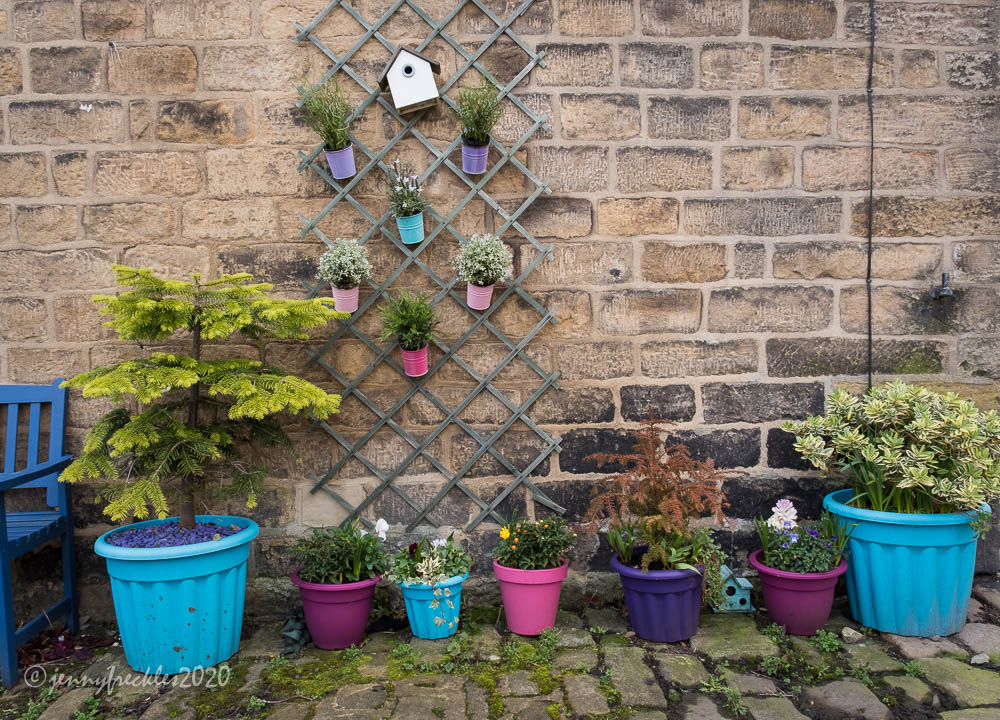
On the edge of the village, a householder had made a cheerful display of brightly coloured pots, rather Mediterranean in feel, I thought.


Wednesday, 5 February 2020

Déjà vu


I walked past the old Carnegie Library building in Windhill on December 1st. It reminded me that I once posted a photo of it. Looking back, I was surprised to see I posted it as long ago as 2012 - on December 1st. That's a little spooky, isn't it? (See HERE)

Sadly the building has deteriorated still further, with shrubs now growing out of the stonework. I'm sure it won't be long before some of the masonry tumbles down. Perhaps then they will demolish this once fine Edwardian building, a very sad end and one that could, I'm sure, have been prevented. It is, I gather, in private ownership and there were plans to redevelop the site for a supermarket. That would have included (apparently) moving the building, but I think the developer pulled out. It has come up for discussion by the local council numerous times and still nothing has happened. Prominently sited at a significant junction on the way into Shipley, the dereliction doesn't do a lot to promote the area.

A few years ago, attempts were made to brighten it up with paintings. It doesn't really work! I think the portrait is of Andrew Carnegie himself (1835-1919), who was a wealthy Scottish-American steel baron and philanthropist, in later life giving away nearly 90% of his fortune. He had over 3000 public libraries built across the world.


Then there is a tango dancing couple (on a suitably Tango orange background!) that references the fact that the upper floor of the Library was once used as a dancehall and function room. 


The rest of the murals are rather psychedelic flower pictures.


Tuesday, 4 February 2020

Along the canal


A crisp, frosty morning had me out for a walk, and I chose to follow the less scenic route on the canal bank, through Shipley, rather than my usual walk towards Dowley Gap. I bumped into some friends in Saltaire and stopped for a chat. That was nice. Then I came across an elderly lady who had fallen into the canal by the mill. That wasn't nice! She had been helped out by a man, who was emptying her wellies back into the canal. I stopped to see if I could assist but there were already people with her, so I walked on. She'd be at risk of hypothermia as the water must have been freezing, so I hope she got home safely to warm up and dry off. She said she lived nearby. It was a little greasy with frost on the towpath, so maybe she slipped.

Further on, I noticed a new 'wellbeing' garden area that has been created by students on an educational scheme. It's not in a particularly lovely spot but it has made a tatty area rather nicer. It's always good to have a few benches where people can sit and watch the world go by.

Further on still and I came to the old bridge at the junction with the former Bradford branch canal. Again, not an especially beautiful area now, but it's interesting and there were two swans with their wings raised, which added a little grace.


The bridge here has a lovely sweeping line, always good for a mono picture.


The swan is one of a pair who nest in this area. They raised at least two cygnets this past year and the younger ones, now adult-sized, were gliding around a little further down the canal. I'm not sure why they sometimes swim with their wings arched, but it looks so attractive when they do.


Finally I spotted this otterly gorgeous stuffed toy on the Canal and River Trust stall. Isn't it cute? Otters have been seen locally, thanks to remedial work done along the canal and river banks, and the gradual improvement in water quality along the River Aire.


Monday, 3 February 2020

100 years of Roberts Park


I'm not sure I've ever shown exactly this view before. It shows one of the shelters in Roberts Park, with the park-keeper's lodge in the background and then Salts Mill across the river beyond. I rather like the shelters and I'm amazed at the care they took in Victorian times to have even the simplest structures look fine and embellished. The shelters were rescued from decline when the park was refurbished a few years ago. Money well-spent, I feel.

I was reminded by a Facebook post from the Saltaire History Club that it is now 100 years (16 January 1920) since Roberts Park (which had previously been known as Saltaire Park) was gifted to Bradford Corporation by Sir James Roberts, a former owner of Salts Mill. It was given in memory of his son, Bertram Foster Roberts (who died suddenly aged 36 in 1912), to be maintained 'for the benefit of the public at all times'. It's a bequest that I enjoy on a very regular basis.


Sunday, 2 February 2020

I can see clearly now...


I promised a proper update on the cataract surgery... I have to say I'm really enjoying no longer having to wear glasses. The wonder of the miracle operation has completely blown my mind. It was so easy and painless, it only took about fifteen minutes each time. Three weeks on from the second surgery and my sight has pretty much settled down, so that I can see distance quite clearly. I still need reading glasses; I'm making do with some of those cheap off-the-peg ones until I can get my eyes tested properly in a few more weeks. Using the desktop computer is the trickiest bit, since it's neither near nor far but somewhere in the middle! I'm back to wearing mascara (phew! I hate being without it!) and feeling quite renewed. The best bit is being able to drive at night without suffering the painful glare of halos round lights.

If anyone is thinking of getting it done, I'd say 'go for it'. I haven't regretted it so far. There was a short period when I couldn't see clearly and, since I can't hear clearly either (being deaf), the combination was all a bit upsetting! Thankfully that didn't last long. I've also developed a black 'floater' in my right eye which can be a bit annoying, but that is more a product of age than the surgery I believe. I feel very fortunate to live somewhere where I could so easily get this treatment, and at a time when the technology is so advanced. (At one time I think you had to lie flat on your back for two weeks after the operation!) I'm still on the eye drops regime for another week or so, but that's a small price to pay for the privilege of better sight. I'm very thankful.

I keep finding that song running through my head:
'I can see clearly now (the rain has gone).
It's going to be a bright, bright, bright, bright sunshiny day'. 


Saturday, 1 February 2020

A trio of oddments


Here's a trio of things around Saltaire that I may vaguely have noticed before but have certainly never stopped to photograph. The mirror is at the Victoria Road entrance to Salts Mill, above the now-sealed tunnel that used to lead to the Dining Hall across the road. There is a larger mirror further along that I have taken pictures of in the past. Whether this smaller one is a recent addition, or whether I've just never seen it, I don't know. (It is quite high up). It must be to enable the security guards to see the driveway from their office.


The ceramic cat is a David Hockney creation, made when he was a student at Bradford College of Art and later given to his brother. It has been loaned to Salts Mill to display in the 1853 Gallery alongside some of Hockney's other work in the Salt collection.

Finally, corks... I'd be interested to know if any of my local readers know where these are?


In fact, it is a large picture that covers the window of the Victoria Off Licence, on Victoria Road. It's one of those wonderful shops that stays open a lot and sells sweets, crisps, milk and other useful sundries as well as alcohol. The same lovely couple have owned and run it for over 30 years.

Friday, 31 January 2020

The Early Music Shop


Perhaps only the real aficionados know it is there but tucked away at the back of Salts Mill in what used to be the wool shed is The Early Music Shop, the world's largest early music instrument specialist and supplier of sheet music, CDs and accessories. I've passed many times and never dared to go in but one day I was feeling bold. It was peaceful inside, just a couple of other people browsing and the sales staff kept a discreet watch from the back of the store. It really is a treasure trove, full of exquisite and unusual instruments, most of which I would hesitate to put a name to. I'm afraid I can't tell a crumhorn from a shawm from a dulcimer. I did recognise the harps, lots of them in different sizes and with varying degrees of decoration. They are so beautiful.


There were some lovely percussion instruments too: drums and bodhrans, as in the picture below and several elegant harpsichords and spinets. There was even a 'build your own' harpsichord from a flatpack kit - quite an undertaking, I imagine.


Most of the instruments appeared to be new, though there was a beautiful Pillement Violone (see below), a Double Bass handmade in France in 1781 and rescued in the French Revolution, as it was part of a collection in the Royal Court of France. The information said it has an extraordinarily beautiful sound, which I could well imagine just from looking at the patina on the wood. It could be yours... for a mere £45,000.


Some of the detail in the instruments was gorgeous, especially the elaborate fretwork on the stringed lutes and fiddles.


I'm so glad I went in to have a look round, as it was a fascinating store.

They offer tuition on harp, viol, lute, recorder and other instruments, run workshops and often perform early music concerts locally.

In addition there is the Yorkshire Music School in the same building, teaching piano, rock guitar, vocals and drums to aspiring young musicians.


Saltaire is often a surprising place!

Thursday, 30 January 2020

Salts Mill yard


The walk through Salts Mill yard from the rear used to be a frequent route for me, my regular lunchtime leg-stretch circular when I was working. Since I retired, I rarely go that way, more often taking the canalside route past the mills. This day however, I was wearing a decent pair of leather boots, not my usual walking clobber, so I decided I would avoid the canal towpath as it is currently really muddy in parts.

Salts Mill always looks stunning on a sunny, blue sky day. The honeyed stone is shown at its mellow best. This route is the one you'd take as a visitor arriving from the main car park, and passes right beside the massive chimney before entering the mill through the glass portico into the 1853 Gallery on the ground floor. (Many visitors, of course, enter from the Victoria Road end of the mill, from the village, as I usually do now.)


I took a detour through the Mill itself. The soft music, calm atmosphere and scent of lilies in the 1853 Gallery is supremely relaxing. I always leave feeling better about myself and the world.

Wednesday, 29 January 2020

Salts Mill from the park


Somehow, seen from across Roberts Park in winter with no leaves on the trees, the bulk of Salts Mill appears much more dominant. It really is a huge building!

Tuesday, 28 January 2020

A bowls match


It was a Monday morning in the depths of winter but there was a bowls tournament underway at Salts Sports Club. With four teams playing on each of the two greens, it appeared to require a good deal of concentration so as not to get in the way of the others' trajectories. I've only once, years ago, tried playing, though there is a club (not Salts) linked, rather bizarrely, to my church. (I think the church owns the land they play on.) Many countries seem to have a variation on the game: think French boules, Italian bocce and Spanish pétanque. The game being played at Salts is crown green bowls, where the playing surface is slightly raised in the middle. The smaller yellow jack is rolled onto the green and the players then have two weighted balls (woods) to deliver as close as they can to the jack. See HERE for a full explanation. It seems a very sociable activity and I know some people play on into their eighties and nineties, so there's time for me yet!

Monday, 27 January 2020

Bradford City AFC


Even further down Manningham Lane towards Bradford city centre, I came to Valley Parade, the home ground of Bradford City football club. They are currently in League Two with a slim chance of 'going up' in the world again this season. I used to have a season ticket in the late 1990s, in the heady days when they were in the Premier League for two seasons. It was good fun but times change, the people I used to go with moved away and my interest eventually waned...

In 1985, the stadium was tragically the scene of one of the worst disasters in football history, when 56 people died and nearly 300 were badly injured in a fire that ravaged through the old wooden main stand in a little over nine minutes. The stadium has had many alterations since, and the current Kop end, main stand, hospitality suites and function rooms were extended and improved in the late 1990s/early 2000s. The ground's capacity is around 25,000, though the highest attendance this season has been about 14,000.


Sunday, 26 January 2020

Student days


After I'd walked round Lister Park, I suddenly took it into my head to walk down Manningham Lane towards Bradford city centre. It was, in many ways, a nostalgia trip, as I passed two places I once used to live, as a student and then when I returned to Bradford in my late twenties. Even in those days (1970s) it was a bit of a run-down area, full of student bedsits. These days it is even more sad, with many empty properties, a lot of litter and decay. The once-grand Victorian villas, former homes of wealthy Victorian industrialists like Titus Salt, now need a good deal of work to bring them up to a decent standard again, though it could be a lovely area if it had enough money spent on it.

One street with particular potential is Apsley Crescent (above). (I believe it was the birthplace of an old school friend of mine, who reads this blog. She may be interested!) It is supposedly a conservation area, having some large and at one time beautiful properties, built in the 1850s in the Classical and Italianate styles that were popular in Victorian Bradford.


Most of them are now either empty, used as commercial premises or broken up into flats and bedsits. The Manningham area is one of the most culturally diverse in Bradford, with many residents of Pakistani and Bangladeshi origin, Afro-Caribbeans, Eastern Europeans, and still some students living there (though many now live in rather stylish modern blocks in the city centre, of a luxurious standard that would have been unthinkable in my student days!)


Saturday, 25 January 2020

Press photography exhibition


The exhibition I went to see at Cartwright Hall was Assignments 2019: British Press Photographers' Association. It didn't disappoint, having some wonderful examples of sport and documentary work taken all over the world on assignments by British press photographers. I particularly enjoyed a shot of the footballer Harry Kane, caught in a balletic pose during a match (third pic). The exhibition is on until mid-April, so there is still time for local folk to see it.

The area in which the exhibition was displayed also holds two sculptures. One is by Anish Kapoor: 'Turning the world inside out', a massive stainless steel piece, purchased in 1997, that reflects its surroundings in a beguiling manner. The other is a Francis Derwent Wood marble (1921), called 'Humanity overcoming War'. (Oh, that we could!) Derwent Wood also created the statue of Sir Titus Salt that stands in Saltaire's Roberts Park.


Photography in Cartwright Hall is not, I think, encouraged but I did manage these quick snaps on my phone. I hate it when they forbid photography, as I think seeing pictures encourages other people to visit. The lighting (as so often) created a lot of reflections on the glass of the pictures. I don't know why they don't use non-reflective glass. It's daft when you can't properly see the pictures you've come to view!